
Use this inverter efficiency calculator to turn DC input, AC output, or meter readings into efficiency, power loss, and usable energy.
Advanced options
Table of contents
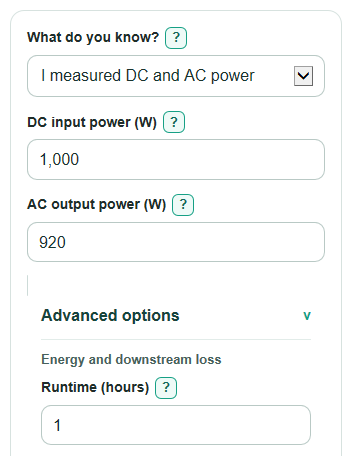
How to use our Inverter Efficiency Calculator
- Choose What do you know? so the calculator shows only the readings you have.
- Enter the visible power fields, or use DC input voltage (V), DC input current (A), AC voltage reading (V), AC current reading (A), AC output type, and Power factor (0 to 1) if you are using meter readings.
- Open Advanced options if you want energy over Runtime (hours), downstream loss from Extra loss after inverter (percent), or Load on the inverter from Rated AC output (W).
- Click Calculate and read Inverter efficiency first, then Power lost in the inverter, usable AC power, energy for the runtime, and any Check note.
- Sanity-check the result: efficiency over 100 percent, negative Power lost in the inverter, or Load on the inverter above 100 percent usually means a wiring side, unit, rating, or power factor entry needs another look.
Definitions
DC input power: The power going into the inverter from a battery, solar array, or DC supply, measured in watts.
AC output power: The real working power coming out of the inverter for AC loads, measured in watts.
Inverter efficiency: The percent of DC input power that becomes AC output power before any extra downstream loss.
Power lost in the inverter: DC input power minus AC output power. Positive loss is mostly heat and standby use. Negative loss usually points to a measurement or entry problem.
Power factor: A number from 0 to 1 that tells how much of the measured AC voltage and current becomes real working power.
Runtime: The time the inverter runs at about the entered power level, in hours.
Extra loss after inverter: Optional cable or downstream loss after the inverter. It changes usable AC power, but it does not change inverter efficiency.
Watt-hour: A unit of energy. One watt-hour means using 1 watt for 1 hour.
Load on the inverter: AC output power as a percent of the inverter's continuous rated AC output.
Common mistakes and quick fixes
Mistake: Entering 0.92 in Inverter efficiency (percent) when you mean 92 percent.
Fix: Enter 92 in Inverter efficiency (percent); the calculator treats the number as a percent.
Mistake: Swapping DC input power (W) and AC output power (W).
Fix: Put battery, solar, or DC supply power in DC input power (W), and the inverter load side in AC output power (W).
Mistake: Leaving Power factor (0 to 1) at 1 for a motor, pump, or power supply load when you have a better reading.
Fix: Enter the measured or nameplate power factor in Power factor (0 to 1) so AC output power is closer to real working watts.
Mistake: Using phase-to-neutral voltage in AC voltage reading (V) after choosing Three-phase AC for AC output type.
Fix: For Three-phase AC, enter line-to-line voltage in AC voltage reading (V) and line current in AC current reading (A).
Mistake: Putting inverter heat loss into Extra loss after inverter (percent).
Fix: Use Extra loss after inverter (percent) only for cable or downstream loss after the inverter; inverter heat loss is shown as Power lost in the inverter.
Mistake: Entering a surge rating in Rated AC output (W).
Fix: Use the continuous watt rating in Rated AC output (W) so Load on the inverter is useful.
Limitations & Key Assumptions / Boundary Conditions
- The calculator treats the entered readings as steady. Fast-changing loads, motor starts, and surge loads can make real energy use differ.
- Efficiency is based on real power in watts. If your meter only shows volts and amps, Power factor (0 to 1) matters.
- Three-phase mode uses the balanced three-phase real-power formula with line-to-line voltage and line current.
- Extra loss after inverter (percent) is applied after AC output power. It is not included in the Inverter efficiency result.
- Rated AC output (W) should be the continuous rating, not a short surge rating.
- Very light loads can have lower real efficiency than a spec-sheet peak value, so the Check note may flag loads below 10 percent of rated output.
- Efficiency over 100 percent is still shown because it helps catch reversed meters, wrong units, power factor mistakes, or readings taken at different times.
Methodology
How the calculator chooses the math
The selected What do you know? mode controls which inputs are used. Hidden mode-specific inputs are ignored so old values do not affect a new calculation.
When you measured both sides directly, efficiency is found from AC output power divided by DC input power.
efficiency_percent = (ac_power_w / dc_power_w) * 100
When you know DC input power and a stated efficiency, AC output power is estimated from the entered percent.
ac_power_w = dc_power_w * (known_efficiency_pct / 100)
When you enter voltage and current readings, DC input power is voltage times current.
dc_power_w = dc_voltage_v * dc_current_a
For single-phase AC output, real AC power is voltage times current times power factor.
ac_power_w = ac_voltage_v * ac_current_a * ac_power_factor
For three-phase AC output, the calculator uses the balanced three-phase real-power form with the square root of 3.
ac_power_w = sqrt(3) * ac_voltage_v * ac_current_a * ac_power_factor
Loss, usable power, and energy
Inverter power loss keeps its sign. A negative value is not clamped to zero because it can reveal a measurement problem.
inverter_loss_w = dc_power_w - ac_power_w
Optional downstream loss is applied after the inverter, so it changes usable AC power but not inverter efficiency.
usable_ac_power_w = ac_power_w * (1 - extra_loss_pct / 100)
Energy uses the entered Runtime (hours). If runtime is 0, both energy outputs are 0 while power results still show.
usable_ac_energy_wh = usable_ac_power_w * runtime_hours
total_lost_energy_wh = (dc_power_w - usable_ac_power_w) * runtime_hours
If Rated AC output (W) is entered, load percent compares AC output power with the continuous inverter rating.
load_percent = (ac_power_w / rated_ac_output_w) * 100
Worked mini-example
If DC input power is 1000 W and AC output power is 920 W, efficiency is 920 / 1000 * 100 = 92 percent. Power lost in the inverter is 1000 - 920 = 80 W. With Runtime (hours) set to 4 and Extra loss after inverter (percent) set to 0, usable AC energy is 920 * 4 = 3680 Wh, and energy not usable for the runtime is 80 * 4 = 320 Wh.
Checks used by the calculator
DC input power must be greater than 0 for an efficiency result. AC output power can be 0, but it cannot be negative. Inverter efficiency (percent) must be from 0 to 100 in the known-efficiency mode. Power factor (0 to 1) must stay between 0 and 1. Extra loss after inverter (percent) must be 0 or more and less than 100. Runtime (hours) must be 0 or more. Rated AC output (W) is optional, but if entered it must be greater than 0.