
Estimate the inverter surge and continuous watt ratings needed when one motor, compressor, pump, or tool starts.
Table of contents
How to use our Inverter Surge Wattage Calculator
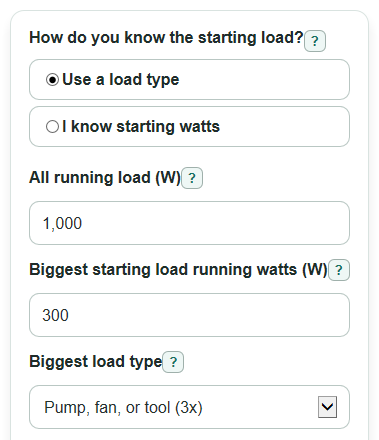
- Choose How do you know the starting load? based on what you have: a load type estimate or the actual Biggest load starting watts.
- Enter All running load and Biggest starting load running watts. All running load should include the biggest load after it has started.
- If you chose Use a load type, pick Biggest load type or use Custom starting multiplier. If you chose I know starting watts, enter Biggest load starting watts.
- Set Safety margin. Open Advanced options only if you want Estimated battery surge current, Estimated battery running current, or a Specific inverter check.
- Select Calculate, then sanity-check the results: Minimum continuous wattage should be above All running load, and Starting watts used for biggest load should usually be at least its running watts.
Definitions
All running load: The total steady watts for everything that may be on at the same time after startup.
Biggest starting load running watts: The normal running watts of the one load that has the largest startup burst.
Biggest load starting watts: The short burst of watts that the biggest load may need when it first turns on.
Safety margin: Extra percent added to the calculated need so the inverter is not sized exactly on the edge.
Minimum surge wattage: The inverter peak or surge watt rating needed for the startup event you entered.
Minimum continuous wattage: The inverter steady watt rating needed after the loads are running.
Surge headroom: The selected inverter surge rating minus Minimum surge wattage. Positive means spare watts, and negative means a shortfall.
Continuous headroom: The selected inverter continuous rating minus Minimum continuous wattage. Positive means spare watts, and negative means a shortfall.
Inverter efficiency: The percent of battery-side power that becomes usable AC output power.
Battery bank voltage: The nominal DC voltage of the battery system feeding the inverter, such as 12 V, 24 V, or 48 V.
Common mistakes and quick fixes
Mistake: Putting only the other loads in All running load.
Fix: All running load should include every load that may be on together, including the biggest load after it has started.
Mistake: Entering startup watts in Biggest starting load running watts.
Fix: Use the steady running watts there, and put the startup value in Biggest load starting watts only when that mode is selected.
Mistake: Choosing a Biggest load type and also trying to make Biggest load starting watts affect the answer.
Fix: In Use a load type mode, the calculator uses Biggest load type or Custom starting multiplier, not Biggest load starting watts.
Mistake: Treating Minimum surge wattage as the only inverter rating that matters.
Fix: Check Minimum continuous wattage too. The inverter needs enough steady watts after the startup burst is over.
Mistake: Reading negative Surge headroom as spare power.
Fix: Surge headroom is Inverter surge rating minus Minimum surge wattage, so a negative value means the inverter is short.
Mistake: Leaving Inverter efficiency at a guess when using Estimated battery surge current.
Fix: Enter the efficiency from your inverter specs when you have it, because lower efficiency means higher battery current.
Limitations & Key Assumptions / Boundary Conditions
- The math assumes one biggest surge-heavy load starts while the other loads are already running. If two compressors or motors start together, treat them as one combined starting event.
- Preset Biggest load type multipliers are rough planning values. Use Biggest load starting watts from a label, manual, or meter reading when available.
- Minimum surge wattage must be compared with an inverter's surge rating and time limit. Some peak ratings last only a very short time.
- Estimated battery surge current and Estimated battery running current use Battery bank voltage and Inverter efficiency only. They do not size cables, fuses, breakers, battery capacity, or voltage drop.
- Modified sine wave inverters, weak batteries, hot conditions, long extension cords, and older motors can change startup behavior.
- The calculator does not decide whether a load is safe for a specific inverter waveform, battery chemistry, breaker, or wiring setup.
Methodology
How the surge event is built
The calculator treats All running load as the steady load after everything has started. For a startup event, it removes Biggest starting load running watts from that total and adds the same load's starting watts instead. This avoids counting the biggest load twice. Inverter sizing guidance separates running watts from starting surge power [1], and the same no-double-count idea is often written as total running watts plus the largest surge difference [2].
If How do you know the starting load? is Use a load type, starting watts are estimated from the selected multiplier:
largest_starting_w = largest_running_w * selected_multiplier
If How do you know the starting load? is I know starting watts, the entered value is used directly:
largest_starting_w = known_starting_w
The surge event before margin is:
base_surge_w = total_running_w - largest_running_w + largest_starting_w
Recommended inverter ratings
The same Safety margin is applied to both the surge event and the steady running load:
recommended_surge_w = base_surge_w * (1 + safety_margin_percent / 100)
recommended_continuous_w = total_running_w * (1 + safety_margin_percent / 100)
The displayed watt answers are rounded to the nearest whole watt.
Battery current estimate
Battery current is estimated from AC watts, Battery bank voltage, and Inverter efficiency:
battery_current_a = ac_watts / (battery_voltage_v * inverter_efficiency_percent / 100)
The calculator uses Minimum surge wattage for Estimated battery surge current and Minimum continuous wattage for Estimated battery running current.
Specific inverter check
When Inverter continuous rating or Inverter surge rating is entered, headroom is shown as a signed difference:
headroom_w = inverter_rating_w - calculated_need_w
A positive headroom means spare capacity. A negative headroom means that rating is short by that many watts.
Mini-example
With All running load = 1000 W, Biggest starting load running watts = 300 W, a 3x load type, and Safety margin = 25%, the starting watts used are 300 * 3 = 900 W.
base_surge_w = 1000 - 300 + 900 = 1600 W
recommended_surge_w = 1600 * 1.25 = 2000 W
recommended_continuous_w = 1000 * 1.25 = 1250 W