
Estimate a battery-side DC inverter fuse size and check whether your cable safe current can handle it.
Table of contents
How to use our Inverter Fuse Size Calculator
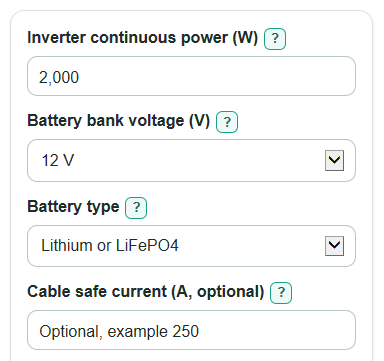
- Enter the inverter's continuous rating in Inverter continuous power (W), not its short surge rating.
- Choose the correct Battery bank voltage (V) and Battery type for the battery feeding the inverter.
- If you know it, enter Cable safe current (A, optional) from the cable rating or install guide; leave it blank if you only want the fuse estimate.
- Open Advanced options if you want to change Inverter efficiency (percent), Extra sizing margin (percent), or Fuse size list, then select Calculate.
- Sanity-check the result: lower battery voltage or lower efficiency should raise Estimated battery-side current, and a failed Cable check means the cable, load, or design needs to change.
Definitions
Inverter continuous power (W): The watts the inverter can deliver for normal running loads, not the short surge rating used for motor starts.
Battery bank voltage (V): The DC voltage of the battery bank feeding the inverter, such as 12 V, 24 V, or 48 V.
Battery type: The battery chemistry group. Lithium and LiFePO4 banks can deliver very high fault current, so fuse interrupt rating matters.
Cable safe current (A, optional): The current the installed cable can safely carry under its real conditions. This is also called ampacity.
Inverter efficiency (percent): The share of battery power that becomes usable AC power. Lower efficiency means more battery-side current for the same watts.
Extra sizing margin (percent): The multiplier applied to estimated steady current before rounding to a fuse size. The default is 125 percent.
Fuse size list: The set of standard amp ratings the calculator can round up to.
Calculated minimum before rounding: The estimated battery-side current after the sizing margin is applied.
Cable headroom: Cable safe current minus recommended fuse size. Positive is extra room; negative means the fuse is above the cable safe current.
DC interrupt rating: The maximum DC fault current a fuse can safely stop. It must fit the battery bank and fuse holder.
Common mistakes and quick fixes
Mistake: Using surge watts in Inverter continuous power (W) .
Fix: Use the continuous watt rating printed in the inverter manual or on the inverter label.
Mistake: Picking the wrong Battery bank voltage (V) because the inverter makes 120 V AC output.
Fix: Choose the DC battery bank voltage feeding the inverter, such as 12 V, 24 V, or 48 V.
Mistake: Leaving Inverter efficiency (percent) at 90 when the manual shows a lower number.
Fix: Enter the manual value because lower efficiency raises Estimated battery-side current .
Mistake: Treating Cable safe current (A, optional) as a cable size like 2/0 AWG.
Fix: Enter the safe amp rating for that exact cable, insulation, temperature, and install method, or leave it blank.
Mistake: Lowering Extra sizing margin (percent) below 100 to force a smaller fuse.
Fix: Keep the margin at 100 or higher; a fuse below the estimated steady current may nuisance-blow or be wrongly sized.
Mistake: Ignoring Cable check when it says the fuse is too large for the cable.
Fix: Do not just install the smaller cable; use larger cable, reduce Inverter continuous power (W) , or get the design reviewed.
Limitations & Key Assumptions / Boundary Conditions
- This calculator estimates a battery-side DC inverter fuse. It does not size the cable, fuse holder, disconnect, bus bars, or battery protection device.
- Cable safe current (A, optional) must come from a trusted ampacity table, manufacturer data, or a qualified design. Cable length, insulation temperature, bundling, conduit, and ambient heat can change it.
- The result is based on continuous inverter power. Short surge loads, motor starting, inverter charger current, and bidirectional inverter operation may need separate checks.
- The calculator rounds up only to the selected Fuse size list. If the calculated minimum is above the largest listed size, the scenario is outside this tool's supported range.
- A passing Cable check only means the chosen fuse is not above the cable safe current you entered. It does not prove the installation meets code or manufacturer instructions.
- Voltage drop is not included. A cable can have enough amp rating and still be too small for voltage drop on a long run.
- For lithium, LiFePO4, or large battery banks, the fuse must have a DC voltage rating and DC interrupt rating high enough for the available fault current.
Methodology
How the fuse size is estimated
The calculator first estimates the battery-side DC current needed to make the inverter's continuous AC power. It includes inverter losses by dividing by efficiency.
estimated_dc_current_a = inverter_watts / (battery_voltage * (inverter_efficiency_percent / 100))
Next, it applies the sizing margin. The default margin is 125 percent, so the minimum fuse amps are 25 percent above the estimated steady current.
minimum_fuse_a = estimated_dc_current_a * (sizing_margin_percent / 100)
The final recommendation is the smallest standard fuse size in the selected list that is at least as large as the calculated minimum.
recommended_fuse_a = smallest selected_standard_fuse_size where selected_standard_fuse_size >= minimum_fuse_a
How the cable check works
If Cable safe current (A, optional) is blank, the calculator skips the cable check. If you enter a cable safe current, it compares that number with the rounded fuse size and keeps the signed headroom.
cable_headroom_a = cable_safe_amps - recommended_fuse_a
if cable_safe_amps is blank: no_check; else if recommended_fuse_a <= cable_safe_amps: ok; else: not_safe
A negative Cable headroom is not rounded up to zero because the negative number shows how far the recommended fuse is above the cable safe current.
Mini example
For a 2000 W inverter on a 12 V battery bank with 90 percent efficiency, estimated battery-side current is 2000 / (12 * 0.90) = 185.19 A. With a 125 percent margin, the calculated minimum before rounding is 185.19 * 1.25 = 231.48 A. Using the common DC fuse list, the next size up is 250 A. If the cable safe current is 250 A, cable headroom is 250 - 250 = 0 A, so the cable check passes exactly with no extra amp room.
Calculation choices
Number fields accept commas, spaces, and simple matching unit suffixes like W, watts, A, amps, V, or percent. Ranges, formulas, and multiple numbers in one field are rejected so the fuse math uses one clear value. If the calculated minimum is larger than the biggest fuse in the selected list, the calculator shows an unsupported-state message instead of inventing a fuse size.