
Enter your local HVAC estimate range and any separate project costs to calculate the full installed-cost planning range.
Advanced options
Table of contents
How to use our HVAC Installation Cost Calculator
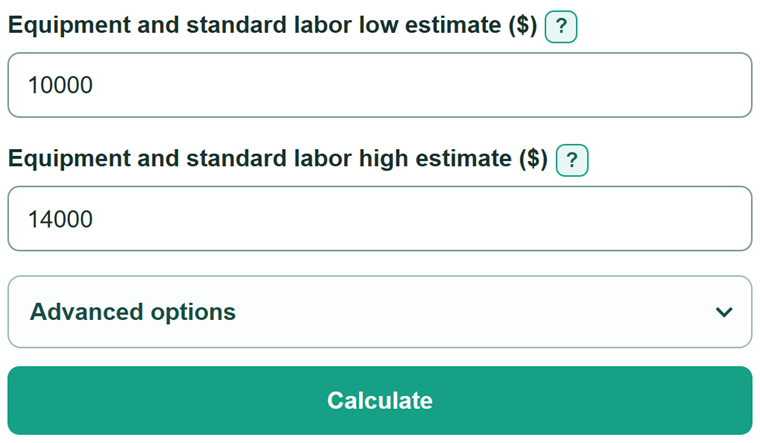
- Copy the low and high equipment-and-standard-labor amounts from a local contractor proposal, installer estimate, builder allowance, or local planning estimate.
- Open Advanced options and enter an allowance only when ductwork, old-system removal, permits, or electrical work is priced separately from the base estimate.
- Click Calculate to see the installed-cost range, its midpoint, the total added scope allowances, and the scope included.
- Compare the included-scope list with the written proposal. Ask for an estimate that lists the work, materials, and price [1]. If an item is already included in the base amount, leave that allowance blank so it is not added twice.
Definitions
Base estimate: The local price range for HVAC equipment and standard installation labor before separately entered allowances.
Scope allowance: A separate dollar amount for work that may be missing from the base estimate, such as ductwork, removal, permits, or electrical work.
Installed-cost range: The calculated low and high totals after the same entered scope allowances are added to both base estimates.
Planning midpoint: The dollar amount halfway between the calculated low and high installed-cost totals. It is a budgeting reference, not a predicted quote.
Common mistakes and quick fixes
Mistake: Reversing the low and high base estimates.
Fix: Enter the smaller base amount as the low estimate and the larger amount as the high estimate.
Mistake: Adding ductwork, removal, permits, or electrical work twice.
Fix: Check the written scope and leave an allowance blank when the base estimate already includes that work.
Mistake: Typing a range or calculation into one dollar field.
Fix: Enter one nonnegative dollar amount per field, such as 12500 or 12,500.
Mistake: Using malformed commas, such as 1,50 or 1,,500.
Fix: Use commas only for thousands, such as 1,500, and use a decimal point for cents.
Mistake: Treating the midpoint as a contractor quote or including annual utility bills.
Fix: Use the midpoint only for budgeting, and keep recurring energy and maintenance costs out of this one-time installation calculation.
Limitations & Key Assumptions / Boundary Conditions
- This is a planning calculation, not a contractor quote, bid, or guarantee of final price.
- It uses only amounts you enter. It does not create a ZIP-code price, local labor-rate estimate, or market-price adjustment.
- Blank optional allowances count as $0. Check the written scope so work already included in a base estimate is not added twice.
- It excludes rebates, tax credits, financing, sales tax, annual energy costs, maintenance, asbestos work, gas-line work, structural changes, and any other work not entered.
- It does not select equipment capacity or replace a site review and load calculation for HVAC sizing.
Methodology
How the math works
The calculator adds every nonblank optional allowance once to both ends of the local base range. Blank allowances count as $0. Each entered amount must be one valid nonnegative dollar amount, and the low base estimate cannot be greater than the high base estimate. Allowances entered as $0 are not listed as included scope.
scope_additions = ductwork_allowance + removal_allowance + permit_allowance + electrical_allowance
installed_cost_low = base_install_low + scope_additions
installed_cost_high = base_install_high + scope_additions
likely_midpoint = (installed_cost_low + installed_cost_high) / 2
Worked example
Start with a base range of $10,000 to $14,000. Add $2,500 for ductwork, $1,500 for removal, $1,350 for permits, and $1,200 for electrical work. The scope additions are $6,550, so the installed-cost range is $16,550 to $20,550. The planning midpoint is $18,550.