
Compare a single-hose and dual-hose portable AC using their prices, power use, cooling schedule, and your electricity rate.
Advanced options
This compares purchase and estimated electricity costs. It does not prove equal cooling, noise, or comfort.
A negative value means the dual-hose unit costs less to buy.
A negative value means the dual-hose unit costs more to run.
Table of contents
How to use our Dual-Hose vs Single-Hose Portable AC Lifetime Cost Calculator
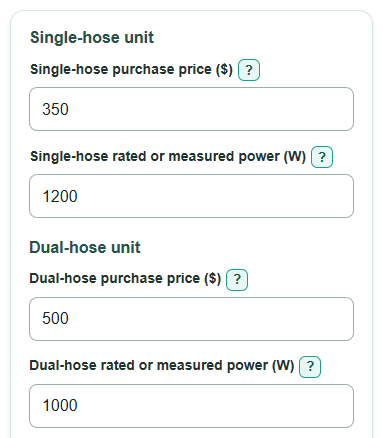
- Enter the Single-hose purchase price and Dual-hose purchase price from listings, carts, or receipts.
- Enter each model's rated or measured power in watts. A measured average from typical cooling use can be more useful than a nameplate rating.
- Set Cooling use, Cooling days per year, Electricity rate, and Years you plan to own the AC for your expected use.
- Optionally enter both DOE SACC capacity values to see whether the models have similar listed cooling capacity.
- Click Calculate, then check the lifetime savings sign: a positive amount means the dual-hose unit costs less under your entries, while a negative amount means it costs more.
Definitions
DOE SACC: Department of Energy seasonally adjusted cooling capacity. It is a portable AC capacity rating in BTU/h that helps compare the room-cooling ability of two models.
Rated or measured power: Electrical power in watts (W). Rated power comes from product information; measured power is an average observed during use.
kWh: Kilowatt-hour, a unit of electricity use billed by utilities. One kW used for one hour equals one kWh.
Cooling season: The entered hours per day and cooling days per year. It is not automatically a full calendar year.
Dual-hose upfront price premium: Dual-hose purchase price minus single-hose purchase price. A positive amount means the dual-hose unit costs more to buy.
Lifetime cost saved with the dual-hose unit: Single-hose lifetime total minus dual-hose lifetime total. A positive amount favors the dual-hose unit; a negative amount favors the single-hose unit.
Common mistakes and quick fixes
Mistake: Entering a cooling capacity in the Single-hose rated or measured power or Dual-hose rated or measured power field.
Fix: Enter electrical power in W, not cooling capacity in BTU/h.
Mistake: Comparing an ASHRAE capacity for one unit with a DOE value in Single-hose DOE SACC capacity or Dual-hose DOE SACC capacity .
Fix: Enter DOE SACC values for both models, or leave both optional capacity fields blank.
Mistake: Using 365 for Cooling days per year when the AC runs only in a warm season.
Fix: Enter the number of days you realistically expect to use cooling during one year.
Mistake: Including a fixed monthly utility account charge in Electricity rate .
Fix: Use the usage-based cents per kWh rate from your bill or plan because a fixed account charge usually does not change between AC choices.
Mistake: Treating a negative Lifetime cost saved with the dual-hose unit as an error.
Fix: Keep the negative sign. It means the dual-hose model costs more over the planned ownership period.
Mistake: Assuming Time for electricity savings to recover the dual-hose price premium guarantees recovery.
Fix: Compare the recovery time with Years you plan to own the AC ; recovery after that period does not happen within your plan.
Limitations & Key Assumptions / Boundary Conditions
- The estimate assumes both units run for the same entered hours per day and cooling days per year.
- Rated watts may not match average power during real cooling. Room size, outdoor heat, thermostat setting, window sealing, humidity, and compressor cycling can change actual electricity use.
- Cost results do not adjust for different DOE SACC capacities. Entering both SACC values only makes a capacity difference visible.
- Purchase price and electricity rate are treated as constant for all planned years. Future price changes, time-of-use rates, taxes, and rate tiers are not modeled.
- Totals exclude fixed utility charges, financing, repairs, maintenance, accessories, replacement parts, resale value, and early replacement.
- The 18.44 cents per kWh and 7-year defaults are US planning values. Replace them with your bill rate and expected ownership period when possible.
Methodology
Cost calculation
The calculator gives both candidates the same cooling schedule. It first finds yearly cooling hours, then calculates each model's electricity use and cost from its entered power.
seasonal_hours = hours_per_day * cooling_days_per_year
seasonal_kwh = (power_w / 1000) * seasonal_hours
seasonal_cost = seasonal_kwh * (electricity_rate_cents / 100)
lifetime_total = purchase_price + seasonal_cost * years_owned
The lifetime saving keeps its sign, so it can show either a saving or an extra cost for the dual-hose model.
lifetime_cost_saved_with_dual = single_lifetime_total - dual_lifetime_total
upfront_price_premium = dual_purchase_price - single_purchase_price
annual_electricity_cost_saved_with_dual = single_seasonal_electricity_cost - dual_seasonal_electricity_cost
If the dual-hose unit costs more upfront and has positive yearly electricity savings, the calculator divides the premium by those yearly savings. If it is cheaper upfront, recovery time is 0 years. If it has no yearly electricity savings, its positive premium is not recovered.
premium_recovery_years = upfront_price_premium / annual_electricity_cost_saved_with_dual
Worked example
A 1,200 W single-hose unit used 8 hours per day for 120 days uses 1,152 kWh per cooling season. At 18.44 cents per kWh, that season costs $212.43. With a $350 purchase price and 7 years of ownership, its estimated lifetime total is $1,837.00. The calculator repeats the same steps with the dual-hose model's own price and power, then compares the totals.
Capacity check
When both optional DOE SACC values are entered, the calculator shows their relationship without changing any cost result.
dual_capacity_percent_of_single = (dual_sacc_btu_h / single_sacc_btu_h) * 100
What this estimate leaves out
The default electricity rate is a 2026 US residential planning estimate from EIA [1]. The 7-year ownership default is based on an EIA portable AC average-life assumption [2]. Actual results can differ when average running power, utility pricing, usage schedule, or the two models' cooling capacity differs from the entered values.