
Estimate a planning cost for replacing a central AC or heat pump, including credits and an optional quote check.
Advanced options
Table of contents
How to use our AC Replacement Cost Calculator
- Enter Home size (sq ft) using the cooled living area, not the lot size or unfinished space.
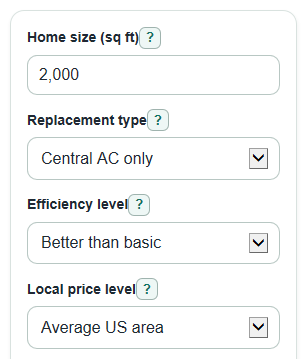
- Choose Replacement type, Efficiency level, Local price level, and Job difficulty to match the project you are pricing.
- Open Advanced options if you know Known AC size (tons), have adders for Duct fixes to include ($), Line-set or drain work ($), Permits and inspection ($), or want to subtract Expected rebates or credits ($).
- If you have a bid, enter Contractor quote to check ($), then select Calculate and read Estimated cost after entered credits first.
- Sanity-check Cooling size used. Tons are cooling size, not weight; if the number looks wrong for your home or quote, enter Known AC size (tons) or ask a contractor for a load calculation.
Definitions
Home size (sq ft): The cooled area of the home in square feet. This is a quick sizing input, not a full HVAC load study.
Replacement type: Central AC only cools the home. A heat pump can cool and also provide heat.
Efficiency level: A broad equipment price tier. Higher-efficiency systems usually cost more up front, and exact efficiency ratings depend on the model.
Local price level: A simple labor and market adjustment for lower, average, or higher cost areas.
Job difficulty: A project difficulty setting for access, equipment location, line-set work, electrical changes, and other install challenges.
Known AC size (tons): The cooling capacity from a quote or equipment label. Tons are AC cooling size, not equipment weight.
Expected rebates or credits ($): Money you expect to receive back or subtract from the project cost. Heat pump credit eligibility depends on the exact equipment and tax situation [1].
Quote compared with net estimate: The quote after subtracting the entered credits, minus the calculator's net midpoint. Enter the gross contractor quote so both sides use the same credits. A positive number is above the estimate; a negative number is below it.
Common mistakes and quick fixes
Mistake: Using the whole property or basement storage area in Home size (sq ft).
Fix: Enter only the cooled living area in Home size (sq ft).
Mistake: Picking Heat pump under Replacement type when the quote is for cooling-only Central AC only.
Fix: Match Replacement type to the equipment being replaced or quoted.
Mistake: Treating Known AC size (tons) as the outdoor unit's weight.
Fix: Use Known AC size (tons) only when the quote or equipment label lists cooling tons, such as 3, 3.5, or 4 tons.
Mistake: Leaving Duct fixes to include ($), Line-set or drain work ($), or Permits and inspection ($) out even though the quote includes them.
Fix: Add those dollar amounts so Estimated replacement cost before credits includes the same work as the quote.
Mistake: Entering Expected rebates or credits ($) before checking that you qualify.
Fix: Enter only rebates or credits you expect to receive; otherwise leave Expected rebates or credits ($) at 0.
Mistake: Reading Quote compared with net estimate as a total project cost.
Fix: Use it as the gap only: positive means Contractor quote to check ($) is above the net estimate, and negative means it is below.
Limitations & Key Assumptions / Boundary Conditions
- The home-size sizing shortcut uses 20 BTU per hour per square foot and rounds up to the next half ton, then caps the derived size at 5 tons. Large homes may need more than one system.
- This is not a Manual J load calculation. Insulation, windows, shade, ceiling height, air leaks, climate, and duct design can change the correct equipment size.
- The built-in $ per ton rates and multipliers are planning constants, not live local bid data.
- Major duct replacement, panel upgrades, crane work, asbestos work, zoning systems, and indoor air quality add-ons are included only if you add them through the dollar add-on fields.
- Expected rebates or credits ($) are subtracted only because you enter them. The calculator does not decide whether you qualify for a utility rebate or tax credit.
- A contractor quote can be outside the planning range and still be reasonable if the scope includes more work, better equipment, longer warranty coverage, or difficult access.
Methodology
How the cooling size is chosen
If Known AC size (tons) is blank, the calculator estimates cooling size from Home size (sq ft). The shortcut uses 20 BTU per hour per square foot, converts BTU per hour to tons using 12,000 BTU per hour per ton, rounds up to the next half ton, and limits the result to 1.5 through 5 tons.
estimated_tons = ceil((home_sqft * 20 / 12000) * 2) / 2
tons_used = known_tons if entered, otherwise estimated_tons
How the cost midpoint is built
The calculator multiplies Cooling size used by a built-in planning rate per ton. Central AC rates are $2,200 basic, $2,600 better than basic, and $3,200 high efficiency. Heat pump rates are $2,800 basic, $3,300 better than basic, and $4,100 high efficiency. Then it applies the Local price level multiplier and Job difficulty multiplier, and adds any entered dollar adders.
base_mid = tons_used * rate_per_ton[replacement_type][efficiency_level]
gross_mid = base_mid * region_multiplier[local_price_level] * difficulty_multiplier[job_difficulty] + ductwork_extra + line_set_extra + permit_extra
Local price multipliers are 0.90 for lower cost area, 1.00 for average US area, and 1.15 for higher cost area. Job difficulty multipliers are 0.90 for easy swap, 1.00 for normal swap, and 1.18 for hard swap.
Range, credits, and quote check
The planning range is based on the gross midpoint before credits. The low end is 15 percent below the midpoint, and the high end is 20 percent above it. Expected rebates or credits ($) are then subtracted from the midpoint to get the main net estimate.
range_low = gross_mid * 0.85
range_high = gross_mid * 1.20
net_after_credits = gross_mid - rebates_credits
quote_gap = (gross_contractor_quote - rebates_credits) - net_after_credits
Mini-example
For a 2,000 sq ft home with Central AC only, Better than basic efficiency, Average US area, and Normal swap, the size estimate is 3.5 tons. The midpoint before credits is 3.5 * $2,600 = $9,100. The likely range before credits is $7,735 to $10,920. With $0 in Expected rebates or credits ($), Estimated cost after entered credits is $9,100. If Contractor quote to check ($) is $10,000, Quote compared with net estimate is $900, meaning the quote is $900 above the planning midpoint.