
Enter your low and high project allowances to calculate a realistic HVAC replacement budget range and a planning midpoint.
Table of contents
How to use our HVAC Replacement Cost Calculator
- Gather early estimates or proposal amounts for equipment, installation labor, ductwork, and other project work.
- Enter a low and high dollar allowance for every category; enter $0 only when that category is truly not part of the plan.
- Check that each high amount is at least the matching low amount, then select Calculate.
- Use the installed-cost range to plan your budget and the midpoint as a reference, not as a contractor quote.
- To compare written proposals, open Advanced options, enter each stated line item, and review any category without a stated price before choosing.
Definitions
Installed cost: The one-time replacement-project budget made from equipment, installation labor, ductwork, and other project work.
Equipment allowance: The planned price for the HVAC equipment being replaced, such as the indoor and outdoor units.
Installation labor allowance: The planned price for removal and installation work when it is not already included in the equipment price.
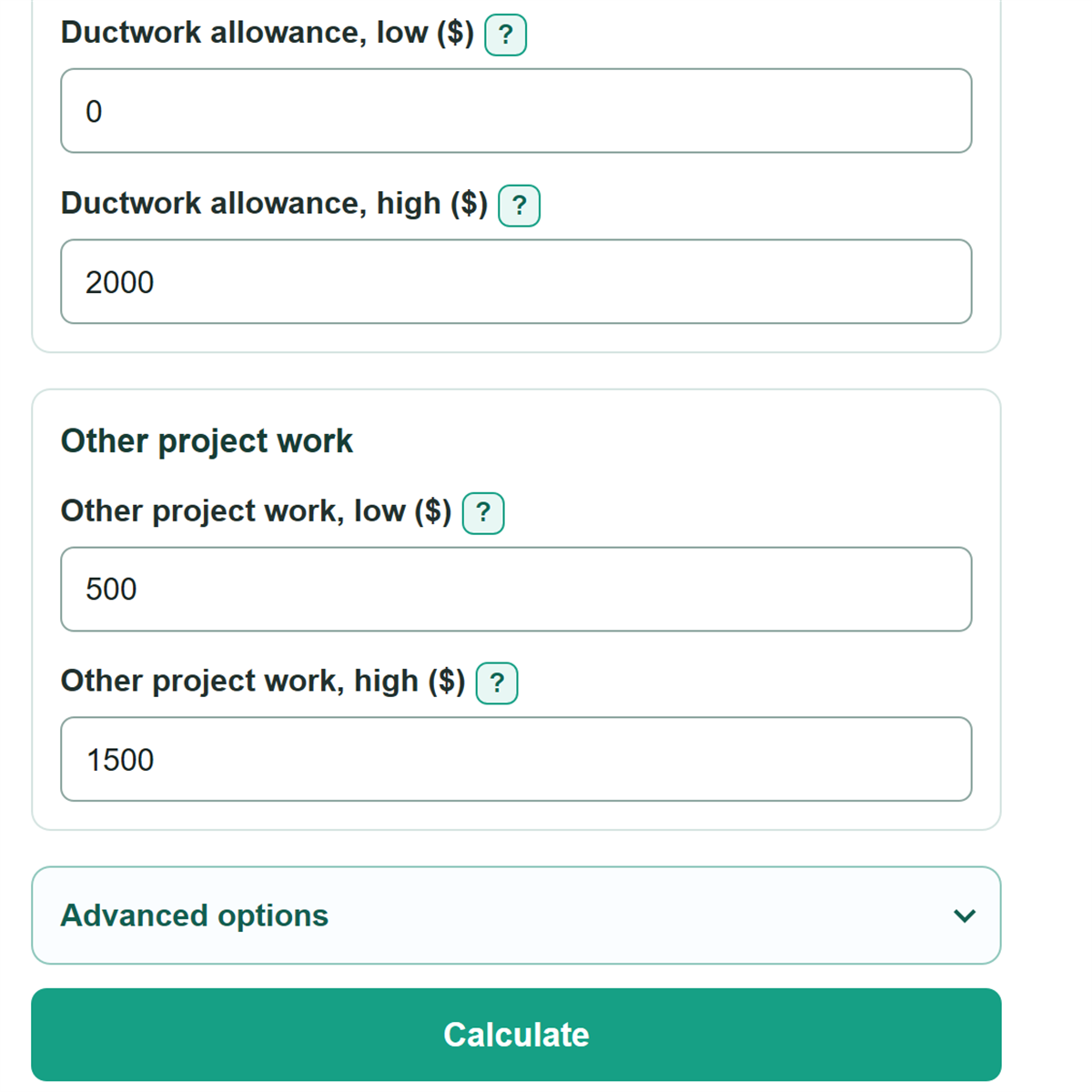
Ductwork allowance: A planned amount for duct sealing, repair, modification, or replacement.
Other project work: A combined amount for electrical work, controls, permits, removal, access work, and similar items.
Planning midpoint: The dollar amount halfway between the low and high installed-cost estimates.
Stated total: The sum of proposal amounts entered in the four comparison categories. A blank category has no stated price; it is not treated as free work.
Common mistakes and quick fixes
Mistake: Leaving a required low or high allowance blank because the amount is uncertain.
Fix: Check Equipment allowance, low and then recalculate. Enter your best planning amount. Use $0 only if that category has no expected cost.
Mistake: Entering a high allowance that is lower than its matching low allowance.
Fix: Check Equipment allowance, low and then recalculate. Correct the amounts so each high allowance is at least the matching low allowance.
Mistake: Counting ductwork inside equipment or labor without checking the proposal.
Fix: Check Equipment allowance, low and then recalculate. Enter ductwork separately when repairs, sealing, changes, or replacement may have a cost.
Mistake: Typing a number such as 1,01.
Fix: Check Equipment allowance, low and then recalculate. Use commas only for thousands, such as 1,000. Use a decimal point for cents, such as 1000.50.
Mistake: Entering part of a proposal while leaving its equipment or installation labor amount blank.
Fix: Check Equipment allowance, low and then recalculate. Add both required proposal amounts, or clear every field for that proposal.
Mistake: Assuming a blank proposal category means the work is included at no cost.
Fix: Check Equipment allowance, low and then recalculate. Ask the contractor whether the blank category is included, excluded, unnecessary, or bundled into another line.
Limitations & Key Assumptions / Boundary Conditions
- This is a homeowner-entered planning range, not a contractor quote, final invoice, or price guarantee.
- The result includes only equipment, installation labor, ductwork, and other project work entered in the calculator. It does not include rebates, financing, maintenance, utility bills, or energy savings.
- A blank proposal category may be included elsewhere, excluded, unnecessary, or bundled into another price. The calculator cannot determine which applies.
- The calculator does not select HVAC capacity, tonnage, SEER2, HSPF2, or AFUE. Final equipment selection needs a project-specific load calculation and matched equipment.
- Site access, electrical capacity, permits, code requirements, hidden conditions, and scope changes can change a contractor's actual price after inspection.
Methodology
Budget calculation
The calculator adds the four low allowances for the lower budget edge and the four high allowances for the upper budget edge. It does not add a market average, regional multiplier, contingency percentage, or hidden fee.
low installed cost = low equipment + low labor + low ductwork + low other project work
high installed cost = high equipment + high labor + high ductwork + high other project work
Every entered amount must be $0 or more. Each high allowance must be at least its matching low allowance.
Planning midpoint
The planning midpoint is the center of the two budget edges.
planning midpoint = (low installed cost + high installed cost) / 2
Example: low allowances of $5,000 for equipment, $3,000 for labor, $0 for ductwork, and $500 for other work total $8,500. High allowances of $7,000, $4,500, $2,000, and $1,500 total $15,000. The midpoint is $11,750.
Proposal comparison
Proposal fields are optional. After any amount is entered for a proposal, equipment and installation labor are required. Blank ductwork and other-project-work fields add $0 to the stated total and are counted as categories without a stated price.
proposal stated total = entered equipment + entered labor + entered ductwork + entered other project work
proposal stated-cost difference = Proposal B stated total - Proposal A stated total
A positive difference means Proposal B has a higher stated total. A negative difference means Proposal B has a lower stated total.