
Compare your AC repair and replacement quotes over time, including confirmed warranty coverage, electricity savings, and future repair estimates.
Advanced options
One-time cost details
Electricity estimate
Future cost and time
Table of contents
How to use our AC Repair or Replace Calculator
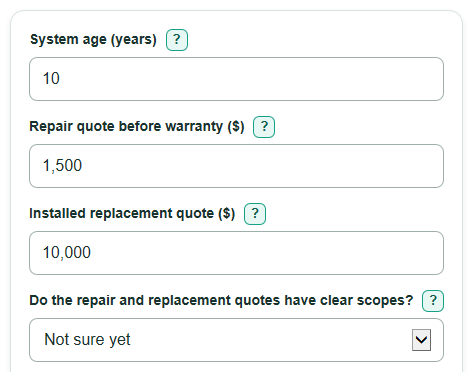
- Enter the current System age, Repair quote before warranty, and Installed replacement quote from written contractor documents.
- Choose whether the repair and replacement quotes have clear scopes. If you are unsure, calculate anyway, then ask contractors to list included equipment, labor, permits, electrical work, ductwork, disposal, and warranties.
- Open Advanced options to enter confirmed warranty coverage, known replacement extras, and your planned Years to compare.
- For an operating-cost comparison, enter AC-only electricity use, your electricity price, a documented expected electricity reduction, and a future repair allowance for the old system.
- Check the modeled next step and both path costs. Change uncertain estimates, such as future repairs or electricity reduction, to see whether the recommendation stays the same.
Definitions
Clear quote scopes: Written details showing what each quote includes, such as equipment, labor, permits, electrical work, ductwork, disposal, and warranties.
Confirmed warranty coverage: The amount a manufacturer, installer, or home warranty has approved to pay toward this repair.
AC-only electricity use: Electricity used for air conditioning in one year, measured in kilowatt-hours (kWh). It does not include other household electricity use.
Electricity price: The variable energy charge in cents per kWh. The editable 17.30 cents per kWh default is a 2025 U.S. residential planning estimate. [1]
Expected AC electricity reduction: Your documented estimate of the percent less electricity a replacement system may use for cooling.
Future repair allowance: Your estimated yearly cost for repairs after the current repair is completed. It is a planning assumption, not a prediction.
Break-even years: The time needed for yearly modeled savings to recover replacement's extra upfront cost.
Common mistakes and quick fixes
Mistake: Entering a whole-home electric bill as Yearly AC electricity use.
Fix: Use AC-only kWh from an energy monitor, thermostat report, utility analysis, or enter 0 if cooling use is unknown.
Mistake: Subtracting an unapproved warranty claim from Repair quote before warranty.
Fix: Enter only a confirmed payment under Confirmed warranty coverage.
Mistake: Treating an incomplete Installed replacement quote as the full installed price.
Fix: Add known excluded work under Extra replacement work not in the quote and verify the proposal scope.
Mistake: Entering a SEER or SEER2 rating as Expected AC electricity reduction.
Fix: Enter a documented percent estimate of lower AC electricity use, or enter 0 when no estimate is available.
Mistake: Reading a negative Replace cost minus repair cost as an error.
Fix: A negative amount means replacement costs less than repair over the selected period in this model.
Mistake: Treating Years for replacement to recover its extra upfront cost as guaranteed.
Fix: Test a shorter and longer period plus different future-repair and energy assumptions.
Limitations & Key Assumptions / Boundary Conditions
- This is a cost-planning comparison, not a diagnosis of AC safety, reliability, comfort, humidity control, or required code work.
- It counts the current repair once, then applies entered electricity and future-repair estimates for the selected number of years. Actual failures, weather, thermostat use, electricity rates, and maintenance can differ.
- The energy calculation needs AC-only kWh and a user-entered reduction percent. It does not calculate savings from system age, home size, SEER, or SEER2 ratings.
- Fixed utility account charges are excluded because replacing an AC normally does not remove them.
- Replacement costs are only comparable when quote scopes match. Add known excluded work, and request written clarification for unclear proposals.
- Break-even is shown only when replacement has a higher upfront cost and positive yearly modeled savings. A break-even beyond your selected period may not fit your ownership plans.
- System age adds context only. This calculator does not use an automatic age cutoff to require replacement.
Methodology
Cost comparison
The calculator subtracts confirmed warranty coverage from the repair quote, then adds known excluded work to the replacement quote.
R = repair quote before warranty - confirmed warranty coverage
P = installed replacement quote + extra replacement work not in the quote
It converts AC-only electricity use into a yearly dollar cost. The electricity price is entered in cents per kWh, so dividing by 100 converts cents to dollars. The default 17.30 cents per kWh is an editable 2025 U.S. residential planning estimate. [1]
E_old = yearly AC electricity use x electricity price / 100
E_new = E_old x (1 - expected AC electricity reduction / 100)
The repair path includes the one-time current repair plus yearly old-system electricity and the entered yearly future-repair allowance. The replacement path includes the one-time replacement cost plus yearly estimated replacement electricity.
C_repair = R + years to compare x (E_old + future repairs for the old system)
C_replace = P + years to compare x E_new
Replace cost minus repair cost = C_replace - C_repair
A positive cost gap means repair costs less in the model. A negative cost gap means replacement costs less. If quote scopes are not confirmed, the modeled next step is to get matching written scopes first, even though both cost paths are still calculated.
Break-even and example
Yearly replacement advantage combines estimated yearly electricity savings with the future-repair allowance avoided by replacing the old system.
Break-even years = (P - R) / (yearly electricity savings + future repairs for the old system)
For example, suppose repair after warranty is $1,000, replacement including extras is $11,000, yearly electricity savings are $300, and future repairs are $500 per year. Replacement costs $10,000 more upfront and has an $800 yearly modeled advantage, so break-even is 12.5 years. If replacement costs no more upfront, break-even is 0 years. If it costs more upfront but has no positive yearly advantage, break-even is not reached under the entered assumptions.
Assumptions and limits
The calculation uses straight yearly costs without inflation, financing charges, tax credits, resale value, maintenance differences, or discounting future dollars. It does not predict equipment failure. The system age at the end of the comparison is current age plus the selected years and does not change the cost calculation.