
Compare your furnace repair payment and replacement quote to get a clear next step, with a safety-first check for serious diagnoses.
Table of contents
How to use our Furnace Repair or Replace Calculator
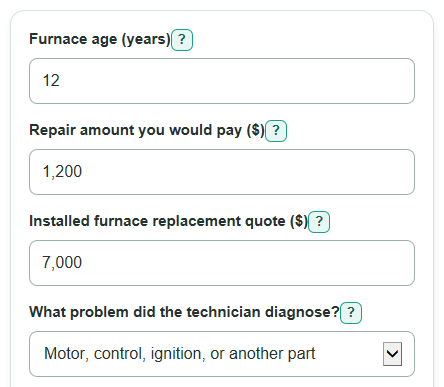
- Enter your Furnace age from an installation record, inspection report, or furnace data plate.
- Enter the final Repair amount you would pay after warranty coverage, including any diagnostic fee you still owe.
- Enter an all-in Installed furnace replacement quote, then choose the technician's diagnosis and what the quote covers.
- Open Advanced options if you know your recent repair history, then enter Major furnace repairs in the last 2 years and the money already spent on them.
- Check the guide and its signals. If the quote scope is unclear or the diagnosis is not clear, get the missing details before approving either choice.
Definitions
Installed replacement quote: The price to replace the furnace with installation work included, rather than the price of the equipment alone.
Out-of-pocket repair amount: What you would pay now after any warranty credit, including an uncredited diagnostic fee.
Heat exchanger: A furnace part that transfers heat into indoor air while keeping combustion gases separate. A reported failure or combustion concern needs safety guidance before a cost comparison.
Repair share: The current repair payment divided by the installed replacement quote, shown as a percent.
Recent repair share: The current repair payment plus earlier major repair spending from the last 2 years, divided by the installed replacement quote.
Replacement-review signal: One of the calculator's planning checks: furnace age of 15 years or more, current repair share of 40% or more, recent repair share of 60% or more, or at least 2 major repairs in 2 years.
Common mistakes and quick fixes
Mistake: Entering a repair price before warranty coverage or leaving out a diagnostic fee you must pay.
Fix: Use the final homeowner payment in Repair amount you would pay.
Mistake: Using the furnace equipment price instead of the installed total.
Fix: Enter a written installed bid in Installed furnace replacement quote and choose the matching answer for What does the replacement quote cover?.
Mistake: Choosing a routine part problem after a technician reported a heat exchanger, carbon monoxide, or combustion concern.
Fix: Select the safety concern answer under What problem did the technician diagnose? and follow the technician's immediate instructions.
Mistake: Counting tune-ups and filter changes as failures.
Fix: Enter only completed technician repairs in Major furnace repairs in the last 2 years.
Mistake: Adding the current repair quote again to Money spent on those prior repairs.
Fix: Enter only earlier major repair payments from the last 2 years because the calculator adds the current repair separately.
Mistake: Typing a malformed money amount such as 1,01.
Fix: Check Furnace age and then recalculate. Use commas only for thousands, such as 1,200, and use a decimal point for cents.
Limitations & Key Assumptions / Boundary Conditions
- This is planning guidance, not a furnace diagnosis, a safety inspection, or a guarantee that the lower-cost choice will stay cheaper.
- A heat exchanger or combustion safety concern overrides the financial score. Follow the technician's shutdown, ventilation, repair, or replacement instructions.
- The comparison uses one-time repair and installed replacement prices. It does not estimate fuel savings, rebates, tax credits, financing, comfort, or future breakdowns.
- The replacement quote must be comparable to repair. Equipment-only prices or unclear bids can omit labor, permits, removal, venting, electrical work, thermostat work, or duct changes.
- The 15-year age check is a United States replacement-review reference, while the 40%, 60%, and repeat-repair checks are transparent calculator assumptions rather than industry rules.
- Prior repair history is only as complete as the invoices or records entered. Routine maintenance should not be counted as a major repair.
Methodology
How the guide is chosen
A reported heat exchanger or combustion safety concern produces "Stop and get safety guidance" first. If the diagnosis is not clear, or if the replacement quote is equipment-only or has unclear scope, the guide returns "Compare quotes or get more information."
For a clear routine-part diagnosis and an all-in installed quote, the calculator counts four replacement-review signals. ENERGY STAR says to consider replacing heating equipment that is more than 15 years old, so age 15 years or more is one signal. [1]
repair share = 100 x repair amount you would pay / installed furnace replacement quote
recent repair share = 100 x (repair amount you would pay + money spent on those prior repairs) / installed furnace replacement quote
signal count = age signal + 40% repair-share signal + 60% recent-repair-share signal + 2-repairs-in-2-years signal
Zero signals gives "Repair looks stronger." One signal gives "Compare quotes or get more information." Two or more signals gives "Replacement looks stronger." The 40%, 60%, and repeat-repair thresholds are calculator planning rules, not official standards.
Worked example
For an 18-year-old furnace, a $3,000 repair, an $8,000 all-in replacement quote, two prior major repairs, and $1,500 spent on those repairs, the current repair share is 37.5% and the recent repair share is 56.25%.
37.5% = 100 x 3,000 / 8,000
56.25% = 100 x (3,000 + 1,500) / 8,000
The age signal and repeat-repair signal make two signals, so the guide says "Replacement looks stronger" if the diagnosis is a routine part problem and the quote is all-in.
Calculation limits
The method compares immediate prices and recent repair history only. It does not predict remaining furnace life, future repair costs, energy use, local code work, incentives, or the quality of a contractor's installation.