
Estimate a rough furnace size in BTU/h using home area, winter climate, insulation, efficiency, and available model sizes.
Advanced options
Table of contents
How to use our Furnace Size Calculator
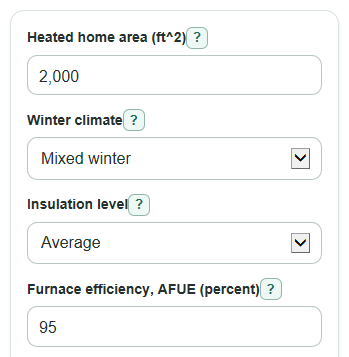
- Enter the Heated home area (ft^2) for only the rooms the furnace actually heats.
- Choose Winter climate and Insulation level, then enter Furnace efficiency, AFUE (percent) from the furnace rating or quote.
- Open Advanced options if you want to change Average ceiling height (feet), Windows and drafts, Extra cushion (percent), Available furnace input sizes (BTU/h), or Quoted furnace size (BTU/h input).
- Click Calculate and read Suggested furnace input size first, then compare Estimated heat needed with Heat delivered by suggested size.
- Sanity-check the output: if the suggested size is far above the exact input size, review your model-size list, cushion, climate choice, and heated area before using the number in a quote discussion.
Definitions
BTU/h: British thermal units per hour. It is a rate of heat, like miles per hour is a rate of speed.
BTU/h output: Useful heat delivered into the home before any duct-loss details are considered.
BTU/h input: Fuel energy going into the furnace each hour. This is usually the furnace nameplate size.
AFUE: Annual fuel utilization efficiency. It is the seasonal percent of fuel energy that becomes useful heat.
Heated home area: The floor area actually served by the furnace, not unheated storage, porch, attic, or garage space.
Winter climate: The rough cold-weather category used to pick BTU/h per square foot.
Available furnace input sizes: The furnace model sizes you can buy or are comparing, entered as BTU/h input values.
Quote heat gap: The quoted furnace output minus the estimated heat needed. Positive is above the estimate, and negative is below it.
Common mistakes and quick fixes
Mistake: Using the whole building for Heated home area (ft^2), including an unheated garage or attic.
Fix: Enter only the floor area served by the furnace.
Mistake: Picking Winter climate based on one record cold day instead of a normal cold season.
Fix: Choose the closest usual winter category for your location.
Mistake: Treating Furnace efficiency, AFUE (percent) as the same thing as the furnace size.
Fix: Enter the AFUE percent separately so the calculator can convert heat needed into BTU/h input.
Mistake: Leaving Available furnace input sizes (BTU/h) with only small models when the home needs more heat.
Fix: Add every model size you are considering, separated by commas or spaces.
Mistake: Entering Quoted furnace size (BTU/h input) as an output rating when the quote lists input BTU/h.
Fix: Use the quoted input rating for that field, or leave it blank if you are not comparing a quote.
Mistake: Setting Extra cushion (percent) very high to feel safer.
Fix: Use a small cushion, then ask for a Manual J load calculation before final equipment selection.
Limitations & Key Assumptions / Boundary Conditions
- This is a planning estimate. Final furnace selection should use a room-by-room residential load calculation, commonly Manual J, and equipment selection guidance such as Manual S.
- The climate factors are rule-of-thumb BTU/h per ft^2 values, not local code design temperatures.
- The calculator does not model room layout, duct losses, air leakage testing, solar gain, basement exposure, attached garages, or internal heat sources.
- AFUE converts input BTU/h to furnace output BTU/h, but real delivered room heat can change if ducts are leaky, poorly insulated, or outside conditioned space.
- If the exact input need is larger than every value in Available furnace input sizes (BTU/h), the calculator does not treat the largest listed model as a valid recommendation.
- A large positive Quote heat gap or Extra heat from suggested size may point to oversizing; a negative quote gap means the quote is below this rough estimate.
Methodology
Calculation steps
The calculator starts with heated floor area and a winter climate factor. The built-in climate factors are 30, 35, 40, 50, and 60 BTU/h per ft^2 for very mild, mild, mixed, cold, and very cold winters. Insulation factors are 0.90 for good, 1.00 for average, and 1.15 for poor. Draft factors are 0.95 for tight or updated, 1.00 for average, and 1.10 for drafty or older.
base_output_btu_per_hr = heated_area_sqft * climate_btu_per_sqft * insulation_factor * (ceiling_height_ft / 8) * draft_factor
The extra cushion is applied after the base heat estimate.
required_heating_output = base_output_btu_per_hr * (1 + cushion_percent / 100)
AFUE is used to convert the useful heat the home needs into the furnace input rating. Input BTU/h is the number commonly shown on a furnace quote or nameplate.
required_furnace_input = required_heating_output / (afue_percent / 100)
The available furnace sizes are parsed as positive numbers, sorted from smallest to largest, and the first size that is large enough is selected.
recommended_input_size = first available_input_size where available_input_size is greater than or equal to required_furnace_input
The calculator then shows how much heat that listed furnace can deliver at the entered AFUE.
delivered_output_at_recommendation = recommended_input_size * (afue_percent / 100)
recommendation_extra_percent = (delivered_output_at_recommendation - required_heating_output) / required_heating_output * 100
If Quoted furnace size (BTU/h input) is entered, the quote comparison keeps the sign. Positive means the quote is above the estimate. Negative means it is below the estimate.
quote_output_gap = quoted_input_btu * (afue_percent / 100) - required_heating_output
quote_gap_percent = quote_output_gap / required_heating_output * 100
Mini-example
For a 2,000 ft^2 home in a mixed winter with average insulation, 8 ft ceilings, average drafts, 95 percent AFUE, and a 10 percent cushion:
base heat is 2,000 * 40 * 1.00 * (8 / 8) * 1.00 = 80,000 BTU/h output. With the cushion, estimated heat needed is 88,000 BTU/h output. Dividing by 0.95 gives 92,631.58 BTU/h input. If the available sizes are 40,000, 60,000, 80,000, 100,000, and 120,000 BTU/h input, the suggested furnace input size is 100,000 BTU/h input, which delivers 95,000 BTU/h output.