
Convert hours to years and choose whether 1 year means calendar time, leap-average time, or full-time work time.
Table of contents
How to use our Hours to Years Converter
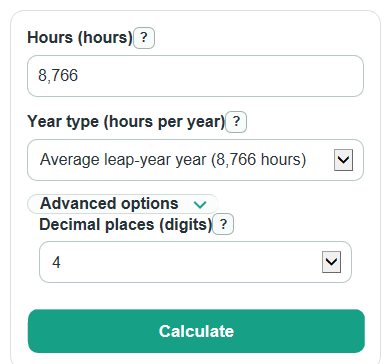
- Enter the total in Hours; commas are fine, so 10,000 works the same as 10000.
- Choose Year type: average leap-year year for long clock time, calendar year for a 365-day year, or full-time work year for 40 hours per week.
- Open Advanced options only if you want to change Decimal places in the main Years answer.
- Select Calculate, then check Hours counted as 1 year if your answer differs from another converter.
- Use Easy breakdown, Total days, and Total weeks to sanity-check whether the decimal years feel reasonable.
Definitions
Hours: The total time you want to convert. The input accepts commas and decimals.
Year type: The choice that decides how many hours count as 1 year.
Average leap-year year: A simple 365.25-day year, equal to 8,766 hours. It is useful for long spans where leap years are averaged.
Calendar year, no leap day: A 365-day year, equal to 8,760 hours. A common year in the Gregorian calendar has 365 days [1].
Full-time work year: A work-time conversion based on 40 hours per week for 52 weeks, equal to 2,080 hours.
Decimal places: The number of digits shown after the decimal point in the main Years result.
Easy breakdown: A whole-year, leftover-day, and leftover-hour version of the same Hours value.
Hours counted as 1 year: The conversion factor used for the selected Year type.
Common mistakes and quick fixes
Mistake: Using Year type set to full-time work year when you mean real calendar time.
Fix: Choose average leap-year year or calendar year, no leap day, then recalculate Years .
Mistake: Using Year type set to calendar year when you mean work experience hours.
Fix: Choose full-time work year so Hours counted as 1 year is 2,080 hours.
Mistake: Typing words, two decimal points, or a minus sign in Hours .
Fix: Enter one nonnegative number, like 8766, 10,000, or 12.5.
Mistake: Rounding Hours before converting and then wondering why Total days is off.
Fix: Enter the most exact hour count you have, and let the converter round only the displayed results.
Mistake: Reading Easy breakdown as calendar dates for every Year type .
Fix: Treat it as a simple years, days, and hours split based on the selected year length.
Mistake: Setting Decimal places too low for small hour counts.
Fix: Use 4 or 6 decimal places so the Years result does not round down to 0.
Limitations & Key Assumptions / Boundary Conditions
- The converter does not count exact dates. A real span from one date to another can include 365 or 366 days, depending on the calendar years involved.
- The average leap-year year uses 365.25 days, which is a simple average. Gregorian calendar leap-year rules include century-year exceptions [3].
- The full-time work year is only a 40 hours per week times 52 weeks conversion. It does not include overtime, part-time schedules, paid time off, holidays, or employer rules.
- Total days always means 24-hour days, and Total weeks always means 7-day weeks. These do not change when Year type changes.
- Easy breakdown rounds leftover hours for display, so it may not reproduce the exact decimal Years value digit for digit.
- Very large hour values beyond safe JavaScript number handling are blocked instead of being converted.
Methodology
How the conversion works
The converter removes commas and spaces from Hours, checks that the value is finite and nonnegative, then picks the conversion factor from Year type. It does not round the input before doing the math.
years = hours / hours_per_year
total_days = hours / 24
total_weeks = hours / (24 * 7)
whole_years = floor(hours / hours_per_year)
remaining_hours = hours - whole_years * hours_per_year
leftover_days = floor(remaining_hours / 24)
leftover_hours = remaining_hours - leftover_days * 24
Year lengths used
Average leap-year year uses 365.25 days times 24 hours per day, so 1 year is 8,766 hours. Calendar year, no leap day uses 365 days times 24 hours per day, so 1 year is 8,760 hours. Full-time work year uses 40 hours per week times 52 weeks, so 1 work year is 2,080 hours.
Mini-example
For Hours = 10,000 and Year type = average leap-year year, the main calculation is:
years = 10000 / 8766 = 1.1407711613
With 6 decimal places, Years displays as 1.140771. The same 10,000 hours is 416.666667 total days and 59.523810 total weeks. The easy breakdown is 1 selected year, 51 days, and about 10 hours because 10,000 - 8,766 = 1,234 leftover hours.