
Compare a home equity loan with a cash-out refinance to see which choice is cheaper by your planned date.
Table of contents
How to use our Home Equity Break-Even Calculator
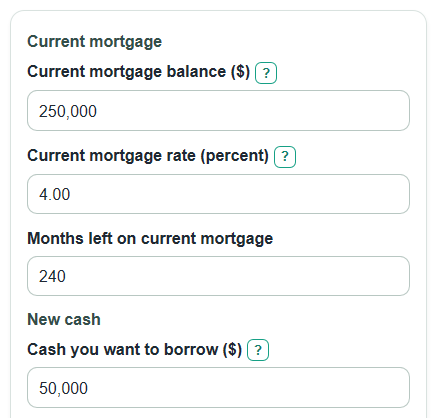
- Enter your Current mortgage balance ($), Current mortgage rate (percent), and Months left on current mortgage.
- Enter Cash you want to borrow ($) and How long you plan to keep this setup (months).
- Fill in the home equity loan and cash-out refinance rates, terms, and fees, then choose whether each set of fees is paid upfront or added to the loan.
- Select Calculate and read the Cash-out refinance break-even month first. If there is no break-even, use the planned-date advantage to compare the choices.
- Sanity-check the results by comparing Monthly payment drop with cash-out refinance against both balance outputs. A lower payment can still leave more debt later.
Definitions
Home equity loan: A separate loan that lets you borrow against your home equity, usually with the home as collateral. Upfront fees and costs can matter, so comparing more than the monthly payment is important [1].
Cash-out refinance: A new larger mortgage that pays off the current mortgage and gives you extra cash from the new loan amount.
Cash-out refinance break-even month: The first month when the cash-out refinance is cheaper after counting payments, upfront fees, and remaining loan balances.
Cash-out refinance advantage at your planned date: Home equity loan setup cost minus cash-out refinance cost at the month you entered. Positive means the refinance is cheaper. Negative means the home equity loan setup is cheaper.
Monthly payment drop with cash-out refinance: The monthly payment for the current mortgage plus the home equity loan, minus the new refinance payment.
Remaining balance: The loan amount still owed after monthly payments reduce principal. Mortgage paydown changes over time because each payment can include interest and principal [3].
Fees financed: Fees added to the loan balance instead of paid upfront. They are still counted, but they affect the loan principal and payment instead of the starting cash cost.
Common mistakes and quick fixes
Mistake: Using the original loan amount for Current mortgage balance ($).
Fix: Enter only what you still owe today in Current mortgage balance ($).
Mistake: Entering Current mortgage rate (percent), Home equity loan rate (percent), or Cash-out refinance rate (percent) as a monthly rate.
Fix: Use the annual rate percent, such as 6.5 for 6.5 percent.
Mistake: Treating Cash-out refinance term (months) as only the extra cash part of the loan.
Fix: Enter the full new mortgage term, because a cash-out refinance changes the whole mortgage.
Mistake: Leaving Home equity loan fees ($) or Cash-out refinance fees ($) out because they are paid at closing.
Fix: Include the fees, then use Add home equity loan fees to the loan? and Add refinance fees to the new mortgage? to say whether they are financed.
Mistake: Reading Monthly payment drop with cash-out refinance as the whole answer.
Fix: Also compare Home equity loan setup balance at your planned date and Cash-out refinance balance at your planned date.
Mistake: Setting How long you plan to keep this setup (months) longer than your real plan to sell or refinance again.
Fix: Use the month when you expect the decision to change, not the full loan term unless you plan to keep it that long.
Limitations & Key Assumptions / Boundary Conditions
- The calculation uses fixed-rate principal and interest payments only. It does not include taxes, insurance, HOA dues, escrow changes, mortgage insurance, or lender-specific APR details.
- It does not include home price changes, tax deductions, prepayment penalties, points, rate locks, or credit-score changes.
- The home equity option is modeled as a fixed home equity loan, not a variable-rate HELOC.
- The break-even test counts payments, upfront fees, and remaining balances. It is not a total lifetime interest comparison unless your planned month reaches the end of every loan.
- If a loan is paid off before your planned month, payments stop and that loan balance is set to $0 after payoff.
- Real lender quotes can differ because of rounding, odd first-payment dates, escrow rules, financed costs, and closing-date interest.
Methodology
Payment model
The calculator treats each loan as a fixed-rate amortizing loan with monthly payments. The annual rate percent is divided by 100 and by 12 to get the monthly rate.
payment = principal * monthly_rate / (1 - (1 + monthly_rate)^(-term_months))
if monthly_rate = 0, payment = principal / term_months
Loan balances
For each tested month, the calculator finds the remaining balance. The tested month is capped at the loan term, so a paid-off loan does not create a negative balance.
balance_m = principal * (1 + monthly_rate)^m - payment * (((1 + monthly_rate)^m - 1) / monthly_rate)
if monthly_rate = 0, balance_m = max(principal - payment * m, 0)
Principals and fees
The home equity loan principal includes the new cash and any home equity loan fees that are added to the loan.
home_equity_principal = cash_needed + financed_home_equity_fees
The cash-out refinance principal includes the current mortgage balance, the new cash, and any refinance fees that are added to the new mortgage.
refi_principal = current_mortgage_balance + cash_needed + financed_refi_fees
Fees are counted either upfront or inside the loan principal, not both.
Cost comparison
At each month, the home equity setup cost adds upfront home equity fees, monthly payments on the current mortgage and home equity loan, and both remaining balances.
home_equity_cost_m = home_equity_upfront + (current_payment + home_equity_payment) * paid_months + current_balance_m + home_equity_balance_m
The refinance cost adds upfront refinance fees, refinance payments, and the remaining refinance balance.
refi_cost_m = refi_upfront + refi_payment * paid_months + refi_balance_m
The refinance advantage is the home equity setup cost minus the refinance cost.
refi_advantage_m = home_equity_cost_m - refi_cost_m
A positive advantage means the cash-out refinance is cheaper at that month. A negative advantage means the home equity loan setup is cheaper.
Break-even search
The calculator tests whole months from month 0 through the longest loan term entered. The break-even month is the first month where the refinance advantage is zero or positive.
break_even_month = first month where refi_advantage_m >= 0
If no tested month qualifies, the calculator reports no break-even instead of making up a month.
Mini-example
Suppose the current mortgage balance is $250,000 at 8 percent with 300 months left, the cash needed is $50,000, the home equity loan is 10 percent for 180 months with $1,000 paid upfront, and the cash-out refinance is 6 percent for 360 months with $6,000 paid upfront. The home equity setup payment is about $2,466.84 per month, and the refinance payment is about $1,798.65 per month. The payment drop is about $668.19 per month. After counting fees, payments, and remaining balances, the refinance first catches up around month 9. At 60 months, the refinance advantage is about $27,271.58, so the refinance is cheaper by that amount in this example.