
Compare a fixed home equity loan with a HELOC to see payments, interest, total cost, and the possible HELOC payment jump.
Advanced options
Table of contents
How to use our Home Equity Loan vs HELOC Calculator
- Enter the Amount you plan to borrow ($), using the amount you expect to actually use.
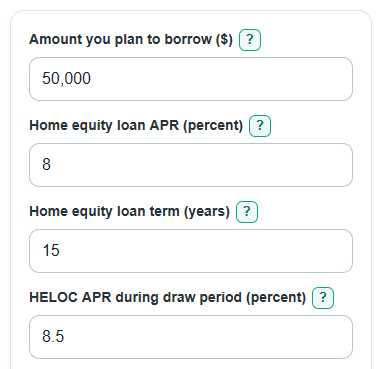
- Enter the Home equity loan annual interest rate (percent), Home equity loan term (years), and HELOC APR during draw period (percent) from your quotes or estimates.
- Open Advanced options if you want to change the HELOC draw period (years), HELOC repayment period (years), future HELOC APR, upfront costs, or annual fee.
- Select Calculate, then compare the Lower total cost option, monthly payments, total interest, and the HELOC payment jump after draw period.
- Sanity-check the result by asking if the HELOC draw payment looks low because it is interest-only, and if the repayment payment fits your budget after principal repayment starts.
Definitions
Home equity loan: A loan that lets you borrow against home equity as one lump sum. It usually has a fixed interest rate, and CFPB notes that upfront fees and costs can matter when comparing offers [1].
HELOC: A home equity line of credit. You can borrow from the line during the draw period, and interest is usually based on the amount you draw.
Home equity loan annual interest rate: Enter the contract interest rate, not a fee-inclusive closed-end APR; upfront costs are counted separately. HELOC APR inputs retain their periodic-interest-rate meaning. The entered annual rates are divided by 100 and 12 for monthly calculations.
Draw period: The HELOC phase when you can use the line of credit and may make interest-only payments.
Repayment period: The HELOC phase after the draw period when the remaining balance is paid back with principal and interest.
Interest-only payment: A payment that covers interest but does not reduce the borrowed balance.
Total interest: The total interest paid over the modeled loan or HELOC phases, before upfront costs and annual fees.
Payment jump: The HELOC repayment-period payment minus the HELOC draw-period payment. Positive means the monthly payment rises after the draw period.
Common mistakes and quick fixes
Mistake: Using the full HELOC credit limit in Amount you plan to borrow ($) when you only expect to draw part of it.
Fix: Enter the amount you expect to actually use, because this calculator estimates interest on the borrowed amount.
Mistake: Leaving "Home equity loan annual interest rate (percent)" or "HELOC APR during draw period (percent)" blank and expecting a zero rate. Fix: Enter the contract rate for the loan and periodic-rate APR for the HELOC. Enter 0 only for a genuine zero-interest offer.
Mistake: Setting HELOC draw period (years) equal to the whole HELOC length.
Fix: Put only the interest-only access phase in HELOC draw period (years) , and put the payback phase in HELOC repayment period (years) .
Mistake: Ignoring HELOC APR during repayment (percent) when you want to stress-test a possible rate change.
Fix: Leave it blank only if you want the repayment phase to use the draw-period APR; otherwise enter the later APR you want to test.
Mistake: Putting negative numbers in Home equity loan upfront costs ($) , HELOC upfront costs ($) , or HELOC annual fee ($ per year) to model a lender credit.
Fix: Enter 0 or a positive fee in those fields, and handle credits outside this calculator.
Mistake: Reading Extra cost of HELOC vs home equity loan as a mistake when it is negative.
Fix: A negative value means the HELOC is cheaper under the entered assumptions; a positive value means it costs more.
Limitations & Key Assumptions / Boundary Conditions
- The HELOC model assumes the full Amount you plan to borrow ($) is drawn at the start of the draw period.
- The HELOC draw period is modeled as interest-only, so no principal is paid down before repayment starts.
- The calculator uses one draw-period APR and one repayment-period APR. Real HELOC rates can change many times.
- Upfront costs and the HELOC annual fee are included only if you enter them. Taxes, insurance, recording fees, appraisal fees, and prepayment penalties are not separately modeled.
- The comparison estimates cost only. It does not check home value, mortgage balance, combined loan-to-value, credit score, income, or approval odds.
- Payments are monthly estimates. Actual lender payments can differ because of daily interest, billing rules, rounding, rate caps, minimum payments, or added fees.
- A lower total cost does not always mean the better choice. A fixed payment may be easier to plan for, while a HELOC may fit borrowers who need flexible draws.
Methodology
How the fixed loan payment is calculated
The home equity loan is treated as a fixed-rate loan paid back over the entered term [3]. Its contract annual interest rate is divided by 100 and 12 for monthly interest, and years are converted to months.
monthly_rate = contract_annual_interest_rate_percent / 100 / 12
months = term_years * 12
payment = principal * monthly_rate / (1 - (1 + monthly_rate)^(-months))
If the monthly rate is 0, the payment formula would divide by zero, so the calculator uses this direct payoff formula instead.
payment = principal / months
The home equity loan total interest is the total of all monthly payments minus the amount borrowed.
home_equity_loan_total_interest = home_equity_loan_monthly_payment * home_equity_loan_term_years * 12 - principal
How the HELOC phases are calculated
The HELOC draw-period payment is modeled as interest-only. That means the payment covers interest on the full borrowed amount, but the principal balance stays the same until the repayment period starts.
heloc_draw_payment = principal * heloc_draw_apr / 100 / 12
heloc_draw_interest = heloc_draw_payment * heloc_draw_period_years * 12
The HELOC repayment-period payment uses the same fixed-payment formula as the home equity loan, using the repayment APR. If HELOC APR during repayment (percent) is blank, the calculator uses HELOC APR during draw period (percent).
heloc_repayment_payment = payment_formula(principal, repayment_monthly_rate, heloc_repayment_period_years * 12)
heloc_repayment_interest = heloc_repayment_payment * heloc_repayment_period_years * 12 - principal
heloc_total_interest = heloc_draw_interest + heloc_repayment_interest
How total cost and the winner are chosen
The cost comparison adds interest and the fees entered by the user. This is important because CFPB notes that home equity loan costs can include upfront fees, so comparing only monthly payments can miss part of the cost [3].
home_equity_loan_total_cost = home_equity_loan_total_interest + home_equity_loan_upfront_costs
heloc_total_cost = heloc_total_interest + heloc_upfront_costs + heloc_annual_fee * (heloc_draw_period_years + heloc_repayment_period_years)
extra_cost_of_heloc_vs_home_equity_loan = heloc_total_cost - home_equity_loan_total_cost
If the extra cost is positive, the HELOC costs more under the entered assumptions. If it is negative, the HELOC costs less. If the difference rounds to $0, the calculator treats the estimated total cost as a tie.
The HELOC payment jump is shown separately because a low draw-period payment can be followed by a larger repayment-period payment.
heloc_payment_jump = heloc_repayment_payment - heloc_draw_payment
Mini-example
For a $50,000 home equity loan at 8 percent for 15 years, the fixed monthly payment is about $477.83 and total interest is about $36,008.69. For a HELOC at 8.5 percent with a 10-year interest-only draw period and 20-year repayment period, the draw payment is about $354.17, the repayment payment is about $433.91, and the payment jump is about $79.74. With no fees, the HELOC total interest is about $96,638.79, so the HELOC costs about $60,630.10 more in this example.
Calculation choices
All year inputs are converted using 12 months per year. Required rate fields must be valid numbers, and 0 percent interest is allowed. Negative rates, negative fees, ranges, and formulas are rejected. The calculator keeps negative values for Extra cost of HELOC vs home equity loan and HELOC payment jump after draw period because those signs are useful: negative extra cost means the HELOC is cheaper, and negative payment jump means the repayment payment is lower under the entered assumptions.
Sources
- What is the difference between a Home Equity Loan and a Home Equity Line of Credit (HELOC)? | Consumer Financial Protection Bureau - Consumerfinance
- What is a home equity line of credit (HELOC)? | Consumer Financial Protection Bureau - Consumerfinance
- What is a home equity loan? | Consumer Financial Protection Bureau - Consumerfinance