
Compare your current mortgage with a refinance offer to see monthly change, break-even timing, and savings by your planned month.
Advanced options
Table of contents
How to use our Mortgage Refinance Savings Calculator
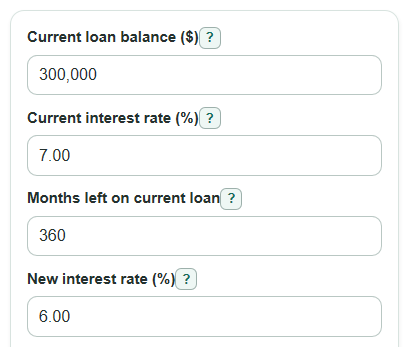
- Enter Current loan balance ($), Current interest rate (%), and Months left on current loan from your current mortgage statement.
- Enter New interest rate (%), New loan length (months), and Refinance costs counted for break-even ($) from the refinance offer or Loan Estimate.
- Open Advanced options if you want to set How long you may keep this loan (months), choose How refinance costs are paid, or add monthly PMI or mortgage fees.
- Select Calculate and read Net savings by your planned time first. A positive number means the refinance is ahead at that month; a negative number means keeping the current loan is ahead.
- Sanity-check the answer by comparing Monthly payment change after refinance with Remaining loan balance change at planned time. A lower payment can still lose money if the new loan leaves you owing much more.
Definitions
Principal and interest: The scheduled loan payment before property taxes, homeowners insurance, escrow deposits, and most optional fees.
Current loan balance ($): The unpaid principal you still owe on the current mortgage.
Refinance costs counted for break-even ($): The costs you want the refinance savings to recover, such as lender fees, points, title fees, and appraisal fees.
Break-even month including loan balance: The first month when refinancing is ahead after counting payments, refinance costs, and the remaining loan balance.
Simple payment break-even: Refinance costs divided by the monthly payment savings. It is a shortcut and does not fully count the loan balance effect.
Net savings by your planned time: The dollar difference between keeping the current loan and refinancing at the month you may sell, pay off, or refinance again.
Rolled into new loan: Refinance costs are added to the new mortgage balance instead of being paid upfront in cash.
Common mistakes and quick fixes
Mistake: Using home value in Current loan balance ($).
Fix: Enter the unpaid principal balance from your mortgage statement, not the estimated sale price of the home.
Mistake: Entering years in Months left on current loan or New loan length (months).
Fix: Convert years to months first, such as 30 years = 360 months and 15 years = 180 months.
Mistake: Leaving Refinance costs counted for break-even ($) too low by excluding points, lender fees, title fees, or appraisal fees.
Fix: Count the new costs needed to get the refinance, but be careful with prepaid taxes and escrow if you would pay them either way.
Mistake: Choosing Paid upfront for How refinance costs are paid when the costs are actually added to the new mortgage.
Fix: Choose Rolled into new loan if the refinance costs increase the new loan balance.
Mistake: Treating Simple payment break-even as the final decision number.
Fix: Use Break-even month including loan balance and Net savings by your planned time because they count the remaining loan balance effect.
Mistake: Ignoring Current monthly PMI or mortgage fees ($) and New monthly PMI or mortgage fees ($) when those costs change.
Fix: Add only monthly costs that change because of the refinance; leave taxes and insurance out if they stay about the same.
Limitations & Key Assumptions / Boundary Conditions
- The calculator estimates principal and interest from the balance, annual rate, and months entered. It does not include taxes, homeowners insurance, escrow changes, HOA dues, or servicing details unless you add changing PMI or mortgage fees.
- APR, points, lender credits, prepaid interest, escrow refunds, and tax effects are not modeled separately. Put the refinance costs you want to recover in Refinance costs counted for break-even ($).
- The result assumes fixed-rate amortization with monthly payments. It is not designed for adjustable-rate mortgages, interest-only periods, balloon payments, biweekly payment plans, or negative-amortization loans.
- If How long you may keep this loan (months) is longer than a loan term, that loan is treated as paid off after its final needed payment and its balance stays at $0.
- A positive Net savings by your planned time means the refinance is ahead using the entered numbers. It does not prove that a lender will approve the loan or that the quote is the best available offer.
- Break-even timing can change if you sell sooner, refinance again, pay extra principal, change PMI, or if actual closing costs differ from the numbers entered.
Methodology
Payment calculation
The calculator first converts each annual interest rate into a monthly rate by dividing the percent rate by 100 and then by 12.
monthly_rate = annual_rate_percent / 100 / 12
For each loan, the scheduled principal and interest payment is based on the standard fixed-payment mortgage formula. If the monthly rate is 0, the payment is the principal divided by the number of months.
monthly_payment = principal * monthly_rate / (1 - (1 + monthly_rate)^(-term_months))
if monthly_rate = 0, monthly_payment = principal / term_months
For the refinance loan, principal equals Current loan balance ($) when costs are paid upfront. If How refinance costs are paid is Rolled into new loan, principal equals Current loan balance ($) plus Refinance costs counted for break-even ($).
Month-by-month tracking
The calculator tracks each loan one month at a time. This avoids overpaying in the final month and lets the planned-time comparison use the actual remaining balances.
interest_this_month = balance_start * monthly_rate
scheduled_payment = min(monthly_payment, balance_start + interest_this_month)
principal_paid = scheduled_payment - interest_this_month
balance_end = balance_start - principal_paid
Decision comparison
Net savings compares the total cost of keeping the current mortgage with the total cost of refinancing at the planned month. It counts cash paid and the loan balance still owed. This is why it can disagree with a simple monthly payment comparison.
net_savings = (current_cash_paid + current_remaining_balance) - (new_cash_paid + new_remaining_balance + upfront_refi_costs)
Current cash paid includes current principal and interest payments plus Current monthly PMI or mortgage fees ($) for active months. New cash paid uses the refinance payment plus New monthly PMI or mortgage fees ($) for active months. Upfront refinance costs are subtracted only when How refinance costs are paid is Paid upfront.
Break-even month including loan balance is the first month where net savings is at least $0. This follows the refinance idea that the time to break even depends on both costs and expected monthly savings, especially if you may move soon [1].
break_even_month = first month m where net_savings_at_month_m >= 0
Simple payment break-even is shown as a quick check only.
monthly_payment_change = (current_monthly_pi + current_extra_monthly_cost) - (new_monthly_pi + new_extra_monthly_cost)
simple_payment_break_even_months = refi_costs / monthly_payment_change
If Monthly payment change after refinance is $0 or negative, there is no simple payment break-even because the new monthly cost is not lower.
Other outputs
Interest saved by your planned time compares interest paid through the planned month. Remaining loan balance change at planned time compares the two balances at that same month.
interest_saved = current_interest_paid_by_planned_time - new_interest_paid_by_planned_time
remaining_balance_change = current_remaining_balance - new_remaining_balance
Full-term interest saved after refinance costs assumes both loans are kept until payoff.
lifetime_interest_saved_after_costs = current_total_interest_to_payoff - new_total_interest_to_payoff - upfront_refi_costs
Mini example
Suppose the current loan balance is $300,000 at 7.00% with 360 months left. The refinance offer is 6.00% for 360 months, refinance costs are $6,000 paid upfront, and the planned time is 60 months. The current principal and interest payment is about $1,995.91 per month, and the new principal and interest payment is about $1,798.65 per month. The monthly payment change is about $197.26 lower. The simple payment break-even is about 30.42 months, but the balance-aware break-even is month 24. By month 60, net savings is about $9,067.05, so the refinance is ahead using those entries.
Sources
- A Consumer's Guide to Mortgage Refinancings - Federalreserve
- 1026.37 Content of disclosures for certain mortgage transactions (Loan Estimate). | Consumer Financial Protection Bureau - Consumerfinance
- A Consumer's Guide to Mortgage Refinancings - Federalreserve
- Consumer Financial Protection Bureau (CFPB) - Should I refinance? (handout PDF) - Consumerfinance