
Compare an extended car warranty quote with the repair help you realistically expect after deductibles, financing, and factory warranty overlap.
Table of contents
How to use our Extended Car Warranty Calculator
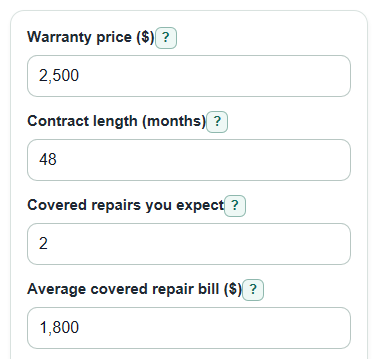
- Enter the Warranty price ($), Contract length (months), and the Covered repairs you expect during the contract.
- Enter the Average covered repair bill ($) and Deductible per repair ($) using repair costs that the contract would likely approve.
- Open Advanced options if the plan pays less than 100%, you still have a factory warranty, or the warranty price is being financed through a loan.
- Click Calculate, then read Expected savings after warranty cost first. Positive means the expected repair help is higher than the real warranty cost; negative means the warranty costs more than the repair help you entered.
- Sanity-check the result by comparing Whole repairs needed to break even with the number of major covered repairs you truly expect, and check Months of coverage that can help for factory warranty overlap.
Definitions
Extended car warranty or vehicle service contract: A paid contract that may help pay for some vehicle repairs above or after the manufacturer warranty, depending on the contract terms [2].
Warranty price ($): The cash price of the contract before any loan interest is added.
Covered repairs you expect: Your estimate of how many approved repair claims the contract will pay during the contract length.
Average covered repair bill ($): The typical approved repair bill before the contract pays and before your deductible is subtracted.
Deductible per repair ($): The amount you pay out of pocket for each approved repair claim or visit.
Contract pays (percent of covered bill): The percent of the covered repair bill the contract pays before the deductible is subtracted.
Factory warranty left (months): The months of manufacturer warranty still remaining on the vehicle.
Real warranty cost with financing: The warranty price plus estimated loan interest when the warranty cost is rolled into a loan.
Months of coverage that can help: The contract months left after subtracting factory warranty overlap when the service contract starts today.
Expected savings after warranty cost: Expected repair help from the contract minus the real warranty cost. Negative means the warranty costs more than the repair help you entered.
Repairs needed to break even: The number of average covered repairs needed for the contract's expected payouts to equal its real cost.
Common mistakes and quick fixes
Mistake: Putting the monthly payment in Warranty price ($) instead of the full contract price.
Fix: Enter the total warranty price before interest, then use Loan APR for warranty (percent) and Loan length for warranty (months) if it is financed.
Mistake: Counting every possible repair in Covered repairs you expect , including repairs the contract excludes.
Fix: Count only repairs you think the contract would approve during the contract period.
Mistake: Using the whole shop bill in Average covered repair bill ($) when the plan has caps or partial coverage.
Fix: Keep the bill amount as the repair bill, but lower Contract pays (percent of covered bill) to match the plan's cap or allowed amount.
Mistake: Leaving Factory warranty left (months) at 0 when the car still has manufacturer coverage and the service contract starts now.
Fix: Enter the remaining factory warranty months and set When does this contract start? to the contract's actual start timing.
Mistake: Entering a one-time deductible total in Deductible per repair ($) when the contract charges a deductible for each claim or visit.
Fix: Enter the deductible charged for one approved repair, then let the calculator multiply it through the expected repair count.
Mistake: Treating Expected savings after warranty cost as a guarantee.
Fix: Use it as a planning estimate, then check the contract's covered parts, exclusions, claim rules, and cancellation terms before buying.
Limitations & Key Assumptions / Boundary Conditions
- The result depends on your repair estimate. The calculator does not predict whether your car will break down.
- It assumes the repairs entered are covered and approved. Real contracts can exclude parts, deny claims, cap labor rates, require maintenance records, or use specific repair shops.
- Factory warranty overlap is measured in months only. Mileage limits, in-service dates, and separate powertrain or emissions warranties can change real coverage.
- Financing math applies only to the warranty price you enter. It does not include taxes, dealer fees, cancellation refunds, or changes to the rest of the car loan.
- The calculator floors per-repair contract help at $0 because a claim cannot pay a negative amount, but it does not floor Expected savings after warranty cost.
- If Months of coverage that can help is 0, cost per useful month is not available because there are no non-overlap months to divide by.
- Break-even repair counts use the average repair bill you enter. One very expensive repair or several small repairs can make the real result different.
Methodology
How the calculator estimates repair help
The calculator uses an expected-value style estimate: it multiplies the number of covered repairs you expect by the average help from one approved repair. Expected value is a long-term average idea, not a promise that one car will have that exact result [3].
per_repair_help = max(avg_repair_bill * coverage_percent / 100 - deductible_per_repair, 0)
expected_repair_help = expected_repairs * per_repair_help
The floor at 0 is used only for one repair claim because the contract cannot pay less than nothing on a claim.
How financing is included
If the warranty is financed with annual percentage rate (APR) above 0 and loan months above 0, the calculator uses fixed-payment loan math for the warranty price only.
monthly_rate = finance_apr / 100 / 12
monthly_finance_payment = warranty_price * monthly_rate / (1 - (1 + monthly_rate)^(-finance_months))
total_warranty_cost = monthly_finance_payment * finance_months
If loan months is 0, the added monthly loan payment is $0 and total warranty cost equals the warranty price. If APR is 0 and loan months is above 0, the monthly payment is the warranty price divided by loan months, and total warranty cost still equals the warranty price.
How savings and break-even repairs are calculated
The main answer keeps the sign of the result. Positive means the expected repair help is larger than the real warranty cost. Negative means the warranty costs more than the repair help you entered.
net_expected_value = expected_repair_help - total_warranty_cost
break_even_repairs_exact = total_warranty_cost / per_repair_help
break_even_repairs_whole = ceil(break_even_repairs_exact)
If per-repair help is 0, break-even repairs is shown as not available instead of dividing by zero.
How factory warranty overlap is handled
Service contracts may pay for some repairs above or after the manufacturer warranty, so overlap matters when the contract starts right away [1].
if contract_start = buy_now: useful_coverage_months = max(contract_months - factory_months_left, 0)
if contract_start = after_factory: useful_coverage_months = contract_months
cost_per_useful_month = total_warranty_cost / useful_coverage_months
If useful coverage months is 0, cost per useful month is shown as not available.
Mini-example
Suppose the warranty price is $2,500, the contract lasts 48 months, you expect 2 covered repairs, the average covered repair bill is $1,800, the deductible is $100, coverage is 100%, there is no factory warranty left, and there is no financing. One repair helps by max($1,800 * 100 / 100 - $100, $0), or $1,700. Expected repair help is 2 * $1,700, or $3,400. Total warranty cost is $2,500, so expected savings after warranty cost is $3,400 - $2,500, or $900. Break-even repairs is $2,500 / $1,700, or about 1.47 repairs, so the whole-repair break-even is 2 repairs.
Calculation choices
Money inputs are parsed after removing commas and spaces. Percent inputs use 100 as the percent base. APR is divided by 12 to estimate a monthly loan rate. The calculator uses the contract length and factory warranty months exactly as entered, without guessing mileage limits or contract exclusions.