
Enter your plated area, bath settings, and material data to calculate plating time, average thickness, rectifier current, and deposited metal mass.
Load
Bath settings
Deposited metal
Advanced options
Plated-area assistant
Result display
Table of contents
How to use our Electroplating Thickness, Area, Current and Time Calculator
- Choose whether you need Time for a target thickness or Average thickness from run time, then choose the units used by your drawing and process sheet.
- Enter Total plated area for every exposed surface on every part in the load. Use the simple-shape area assistant only for a supported plate or round rod.
- Enter either Target average thickness or Plating run time, depending on the calculation you chose.
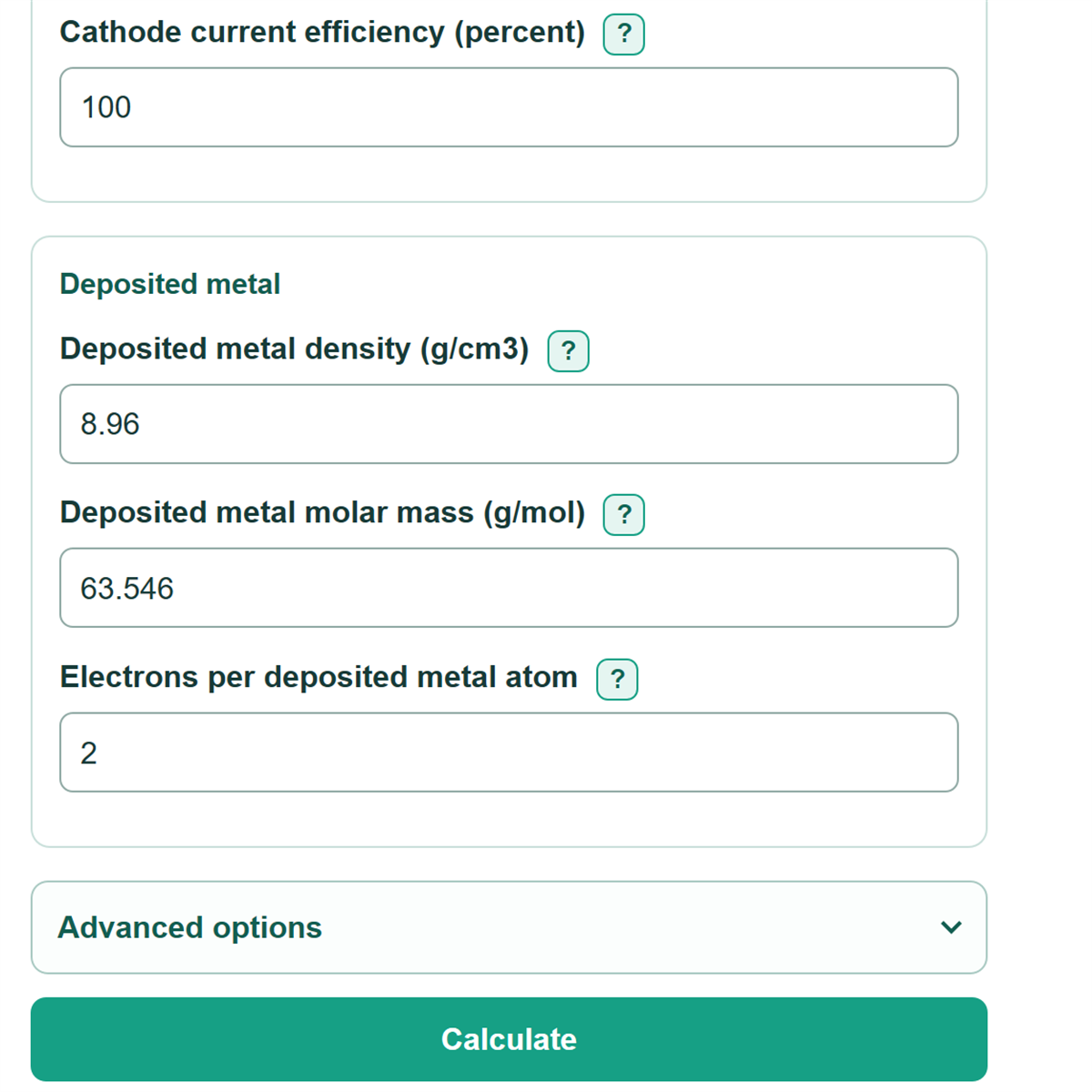
- Copy Cathode current density and Cathode current efficiency from the approved bath process data, then enter the deposited metal properties and electron count for that chemistry.
- Click Calculate. Check that Required rectifier current matches the planned load and that Total plated area used includes all parts and plated faces before using the time estimate.
Definitions
Cathode current density: Electrical current applied per unit of plated cathode area. It is entered as A/ft2 in US mode or A/dm2 in metric mode.
Cathode current efficiency: The percent of electrical charge that deposits the intended metal. The rest may drive other reactions.
Average thickness: Coating volume divided by the total entered plated area. It is not the thinnest point on a real part.
Mil: One thousandth of an inch. One mil equals 25.4 microns.
Molar mass: The mass of one mole of the deposited metal, entered in g/mol.
Electrons per deposited metal atom: The number of electrons required by the deposition reaction, also called valence.
Faraday constant: 96,485.33212 coulombs per mole, used to connect electrical charge with chemical amount in Faraday's law. [1]
Amp-hour (Ah): A unit of electrical charge equal to one amp flowing for one hour.
Common mistakes and quick fixes
Mistake: Entering total rectifier amps in Cathode current density.
Fix: Enter the bath-approved current per area, in A/ft2 or A/dm2. The calculator finds Required rectifier current from current density and area.
Mistake: Counting only one visible face in Total plated area.
Fix: Include every exposed plated face and every part in the load, or use Use the simple-shape area assistant for a supported simple load.
Mistake: Mixing mil values with metric settings or micron values with US settings for Target average thickness.
Fix: Check the unit selector first. US mode uses mil, while metric mode uses microns.
Mistake: Treating Cathode current efficiency as 100 percent without checking the actual bath data.
Fix: Enter the qualified efficiency for the bath and operating conditions. A lower efficiency increases calculated plating time.
Mistake: Using bulk material data that does not match the deposited coating in Deposited metal density, Deposited metal molar mass, or Electrons per deposited metal atom.
Fix: Use values approved for the deposited metal or alloy and the actual deposition reaction.
Limitations & Key Assumptions / Boundary Conditions
- The results are theoretical average-plating estimates based on Faraday's law and the values entered.
- Actual local thickness can differ at edges, corners, holes, recesses, shielded areas, and rack-contact areas because current distribution is not modeled.
- The calculation does not model throwing power, bath chemistry changes, agitation, temperature, anode condition, voltage, part orientation, or startup and shutdown effects.
- Use a current density and cathode efficiency qualified for the actual bath, metal, temperature, and operating range.
- The simple-shape area assistant applies only to the selected rectangular plate or round rod surfaces. Use CAD or documented surface area for complex, masked, threaded, hollow, or mixed-part loads.
- Zero target thickness or zero run time correctly gives zero deposited mass and charge, but required rectifier current remains based on the entered area and current density.
Methodology
Calculation method
The calculator uses Faraday's law to relate electrical charge to deposited metal mass. Required current comes from cathode current density multiplied by the plated area. [1]
required_current_a = current_density_a_cm2 * area_cm2
For a target thickness, coating volume is plated area times thickness. Multiplying that volume by deposited metal density gives the target metal mass.
deposited_mass_g = area_cm2 * target_thickness_cm * density_g_cm3
The target-time calculation uses the entered reaction electron count, molar mass, cathode efficiency, and Faraday constant of 96,485.33212 C/mol.
process_time_min = target_thickness_cm * density_g_cm3 * valence * faraday_constant / (current_density_a_cm2 * molar_mass_g_mol * efficiency_fraction * 60)
For a known current-on time, charge is current times seconds. The deposited mass is then converted to coating volume and divided by plated area to find average thickness.
charge_coulombs = required_current_a * run_time_min * 60
average_thickness_um = deposited_mass_g / (density_g_cm3 * area_cm2) / 0.0001
Area calculation
Direct area entry converts ft2 to cm2 by multiplying by 929.0304, or dm2 to cm2 by multiplying by 100. The area assistant uses outside surface area only: a plate can include two main faces or all six faces, while a rod can include its curved side alone or its curved side plus two flat ends.
Worked example
With 2 ft2 of plated area, 20 A/ft2 current density, a 1 mil target, 100 percent efficiency, density of 8.96 g/cm3, molar mass of 63.546 g/mol, and electron count of 2, required current is 40 A. The calculated theoretical time is about 53.5 minutes, deposited metal mass is about 42.29 g, and plating charge is about 35.67 Ah.