
Use this current divider calculator to split a total current across 2 to 10 parallel resistors and check voltage, power, and tolerance ranges.
Table of contents
How to use our Current Divider Calculator
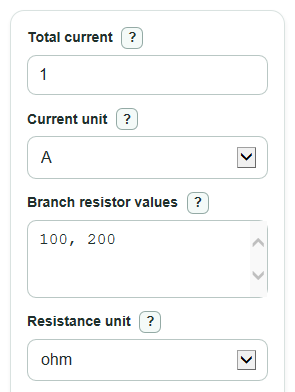
- Enter the Total current that flows into the whole parallel resistor group, then choose the Current unit.
- Enter 2 to 10 numbers in Branch resistor values, then choose the Resistance unit used by every value in that list.
- Open Advanced options only if you want to add Resistor tolerance or a Power limit per resistor for real-part checks.
- Click Calculate and read Branch results first, then check Equivalent parallel resistance, Voltage across every branch, and Current check.
- Sanity-check the answer: lower resistance should get more current, Equivalent parallel resistance should be below the smallest branch resistor, and Current check should match Total current except for rounding.
Definitions
Total current: The current entering the full parallel resistor group before it splits into branches.
Branch resistor values: The resistance values for the parallel paths. Each value must be greater than 0.
Current unit: The unit used for Total current and the branch current results: A, mA, or uA.
Resistance unit: The unit used for every number in Branch resistor values: ohm, kohm, or Mohm.
Equivalent parallel resistance: One resistor value that would draw the same Total current at the same voltage as the whole parallel group.
Voltage across every branch: The shared voltage across all parallel branches.
Resistor tolerance: The allowed percent change from the marked resistor value, such as 5 percent for a typical 5 percent part.
Power limit per resistor: The maximum power rating you want each resistor to stay under, in watts.
Common mistakes and quick fixes
Mistake: Entering the current through one resistor as Total current.
Fix: Use the current entering the whole parallel group for Total current.
Mistake: Typing 1,000 in Branch resistor values to mean one thousand ohms.
Fix: Do not use comma thousands separators in Branch resistor values; enter 1000, or choose Resistance unit as kohm and enter 1.
Mistake: Leaving Current unit or Resistance unit set to the wrong unit.
Fix: Match Current unit to Total current and Resistance unit to every number in Branch resistor values before calculating.
Mistake: Entering 0.05 for Resistor tolerance when you mean a 5 percent resistor.
Fix: Enter 5 for Resistor tolerance if the part is marked 5 percent.
Mistake: Ignoring Power limit per resistor when using small resistors.
Fix: Enter the resistor rating in Power limit per resistor and read Power warning before building the circuit.
Mistake: Comparing rounded Branch results by hand and thinking Current check is wrong.
Fix: Use Current check for the full-precision total; tiny differences are usually just display rounding.
Limitations & Key Assumptions / Boundary Conditions
- This calculator models an ideal resistor-only parallel network with one shared voltage across all branches.
- It does not include wire resistance, source resistance, switch resistance, temperature change, or resistor heating changes.
- Branch resistor values must contain 2 to 10 positive values. A 0 ohm short circuit is rejected instead of modeled.
- Negative Total current is allowed. It means the current direction is opposite your chosen positive direction, not that power is negative.
- Resistor tolerance ranges are worst-case ranges, not statistical averages or a guarantee that real parts will land at the worst case.
- Power limit per resistor uses one limit for all branches and does not apply manufacturer derating curves for heat, airflow, or package size.
Methodology
How the calculation works
The calculator converts Total current to amps and each value in Branch resistor values to ohms. It then uses conductance, which is 1 divided by resistance, so lower resistance gets a larger share of current in a parallel network [1].
I_A = input_current * current_unit_factor
R_i_ohm = input_R_i * resistance_unit_factor
G_i = 1 / R_i
G_total = sum(1 / R_i)
R_eq = 1 / G_total
I_i = I_total * (1 / R_i) / G_total
For exactly two branches, the same rule can be written as the common shortcut:
I_1 = I_total * R_2 / (R_1 + R_2)
I_2 = I_total * R_1 / (R_1 + R_2)
The calculator still uses the conductance formula for every case so it works for 2 to 10 branches.
Voltage, share, and power
After finding Equivalent parallel resistance, the shared voltage comes from Ohm's law. Branch power uses the squared branch current times that branch resistance, so power stays nonnegative even when Total current is negative.
V_parallel = I_total * R_eq
P_i = I_i * I_i * R_i
share_i_percent = I_i / I_total * 100
If Total current is 0, every current, voltage, power, and percent share is shown as 0 to avoid division by zero. Current check adds the branch currents and compares that sum with Total current, which is Kirchhoff's current law for a junction [1].
current_check = sum(I_i)
Tolerance and power checks
If Resistor tolerance is entered, each branch gets a conservative low-to-high current range. For branch i, its lowest current happens when that branch resistance is high and the other branch resistances are low. Its highest current happens when that branch resistance is low and the other branch resistances are high.
R_low = R * (1 - tolerance_percent * 0.01)
R_high = R * (1 + tolerance_percent * 0.01)
I_i_min_abs = abs(I_total) * (1 / R_i_high) / ((1 / R_i_high) + sum_j_not_i(1 / R_j_low))
I_i_max_abs = abs(I_total) * (1 / R_i_low) / ((1 / R_i_low) + sum_j_not_i(1 / R_j_high))
The original current sign is applied when the tolerance range is displayed. If Power limit per resistor is entered without tolerance, the calculator compares nominal branch power to that limit. If tolerance is also entered, it checks every low/high resistor corner and keeps the largest power found for each branch.
worst_case_power_i = largest P_i found across all low/high resistor corners
Mini example
For Total current = 1 A, Branch resistor values = 100, 200, and Resistance unit = ohm, the conductances are 0.01 S and 0.005 S, so total conductance is 0.015 S. Equivalent parallel resistance is 66.6667 ohm, Voltage across every branch is 66.6667 V, branch 1 current is 0.6667 A, branch 2 current is 0.3333 A, and Current check is 1 A.