
Enter your bath analysis, approved target, working volume, supplier factor, and price to calculate the replenisher mass and chemical cost.
Table of contents
How to use our Electroplating Bath Replenishment Cost Calculator
- Copy Actual concentration from the latest bath-analysis result and enter the approved Target concentration in the same g/L basis.
- Choose What the concentrations measure so both values refer to the same component, such as metal ion or a salt.
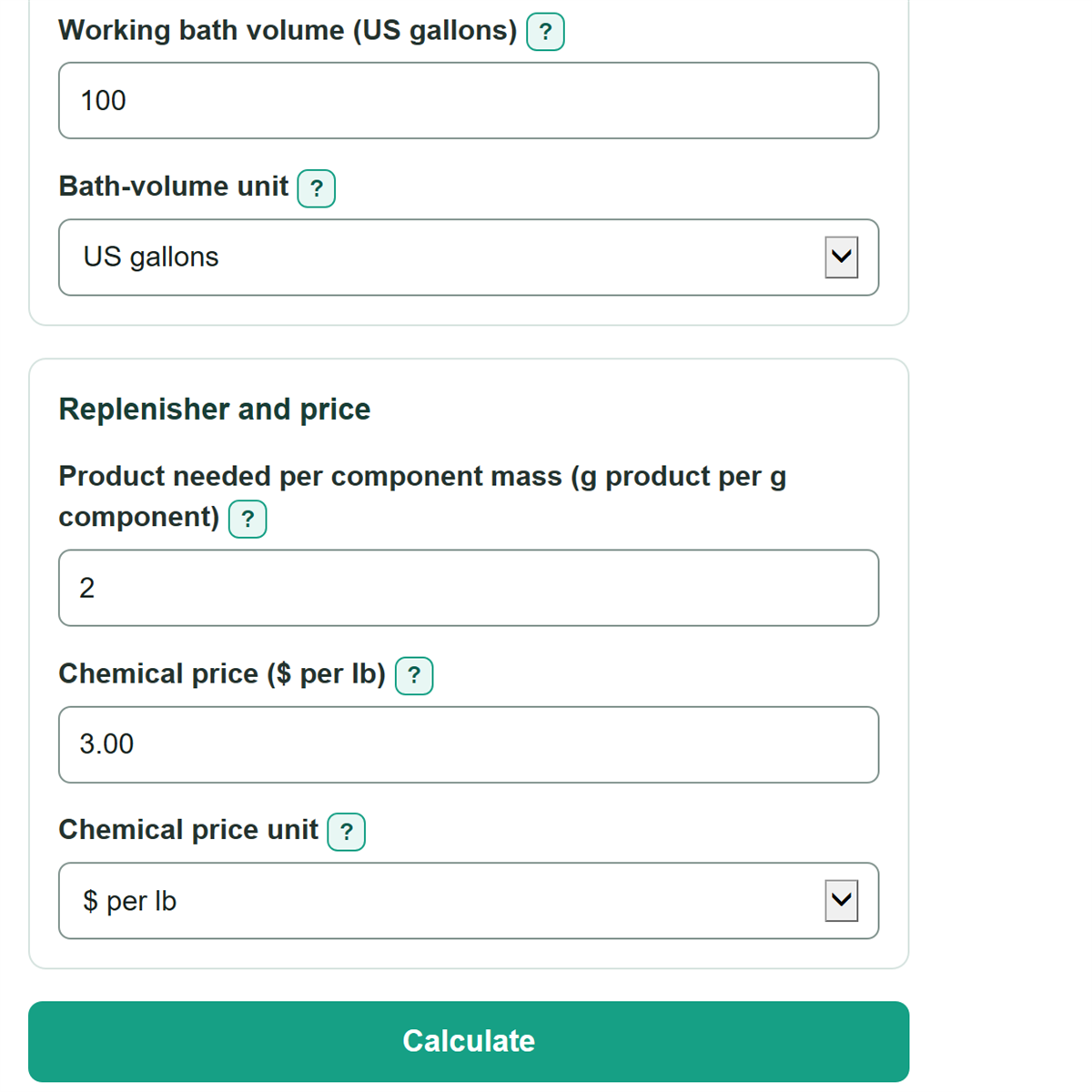
- Enter the current Working bath volume and select the matching Bath-volume unit from the tank record.
- Enter the supplier-approved Product needed per component mass, then enter Chemical price and its invoice unit.
- Select Calculate and check that the displayed Concentration shortfall matches the difference between your target and analysis before following the approved addition procedure.
Definitions
Actual concentration: The measured amount of the chosen component currently dissolved in the bath, in grams per liter (g/L).
Target concentration: The approved concentration the bath is intended to reach, in the same g/L component basis as the actual result.
Component basis: The chemical thing reported by both concentration values, such as a metal ion or a particular salt.
Working bath volume: The current amount of solution in use, not the tank's maximum capacity.
Product needed per component mass: A supplier factor that states how many grams of the selected product are needed for each gram of the measured component deficit.
Concentration shortfall: Target concentration minus actual concentration. A value of 0 g/L means this concentration-based calculation calls for no addition.
Metal-salt replenisher: The specific commercial product or metal salt whose mass is calculated from the supplier factor.
Common mistakes and quick fixes
Mistake: Entering Actual concentration as metal ion and Target concentration as a salt value.
Fix: Set What the concentrations measure to the shared basis used by both the analysis report and approved procedure.
Mistake: Using maximum tank capacity for Working bath volume.
Fix: Enter the current working solution volume from the tank record, level measurement, or verified fill record.
Mistake: Selecting liters while entering a gallon value for Working bath volume.
Fix: Match Bath-volume unit to the unit written in the tank record; the calculator converts US gallons to liters.
Mistake: Treating Product needed per component mass as a product active percentage.
Fix: Enter the direct supplier factor in g product per g component for the exact replenisher and concentration basis.
Mistake: Entering a Chemical price quoted per kg while Chemical price unit is set to $ per lb.
Fix: Select the same purchase unit printed beside the price on the invoice or quote.
Mistake: Using amp-hours or estimated deposited metal as Actual concentration.
Fix: Use a bath-analysis, titration, or laboratory concentration result; theoretical consumption is not a measured bath concentration.
Limitations & Key Assumptions / Boundary Conditions
- This calculation applies only to the selected replenisher and the entered direct supplier factor. Do not substitute a factor from a different bath, product, hydration state, or concentration basis.
- It requires actual and target concentrations in the same g/L component basis. It cannot convert a metal-ion analysis into a salt concentration without a supported chemical conversion.
- If Actual concentration is above Target concentration, the calculator stops instead of recommending a negative addition. Review the bath condition and approved procedure.
- The result is a mass-based chemical addition only. It excludes electricity, labor, shipping, waste treatment, fixed charges, evaporation effects, drag-out effects, and overhead.
- Use the current working solution volume. Changes in bath level, additions of water, or unrecorded solution loss can change the required mass.
- Follow the approved addition limit, mixing order, agitation, temperature, safety requirements, and retest procedure for the exact bath. This arithmetic result is not a universal dosing instruction.
Methodology
Calculation steps
The calculator first converts Working bath volume to liters when US gallons are selected. One US gallon is 3.785411784 liters.
bath_volume_liters = bath_volume * 3.785411784
concentration_shortfall = target_concentration - actual_concentration
The target must be at least the actual concentration. A zero shortfall is valid and produces a zero addition.
component_mass_needed_kg = concentration_shortfall * bath_volume_liters / 1000
The concentration shortfall in g/L multiplied by liters gives grams of the measured component. Dividing by 1000 changes grams to kilograms.
replenisher_mass_kg = component_mass_needed_kg * product_per_component
The direct g product per g component factor has the same numeric value when applied to kilograms. For a price quoted per pound, kilograms are converted using 2.2046226218487757 lb per kg.
replenisher_amount_purchase_unit = replenisher_mass_kg * 2.2046226218487757
chemical_cost = replenisher_amount_purchase_unit * chemical_price
Worked example
Suppose actual concentration is 40 g/L, target concentration is 50 g/L, working volume is 100 L, the supplier factor is 2 g/g, and price is $5 per kg. The shortfall is 10 g/L. The bath needs 1 kg of the measured component, then 2 kg of replenisher. The chemical cost is $10.00.
The calculation uses an analysis-based concentration shortfall. It does not use amp-hours or deposited-metal estimates as a replacement for a measured concentration result.