
Estimate yearly bill savings, simple payback, and heat-flow reduction from a duct insulation upgrade.
Table of contents
How to use our Duct Insulation Savings Calculator
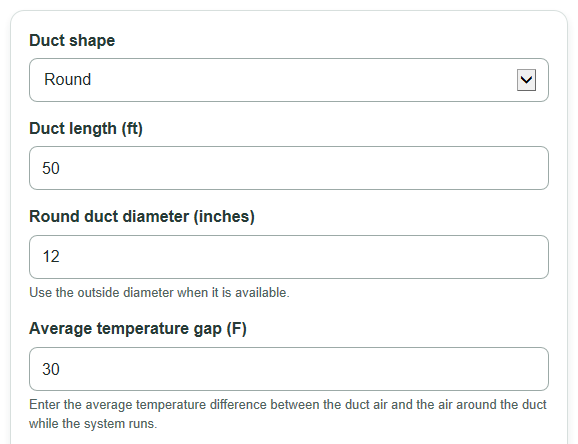
- Choose Duct shape, then enter the matching duct size fields and Duct length.
- Enter Average temperature gap, System run time, Current duct R-value, and New duct R-value for the duct section being upgraded.
- Choose Energy used by the system, then enter either Furnace efficiency and Gas price or Electric system COP and Electricity price.
- Enter Installed insulation cost, then select Calculate to see Estimated yearly energy bill change and Simple payback time.
- Sanity-check the Duct surface area used and Duct heat flow cut while running; a wrong duct size, runtime, or temperature gap can make the dollar result look too high or too low.
Definitions
R-value: How well insulation slows heat flow. A higher R-value means less heat moves through the duct surface for the same temperature gap.
Average temperature gap: The average absolute temperature difference in degrees F between the air inside the duct and the air around the duct while the system runs.
System run time: The number of hours per year the duct carries heated or cooled air.
COP: Coefficient of performance. It means heat moved per unit of electricity used by an electric heat pump or AC system.
Therm: A gas energy unit equal to 100,000 Btu.
Btu/hr: British thermal units per hour. In this calculator, it describes the rate of heat moving through the duct surface while the system is running.
Simple payback time: Installed insulation cost divided by estimated yearly bill savings, shown in years when savings are positive.
Common mistakes and quick fixes
Mistake: Using the total house duct system for Duct length when only one section will be insulated.
Fix: Enter only the Duct length for the section included in Installed insulation cost.
Mistake: Entering the added insulation layer for New duct R-value instead of the total new R-value.
Fix: Use the total New duct R-value after the upgrade, including the current duct covering if it stays in place.
Mistake: Treating Average temperature gap as the thermostat setting.
Fix: Enter the average difference between duct air and the air around the duct while the system runs.
Mistake: Leaving Energy used by the system on gas while entering electric bill numbers.
Fix: Choose Electric heat pump or AC so Electric system COP and Electricity price are used.
Mistake: Reading a negative Estimated yearly energy bill change as a calculator error.
Fix: A negative value means the New duct R-value is lower than Current duct R-value or another input makes the upgrade increase estimated energy use.
Mistake: Using Simple payback time when savings are zero or negative.
Fix: Use Simple payback time only when Estimated yearly energy bill change is positive.
Limitations & Key Assumptions / Boundary Conditions
- The estimate uses steady heat flow through the duct surface. Real ducts can have changing air temperatures, changing attic or crawlspace temperatures, and stop-start run cycles.
- The calculator does not include duct leakage, duct sealing, disconnected ducts, crushed insulation, wet insulation, solar heating, or air movement around the duct.
- R-value is treated as the total effective duct covering R-value. If the insulation is compressed, has gaps, or is installed unevenly, real savings can be lower.
- Gas results use Furnace efficiency as the only gas system efficiency input. Electric results use Electric system COP as the only electric system efficiency input.
- Simple payback time ignores maintenance changes, fuel price changes, discount rates, rebates, taxes, and the time value of money.
- If New duct R-value is lower than Current duct R-value, the calculator keeps the negative savings instead of forcing it to zero.
Methodology
Calculation method
The calculator first estimates the outside surface area of the duct section. Round ducts use circumference times length. Rectangular ducts use perimeter times length.
surface_area_sqft = pi * (duct_diameter_in / 12) * duct_length_ft
surface_area_sqft = 2 * ((duct_width_in / 12) + (duct_height_in / 12)) * duct_length_ft
Next it estimates heat flow through the duct covering. R-value means how well insulation slows heat flow, so a higher R-value lowers the heat-flow rate.
current_heat_transfer_btu_hr = surface_area_sqft * average_temp_gap_f / current_r_value
upgraded_heat_transfer_btu_hr = surface_area_sqft * average_temp_gap_f / upgraded_r_value
heat_transfer_reduction_btu_hr = current_heat_transfer_btu_hr - upgraded_heat_transfer_btu_hr
The yearly heat load change multiplies the running heat-flow change by System run time.
annual_load_reduction_btu = heat_transfer_reduction_btu_hr * run_hours_per_year
For gas heat, the calculator converts heat-load reduction to therms at the gas meter by using Furnace efficiency and 100,000 Btu per therm.
annual_gas_saved_therms = annual_load_reduction_btu / ((gas_efficiency_percent / 100) * 100000)
annual_energy_cost_saved = annual_gas_saved_therms * gas_price_per_therm
For electric heat pump or AC, the calculator converts heat-load reduction to kWh by using Electric system COP and 3,412.142 Btu per kWh.
annual_electricity_saved_kwh = annual_load_reduction_btu / (electric_cop * 3412.142)
annual_energy_cost_saved = annual_electricity_saved_kwh * electric_price_per_kwh
Simple payback time is shown only when Estimated yearly energy bill change is greater than zero.
simple_payback_years = installed_cost / annual_energy_cost_saved
Mini example
A 50 ft round duct with a 12 inch diameter has about 157.08 sq ft of surface area. With a 30 F temperature gap, Current duct R-value of 1, and New duct R-value of 6, current heat flow is about 4,712 Btu/hr and new heat flow is about 785 Btu/hr. The Duct heat flow cut while running is about 3,927 Btu/hr. If it runs 1,200 hours per year on an 80 percent gas furnace, that saves about 58.9 therms per year. At $1.50 per therm, Estimated yearly energy bill change is about $88.36 per year. With a $600 Installed insulation cost, Simple payback time is about 6.8 years.