
Estimate one consolidation loan payment and compare it with your current debt payments, payoff time, and total cost.
Advanced options
Table of contents
How to use our Debt Consolidation Loan Payment Calculator
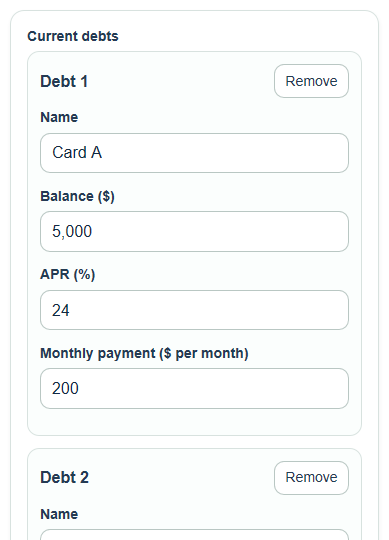
- Enter your Current debts with each balance, APR, and monthly payment you plan to keep making if you do not consolidate.
- Enter the New loan APR and New loan term from the loan offer or quote you want to test.
- Open Advanced options only if you need to add an Origination fee, choose How the fee is paid, or add an Extra payment on new loan.
- Click Calculate and read New required monthly payment first, then check Change from current monthly total, Total cost saved, and Time saved.
- Sanity-check the result: if Total cost saved is negative or Time saved is negative, the lower monthly bill may be coming from a longer payoff, not a cheaper loan.
Definitions
Debt consolidation: Combining several debts into one new loan with one monthly payment.
APR: Annual percentage rate. It is the yearly borrowing rate used for comparing credit offers.
New loan term: The number of monthly payments in the new consolidation loan if you make only the required payment.
Origination fee: A lender fee charged to make the loan. It can be paid upfront or added to the loan balance.
Current balance-weighted APR: The average APR on Current debts, weighted by how much balance is at each rate.
Total cost saved: Current plan interest minus New loan interest plus fee. A negative value means the new loan costs more overall.
Extra payment on new loan: Money paid each month above the New required monthly payment.
Common mistakes and quick fixes
Mistake: Leaving a debt out of Current debts because it has a small balance.
Fix: Include every debt the new loan will pay off, or Total cost saved and Current plan payoff time will not match the real plan.
Mistake: Typing the New loan APR as a monthly rate instead of a yearly APR.
Fix: Enter the annual percent from the offer, such as 12.5 for 12.5% APR.
Mistake: Using the minimum possible payment in Current debts when you actually pay more each month.
Fix: Enter the payment you plan to keep making so Change from current monthly total and Time saved are useful.
Mistake: Ignoring Origination fee or choosing the wrong How the fee is paid option.
Fix: Enter the fee percent and choose Paid upfront or Added to loan balance based on the lender's offer.
Mistake: Judging only New required monthly payment.
Fix: Compare Total cost saved, Time saved, and Cost saved if you keep paying that amount before deciding.
Limitations & Key Assumptions / Boundary Conditions
- The current-debt comparison assumes each payment in Current debts stays fixed until that specific debt is paid off.
- The calculator does not move payments from paid-off current debts to the remaining current debts, so a debt snowball or avalanche plan can differ.
- APR is converted to a monthly rate by dividing by 12. Real lenders may use different day-count rules, payment dates, or rounding.
- Origination fee is based on the total current balance, not on a lender-specific approved amount that may differ after underwriting.
- The results do not include late fees, balance transfer fees, prepayment penalties, taxes, insurance, or changes in spending after consolidation.
- If a current payment does not cover that debt's first month of interest, the debt is not paying down under the entered plan and the comparison cannot be trusted.
- Payoff simulations are capped at 1200 months to avoid showing unrealistic century-long payoff plans.
Methodology
How the new loan payment is found
The calculator adds the balances in Current debts. If the Origination fee is Added to loan balance, the fee is included in the borrowed principal. If the fee is Paid upfront, it is counted as cost but is not borrowed.
total_balance = sum(balance_i)
monthly_rate = New loan APR / 100 / 12
if monthly_rate = 0: New required monthly payment = principal / New loan term
if monthly_rate is not 0: New required monthly payment = principal * monthly_rate / (1 - (1 + monthly_rate)^(-New loan term))
How current debts are simulated
Each current debt is simulated month by month. Interest is added first, then the entered payment is applied. The final month can use a smaller payment so the balance does not go below zero.
monthly_interest = balance * APR / 100 / 12
payment_used = min(monthly_payment, balance + monthly_interest)
new_balance = balance + monthly_interest - payment_used
Current plan interest is the total paid on all current debts minus the starting balances. Current plan payoff time is the longest payoff time among the current debts.
Current plan interest = sum(total_paid_i - starting_balance_i)
Current plan payoff time = max(payoff_months_i)
How savings are compared
The new loan is also simulated month by month so Extra payment on new loan can shorten the payoff. New loan interest plus fee is compared with Current plan interest.
planned_new_payment = New required monthly payment + Extra payment on new loan
New loan interest = total_paid_on_new_loan - principal
New loan interest plus fee = total_paid_on_new_loan - total_balance + upfront_fee_amount
Total cost saved = Current plan interest - New loan interest plus fee
Change from current monthly total = New required monthly payment - current_monthly_total
Time saved = Current plan payoff time - new_loan_payoff_months
If the current monthly total is higher than the planned new loan payment, the calculator runs one more payoff simulation using the current monthly total as the new loan payment. That creates If you keep paying your current monthly total and Cost saved if you keep paying that amount.
Mini example
With the default debts, the current balances total $10,000 and the Current balance-weighted APR is 19.8%. A 36-month loan at 12% APR with no fee has a New required monthly payment of about $332.14. The current payments total $420 per month, so Change from current monthly total is about -$87.86. The current plan interest is about $3,031.64, and the new loan cost is about $1,957.15, so Total cost saved is about $1,074.49. If the borrower keeps paying $420 per month, the new loan is paid off in about 28 months and the cost saved rises to about $1,552.95.