
Calculate estimated original-sample CFU/mL from colony counts, plated volumes, and either a known dilution or your recorded serial dilution steps.
Advanced options
The 30 to 300 colony guide is an editable 2016 US teaching example. Replace it with the limits in your course or validated laboratory method.
Table of contents
How to use our CFU per mL and Serial Dilution Plate Count Calculator
- Choose how you know the dilution: select "Use a known dilution" if the plated tube's cumulative dilution is already recorded, or "Build dilution steps" to enter each transfer.
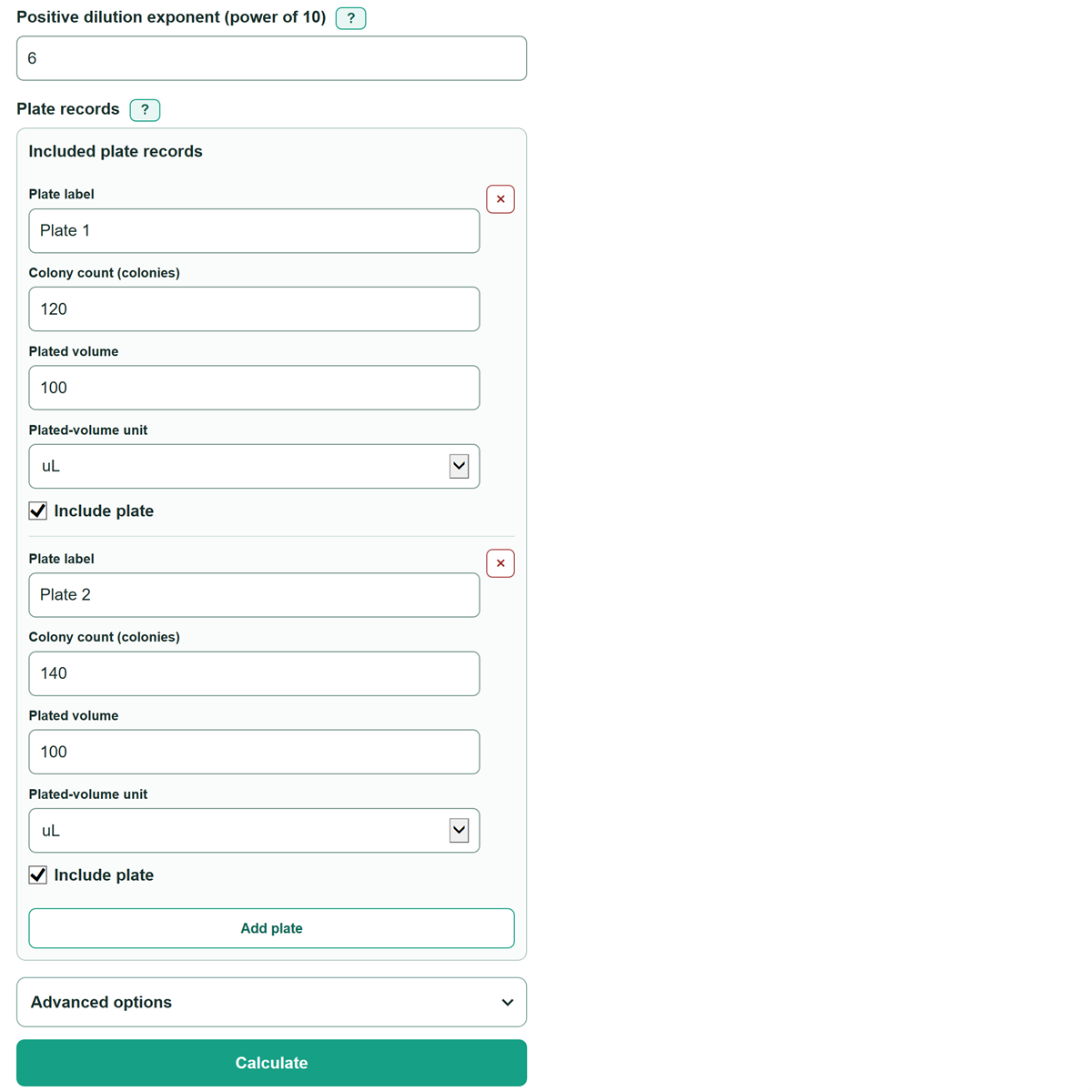
- For known dilution, enter the positive number after the minus sign in "Positive dilution exponent"; enter 6 for 10^-6.
- Add each relevant row under "Plate records" or "Plates from the dilution series," including colonies, plated volume, its unit, and the correct source tube when needed.
- Leave included only the plates from the same original sample and compatible plating conditions, then click Calculate.
- Sanity-check that the displayed "Cumulative dilution used" matches your worksheet and that 100 uL was treated as 0.1 mL, not 100 mL.
Definitions
CFU: Colony-forming unit. One visible colony is treated as one CFU for this arithmetic estimate.
CFU/mL: Estimated colony-forming units in one milliliter of the original liquid sample.
Positive dilution exponent: The positive number in a dilution written as 10 raised to a negative power. For 10^-6, the exponent is 6.
Cumulative dilution: The fraction of original sample in the tube that supplied a plate. In a series, multiply the fraction from each step.
Plated volume: The amount spread or placed on one plate. The calculator converts uL to mL before calculating.
One-colony detection level: The original-sample CFU/mL represented by one colony across all included plate exposure.
Base-10 log: A log10 CFU/mL value. An increase of 1 means a tenfold increase in estimated CFU/mL.
Common mistakes and quick fixes
Mistake: Entering 1000000 in "Positive dilution exponent" for a 10^-6 dilution.
Fix: Enter 6, the positive number after the minus sign.
Mistake: Treating a transfer of 1 mL into 9 mL diluent in "Serial dilution steps" as 1:9.
Fix: The final mixture is 10 mL, so that step is 1/10.
Mistake: Using one step's dilution instead of the full dilution for the plated tube.
Fix: Check How do you know the dilution? and then recalculate. Use "Build dilution steps" so the calculator multiplies the step fractions through the source tube.
Mistake: Entering 100 in a plated-volume field while its unit is mL.
Fix: Check How do you know the dilution? and then recalculate. Select uL for 100 uL, or enter 0.1 with mL selected.
Mistake: Including plates from different original samples in "Plate records" or "Plates from the dilution series."
Fix: Calculate each original sample separately and include only compatible replicate plates.
Mistake: Reading an estimate of zero as proof that no viable organisms were present.
Fix: Use "One-colony detection level" to describe the entered setup's detection boundary.
Limitations & Key Assumptions / Boundary Conditions
- This is an arithmetic estimate based on entered colony counts, dilution records, and plated volumes. It does not validate laboratory technique or a reporting method.
- Include only plates from the same original sample and compatible plating conditions. Mixing unrelated samples makes the pooled estimate invalid.
- The calculation assumes each counted colony corresponds to one CFU in the plated material. Clumping, merged colonies, uneven spreading, selective media, incubation conditions, and counting errors can change the real result.
- The editable 30 to 300 colony guide is only a planning guide. Use the count range, rounding rule, and reporting rule in the applicable validated laboratory or course protocol.
- Zero observed colonies produces an estimate of 0 in this arithmetic model, but the practical interpretation is below the displayed "One-colony detection level," not confirmed absence.
- Very small dilution fractions or volumes can produce large estimates. Recheck the tube number, cumulative dilution, and uL versus mL selection before reporting.
Methodology
Calculation method
For a known dilution, the calculator turns the entered positive exponent into the fraction of original sample in every included plate.
d = 10-e
Here, e is the Positive dilution exponent and d is the dilution fraction. For serial steps, each tube fraction is the transferred amount divided by the transfer plus diluent amount.
dstep = transfer / (transfer + diluent)
The calculator multiplies step fractions from the first tube through the source tube named for each included plate.
dtube = Π dstep
Each plated volume is converted to mL, using 1 mL = 1000 uL. It then adds the original-sample exposure represented by every included plate.
effective exposure (mL) = Σ(plate dilution fraction x plated volume in mL)
The estimated concentration is the combined colony count divided by that exposure.
estimated CFU/mL = total included colonies / effective exposure (mL)
The one-colony detection level uses the same exposure.
one-colony detection level = 1 / effective exposure (mL)
Worked mini-example
Two included plates each receive 100 uL, or 0.1 mL, from a 10^-6 dilution. If they have 120 and 140 colonies, the total is 260 colonies and effective exposure is 10^-6 x (0.1 + 0.1) = 0.0000002 mL. The estimate is 260 / 0.0000002 = 1,300,000,000 CFU/mL. The average is 130 colonies per included plate.
The calculator also divides total colonies by included plates for "Average colonies per included plate," calculates log10 only when the estimate is above zero, and counts plates within the selected guide only when both guide limits are filled in.