
Enter hemocytometer cell counts to calculate viable cells per mL, total concentration, viability, and optional per-square count spread.
Advanced options
Experiment planning
Table of contents
How to use our Hemocytometer Cell Count, Concentration and Viability Calculator
- Choose "Use total counts" if you added counts from all squares, or choose "Per-square check" if you recorded viable and dead cells for each large square.
- Enter viable and dead counts from the same large squares, then enter the number of large squares when using total counts.
- Enter the Dilution factor from your preparation record. For a 1:1 mixture of cell suspension and Trypan Blue, enter 2.
- Open Advanced options only if you need to change the Chamber factor, calculate viable cells in the full suspension, or find the volume needed for a target.
- Check that the viable and total concentrations match your counts and dilution. In Per-square check mode, review Between-square spread and the Count consistency note before planning an experiment.
Definitions
Viable cells: Cells counted as unstained in the selected staining method.
Dead cells: Cells counted as stained in the same squares used for viable cells.
Dilution factor: The multiplier that corrects the counted mixture back to the original cell suspension. A 1:1 cell suspension and dye mixture has a factor of 2.
Chamber factor: The number that converts an average count per square to cells/mL. For a standard large square with a 0.1 mm chamber depth, the default factor is 10,000 because the square volume is 0.0001 mL. [1]
Cell viability: The percentage of all counted cells that are viable.
Between-square spread: The sample coefficient of variation (CV) of total cells per square. It shows how much the square totals differ relative to their average.
Common mistakes and quick fixes
Mistake: Entering 0.5 for Dilution factor after mixing equal volumes of cells and dye.
Fix: A 1:1 mixture doubles the original sample volume, so enter 2 as the Dilution factor.
Mistake: Using Viable cells counted and Dead cells counted from different Large squares counted.
Fix: Count both categories in the same square set so Cell viability uses matching observations.
Mistake: Leaving the standard Chamber factor unchanged when counting a different chamber area or depth.
Fix: Check the instructions for the exact chamber and counted square, then enter its stated factor in Chamber factor (cells/mL per average cell per square).
Mistake: Treating Viable cell concentration as the number of viable cells in the tube.
Fix: Enter Total suspension volume (mL) to calculate Viable cells in the full suspension.
Mistake: Ignoring a high Between-square spread in Per-square check mode.
Fix: Review mixing, settling, chamber loading, bubbles, tally entry, and border-counting rules before relying on the concentration.
Mistake: Entering a target such as 1,01 in Target viable cells (cells).
Fix: Use a plain number or normal thousands commas, such as 101 or 1,000,000.
Limitations & Key Assumptions / Boundary Conditions
- The calculation is only as representative as the counted sample. Poor mixing, settling, uneven chamber loading, bubbles, or debris can change the observed count.
- Viable and dead counts must come from the same set of equal large squares and use the same border-counting rule.
- The default Chamber factor of 10,000 applies to a standard large square with a 0.1 mm chamber depth. Enter the correct factor from the chamber instructions for another counted area or depth.
- Cell viability describes the stained and unstained cells counted by the selected method. It does not measure cell growth, function, contamination, or suitability for a specific assay.
- Between-square spread is a descriptive check, not a universal pass or fail rule. Compare it with your laboratory procedure and the needs of the experiment.
- The optional Suspension volume needed for the target assumes the calculated viable concentration is uniform throughout the full suspension and does not account for pipetting loss.
Methodology
Calculation method
The calculator first adds viable and dead cells from the selected entry method. Total-count mode uses the two combined tallies. Per-square check mode adds each visible row and uses the number of complete rows as the number of counted squares.
all cells counted = viable cells counted + dead cells counted
It divides each count by the number of large squares to get an average per square. It then applies the dilution correction and chamber factor.
viable cell concentration = viable cells counted / large squares included * dilution factor * chamber factor
dead cell concentration = dead cells counted / large squares included * dilution factor * chamber factor
total cell concentration = all cells counted / large squares included * dilution factor * chamber factor
For a standard large square, the default chamber factor is 10,000 because a 1 mm by 1 mm square at 0.1 mm depth holds 0.0001 mL. [1]
Viability and per-square check
Viability uses the share of counted cells that are viable. Dilution and chamber geometry cancel out of this percentage.
cell viability = viable cells counted / all cells counted * 100
In Per-square check mode, the calculator adds viable and dead cells within each square, calculates the sample standard deviation of those square totals, divides it by their average, and shows the result as a percent CV.
between-square spread = sample standard deviation of square totals / average square total * 100
Optional planning calculations
When a total suspension volume is entered, the calculator estimates viable cells in the full suspension. When a target viable-cell count is entered, it calculates the suspension volume needed and converts mL to uL.
viable cells in the full suspension = viable cell concentration * total suspension volume
suspension volume needed for the target (uL) = target viable cells / viable cell concentration * 1000
Worked example
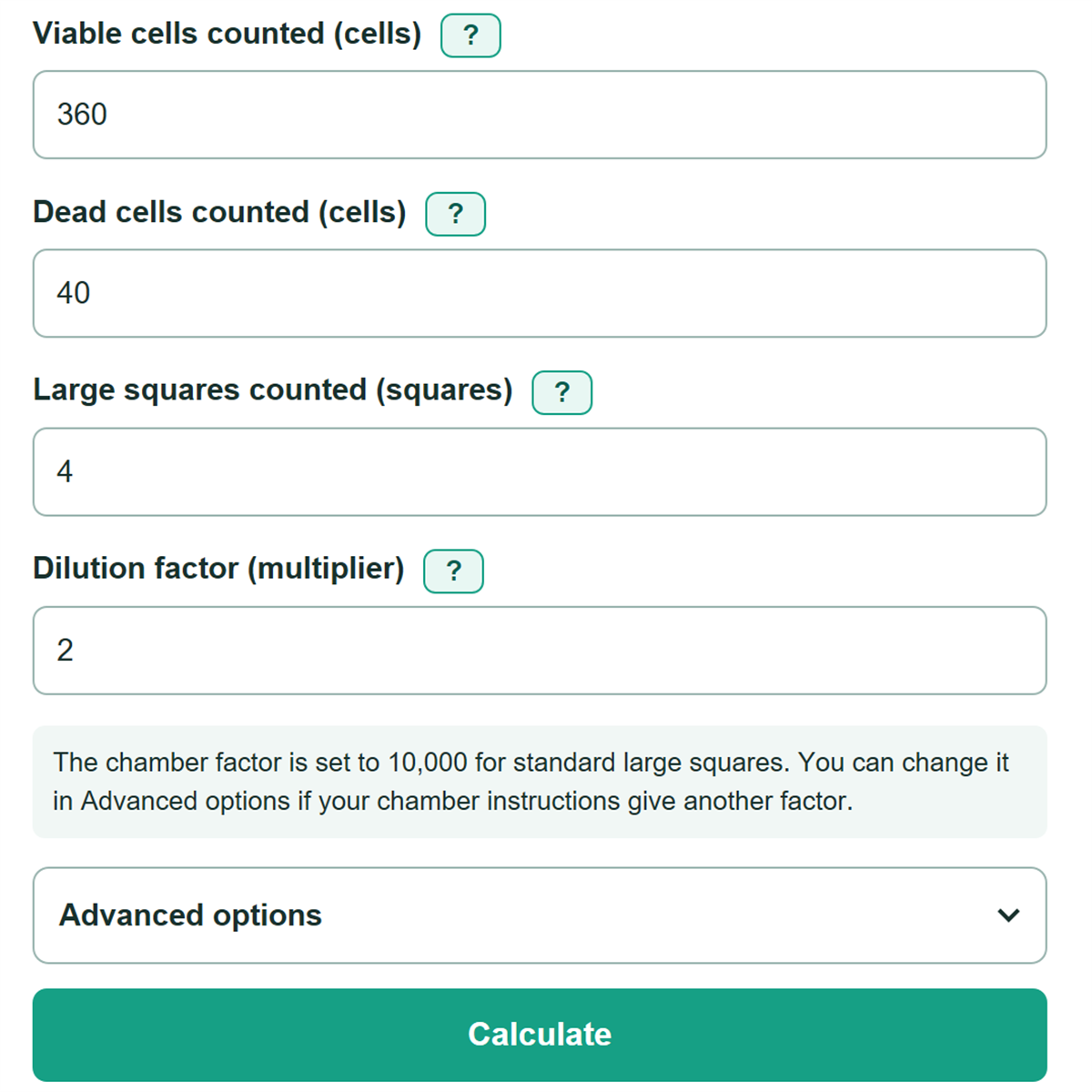
With 360 viable cells, 40 dead cells, 4 large squares, dilution factor 2, and chamber factor 10,000, the viable concentration is 360 / 4 * 2 * 10,000 = 1,800,000 cells/mL. Total concentration is 2,000,000 cells/mL, and viability is 360 / 400 * 100 = 90%.