
Estimate your new car payment when old loan debt is rolled into your next auto loan.
Advanced options
Table of contents
How to use our Car Loan Negative Equity Rollover Calculator
- Enter Current loan payoff ($), Trade-in value ($), and New car price ($) using the best numbers you have from your lender, dealer, or buyer.
- Enter APR (percent) and choose Loan term (months) to match the loan quote or the term you want to test.
- Open Advanced options if you want to add Down payment for new car ($), Rebate or discount ($), Taxes and fees financed ($), or Cash paid toward old loan gap ($).
- Select Calculate and compare Estimated new monthly payment with Payment if no old debt was rolled in to see the monthly effect of the rollover.
- Sanity-check the output: Trade equity should be negative when payoff is higher than trade value, and Old debt rolled into new loan should fall when Cash paid toward old loan gap ($) is higher.
Definitions
Current loan payoff ($): The amount needed to pay off the loan on your current car.
Trade-in value ($): The amount a dealer or buyer gives you for your current car.
Trade equity: Trade-in value minus current loan payoff. A negative number means you owe more than the car is worth.
Old debt rolled into new loan: Negative equity that remains after any Cash paid toward old loan gap ($) and is added to the next loan.
APR (percent): The yearly borrowing rate used to estimate the monthly loan payment.
Estimated amount financed: The principal used for the payment estimate after price, financed fees, trade credit, rollover, down payment, and rebate are counted.
Loan compared with new car price: Estimated amount financed divided by New car price ($), shown as a percent. Over 100% means the loan is larger than the car price.
Common mistakes and quick fixes
Mistake: Using the total of remaining payments for Current loan payoff ($).
Fix: Use the lender payoff amount for Current loan payoff ($), because it can differ from unpaid payments added together.
Mistake: Entering a hopeful private-sale number for Trade-in value ($) when the deal uses a dealer trade offer.
Fix: Use the actual amount the dealer or buyer will credit for Trade-in value ($).
Mistake: Leaving APR (percent) blank because the rate is not final.
Fix: Enter a realistic APR (percent), such as a preapproval rate, so the payment and interest math can run.
Mistake: Putting taxes and fees in New car price ($) and again in Taxes and fees financed ($).
Fix: Enter the car price in New car price ($) and only the financed taxes or fees in Taxes and fees financed ($).
Mistake: Treating Cash paid toward old loan gap ($) as a down payment for the new car.
Fix: Use Cash paid toward old loan gap ($) only for money paid to reduce negative equity, and use Down payment for new car ($) for money paid toward the new vehicle.
Mistake: Reading Extra monthly payment from old debt as the total payment.
Fix: Use Estimated new monthly payment for the full estimated payment and Extra monthly payment from old debt for only the old-debt part.
Limitations & Key Assumptions / Boundary Conditions
- This is an estimate, not a lender quote or a sales contract.
- The calculator assumes the same APR (percent) and Loan term (months) apply to the new car amount and the Old debt rolled into new loan.
- Taxes, registration, dealer fees, service contracts, warranties, and add-ons affect the result only if you include them in Taxes and fees financed ($) or New car price ($).
- Cash paid toward old loan gap ($) can reduce Old debt rolled into new loan to $0, but extra cash beyond the gap is not treated as a new-car down payment unless you enter it in Down payment for new car ($).
- Estimated amount financed is floored at $0 because a loan principal cannot be negative. If credits are larger than costs, the payment math uses $0.
- Interest estimates assume scheduled monthly payments for the full term. Early payoff, late payments, fees, or rate changes can change total interest.
- Loan compared with new car price is not available when New car price ($) is $0, because dividing by zero is not meaningful.
Methodology
How the rollover is found
Negative equity means you owe more on a vehicle than the vehicle is worth [2]. The calculator first compares Current loan payoff ($) with Trade-in value ($), then reduces any gap by Cash paid toward old loan gap ($).
trade_equity = trade_in_value - current_loan_payoff
negative_equity_before_cash = max(current_loan_payoff - trade_in_value, 0)
negative_equity_rollover = max(negative_equity_before_cash - cash_to_old_loan, 0)
positive_trade_credit = max(trade_in_value - current_loan_payoff, 0)
How the loan amount is built
The calculator adds the new car price, financed taxes and fees, and any old debt rollover. It subtracts positive trade credit, down payment, and rebate. If the result is below $0, payment math uses $0.
amount_before_floor = new_vehicle_price + taxes_fees_financed + negative_equity_rollover - positive_trade_credit - down_payment - rebate
amount_financed = max(amount_before_floor, 0)
How the payment is calculated
APR (percent) is converted to a monthly rate by dividing by 100 and then by 12. For a 0% APR, the payment is principal divided by Loan term (months). Otherwise, the standard fixed-payment loan formula is used.
monthly_rate = apr_percent / 100 / 12
if monthly_rate = 0, payment = principal / term_months
if monthly_rate is not 0, payment = principal * monthly_rate / (1 - (1 + monthly_rate)^(-term_months))
The same payment function is used for Estimated new monthly payment, Payment if no old debt was rolled in, and Extra monthly payment from old debt.
monthly_payment_without_rollover = payment(max(new_vehicle_price + taxes_fees_financed - positive_trade_credit - down_payment - rebate, 0), monthly_rate, term_months)
added_monthly_from_rollover = payment(negative_equity_rollover, monthly_rate, term_months)
interest_on_rollover = added_monthly_from_rollover * term_months - negative_equity_rollover
total_interest = estimated_monthly_payment * term_months - amount_financed
loan_to_price_percent = amount_financed / new_vehicle_price * 100
Mini-example
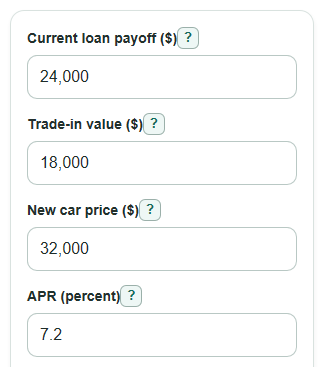
Suppose Current loan payoff ($) is $24,000, Trade-in value ($) is $18,000, New car price ($) is $32,000, APR (percent) is 7.2, and Loan term (months) is 72. Trade equity is -$6,000, so Old debt rolled into new loan is $6,000 when no cash is paid toward the gap. Estimated amount financed is $38,000. The Estimated new monthly payment is about $651.52, compared with about $548.65 if no old debt was rolled in. The old debt adds about $102.87 per month and about $1,406.73 of interest over the term.