
Estimate buyer closing costs and cash needed at closing after your down payment, deposit, credits, points, and cash available.
Table of contents
How to use our Buyer Closing Costs Calculator
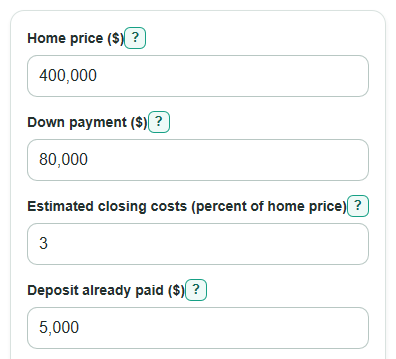
- Enter the Home price ($) from your purchase agreement, then enter your planned Down payment ($).
- Enter Estimated closing costs (percent of home price); use your Loan Estimate or Closing Disclosure when you have one.
- Enter Deposit already paid ($) and Cash available for closing ($) so the calculator can show cash left or a shortfall.
- Open Advanced options if you know any Seller, builder, or agent credit ($), Lender credit ($), points, interest rate, or prepaid interest days.
- Check whether Estimated buyer closing costs before down payment is only a fee estimate, then use Estimated cash needed at closing after credits for the bigger cash planning number.
Definitions
Home price ($): The purchase price of the home, before subtracting the down payment.
Down payment ($): Cash paid toward the home price. It is part of cash needed at closing, but it is not a closing cost fee.
Estimated closing costs (percent of home price): A quick fee estimate based on the home price. It can include lender fees, title costs, taxes, prepaids, and escrow items, but your lender documents control the final numbers [1].
Deposit already paid ($): Earnest money or another buyer deposit already paid before closing. It usually reduces the cash still due at closing.
Seller, builder, or agent credit ($): A credit from another party that may reduce cash due, subject to lender and program rules.
Lender credit ($): A credit from the lender that can lower upfront cash due. It may be tied to a higher interest rate [3].
Points paid to lower rate (percent of loan): Upfront cost based on the loan amount. One point equals 1 percent of the loan amount.
Prepaid interest days: Days of mortgage interest collected at closing before the first full payment period begins.
Cash left after closing, or shortfall: Cash available for closing minus estimated cash needed. A positive number is money left over; a negative number is the estimated shortage.
Common mistakes and quick fixes
Mistake: Entering the loan amount in Home price ($) .
Fix: Use the agreed purchase price in Home price ($) ; the calculator finds Estimated loan amount from the down payment.
Mistake: Treating Estimated buyer closing costs before down payment as the full amount to bring.
Fix: Use Estimated cash needed at closing after credits because it adds Down payment ($) and subtracts deposits and credits.
Mistake: Leaving Estimated closing costs (percent of home price) blank or typing a percent far outside a normal estimate.
Fix: Enter a number from 0 to 20, and replace the estimate with your lender's figures when available.
Mistake: Forgetting that Deposit already paid ($) usually reduces cash still due at closing.
Fix: Enter your earnest money deposit in Deposit already paid ($) , not in Cash available for closing ($) unless it is still in your account.
Mistake: Entering Seller, builder, or agent credit ($) as guaranteed cash back.
Fix: Use the credit only as an estimate reducer and confirm lender or program limits before relying on it.
Mistake: Adding points to Estimated closing costs (percent of home price) and also entering Points paid to lower rate (percent of loan) .
Fix: Avoid double counting; either include points in the percent estimate or enter them separately in Advanced options.
Limitations & Key Assumptions / Boundary Conditions
- This is a planning estimate, not a lender's Loan Estimate or Closing Disclosure. Final fees, prepaids, escrows, and cash to close can differ.
- The closing cost percent is applied to the home price, not to the loan amount. Use known line items from lender documents when you have them.
- Credits may be limited by loan type, down payment, occupancy, and other rules. A large credit may not reduce cash due dollar for dollar [4].
- Prepaid interest uses a simple 365-day year estimate. A lender's final day-count method may differ.
- Negative Estimated cash needed at closing after credits is not changed to $0. It means entered deposits and credits are larger than the estimate and should be checked with the lender.
- Negative Cash left after closing, or shortfall is kept as a negative number so the shortfall is visible.
- The calculator does not test loan approval, reserve requirements, mortgage insurance rules, tax proration details, wire fees, moving costs, or repairs after closing.
Methodology
How the estimate is calculated
The calculator starts with the purchase price and down payment to estimate the loan amount.
loan_amount = home_price - down_payment_amount
It estimates base buyer closing costs from the percent entered by the user.
base_closing_costs = home_price * closing_cost_rate / 100
If points are entered, the points cost is based on the loan amount. Points and lender credits are common mortgage closing cost tradeoffs [3].
points_cost = loan_amount * discount_points_percent / 100
Prepaid interest is estimated with the loan amount, annual interest rate, a 365-day year, and the number of prepaid interest days.
prepaid_interest = loan_amount * (annual_interest_rate_percent / 100) / 365 * prepaid_interest_days
The estimated closing costs before the down payment add the base estimate, points, and prepaid interest.
buyer_closing_costs_before_down_payment = base_closing_costs + points_cost + prepaid_interest
The cash needed at closing then adds the down payment and subtracts the deposit, seller credit, and lender credit.
cash_needed_after_credits = down_payment_amount + buyer_closing_costs_before_down_payment - deposit_paid - seller_credit - lender_credit
Cash left or shortfall compares the buyer's available cash with the estimated cash needed.
cash_left_after_closing = cash_available - cash_needed_after_credits
The down payment share is the down payment divided by the home price.
down_payment_percent_of_price = down_payment_amount / home_price * 100
Mini example
For a $400,000 home, an $80,000 down payment, 3 percent estimated closing costs, a $5,000 deposit already paid, and $100,000 available for closing, the estimated loan amount is $320,000. Base closing costs are $12,000. With no credits, no points, and no prepaid interest days, estimated cash needed at closing after credits is $80,000 + $12,000 - $5,000 = $87,000. Cash left after closing is $100,000 - $87,000 = $13,000, and the down payment share is 20 percent.
Validation choices
Home price must be greater than $0. Down payment must be from $0 up to the home price. Estimated closing costs must be from 0 percent to 20 percent. Deposit, cash available, credits, points, interest rate, and prepaid interest days cannot be negative. If the loan amount is $0, points cost and prepaid interest are calculated as $0 even when nonzero point or prepaid interest entries are present.
Sources
- Closing disclosure explainer | Consumer Financial Protection Bureau - Consumerfinance
- What costs come with taking out a mortgage? | Consumer Financial Protection Bureau - Consumerfinance
- How should I use lender credits and points (also called discount points)? | Consumer Financial Protection Bureau - Consumerfinance
- Interested Party Contributions (IPCs) | Fannie Mae - Fanniemae