
Estimate the mortgage payoff due at closing and the cash left after seller costs, payoff debts, and liens.
Table of contents
How to use our Mortgage Payoff at Sale Calculator
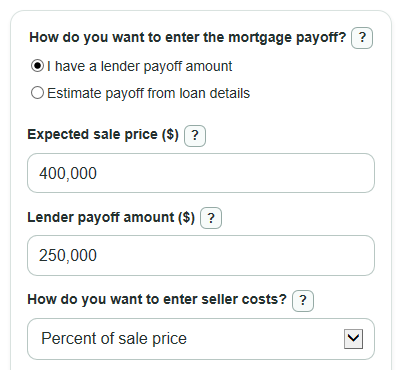
- Choose How do you want to enter the mortgage payoff?: use I have a lender payoff amount if your lender gave you a payoff figure, or Estimate payoff from loan details if you only have loan details.
- Enter Expected sale price ($), then choose How do you want to enter seller costs? and fill either Seller costs (percent of sale price) or Seller costs ($).
- Add Other liens or payoff debts ($) if a second mortgage, HELOC, judgment lien, or similar payoff will be paid from the sale.
- If estimating the payoff, enter Principal balance after your last payment ($), Loan interest rate (percent per year), Monthly principal and interest payment ($), Interest paid through date, Expected sale payoff date, and Payoff fees or release fees ($).
- Check whether Estimated mortgage payoff at sale is higher than your principal balance because of Accrued interest added for payoff date, and review Estimated cash left after sale costs; a negative number means you may need cash to close.
Definitions
Mortgage payoff: The amount needed to fully pay off the mortgage by a stated date. It can be different from the current balance because it may include interest through the payoff date and fees [1].
Principal balance: The unpaid loan amount after your last payment. It does not include future interest, escrow, taxes, or insurance.
Interest paid through date: The date through which your last paid mortgage payment has already covered interest.
Expected sale payoff date: The date the closing agent is expected to send payoff funds to the lender.
Seller costs: Sale costs you choose to subtract, such as agent fees, transfer taxes, title charges, repairs, credits, and other selling expenses.
Other liens or payoff debts: Other debts that must be paid from sale proceeds, such as a second mortgage, HELOC, or judgment lien.
Accrued interest: Interest that builds up after the interest paid through date and is added to the payoff estimate.
Common mistakes and quick fixes
Mistake: Entering today's balance in Lender payoff amount ($) when the lender has not given a payoff figure.
Fix: Choose Estimate payoff from loan details, or get the actual Lender payoff amount ($) from your lender for the sale date.
Mistake: Putting taxes, insurance, HOA dues, or escrow into Monthly principal and interest payment ($).
Fix: Use only the principal and interest part of the payment so Scheduled principal paid before sale is not overstated.
Mistake: Using the payment due date as Expected sale payoff date instead of the day funds are expected to reach the lender.
Fix: Enter the closing payoff funding date in Expected sale payoff date, because Accrued interest added for payoff date is based on days.
Mistake: Typing 0.07 in Seller costs (percent of sale price) when you mean 7 percent.
Fix: Enter 7 for 7 percent, or switch How do you want to enter seller costs? to Dollars and use Seller costs ($).
Mistake: Leaving a second mortgage or HELOC out of Other liens or payoff debts ($).
Fix: Add all non-first-mortgage debts paid from sale proceeds so Estimated cash left after sale costs is not too high.
Mistake: Treating Estimated cash left after sale costs as the final closing number.
Fix: Use it for planning, then compare it with the title company or lender documents before closing.
Limitations & Key Assumptions / Boundary Conditions
- This is a planning estimate. The final payoff should come from your lender, title company, or closing agent.
- The estimate uses simple daily interest with a 365-day year. Some loans, servicers, and payoff statements may use different day-count or cutoff rules.
- The loan-detail mode does not include escrow refunds, late fees, prepayment penalties, corporate advances, recording charges, wire fees, or lender-specific adjustments unless you enter them in Payoff fees or release fees ($).
- Seller costs are only the costs you enter. The calculator does not separately itemize commissions, transfer taxes, prorated taxes, repair credits, HOA charges, title fees, or concessions.
- Scheduled payment timing is estimated from the Interest paid through date. Real servicing records can differ if a payment is pending, late, reversed, or posted on a different date.
- A negative Estimated cash left after sale costs is allowed. It means the entered payoff debts and costs are higher than the expected sale price.
Methodology
Core sale calculation
The calculator starts with the expected sale price and subtracts the mortgage payoff, seller costs, and other liens. If you choose lender payoff mode, the mortgage payoff is the Lender payoff amount ($) you enter. A payoff amount is not always the same as the current principal balance [1].
seller_costs = sale_price * seller_cost_percent / 100
seller_costs = seller_cost_amount
mortgage_payoff = known_payoff_amount
estimated_equity_before_selling_costs = sale_price - mortgage_payoff - other_liens
estimated_cash_after_sale_costs = sale_price - mortgage_payoff - seller_costs - other_liens
Loan-detail payoff estimate
When you choose Estimate payoff from loan details, the calculator projects the balance forward from Principal balance after your last payment ($). It first checks for scheduled monthly payments due after the Interest paid through date and before the Expected sale payoff date. For each such payment, it estimates the interest part, subtracts the remaining payment from principal, and lowers the balance. If the payment is not enough to cover monthly interest while the balance is positive, the calculator stops and shows a note because the payment would not reduce principal.
monthly_rate = annual_interest_rate / 100 / 12
interest_due = balance * monthly_rate
principal_paid = min(monthly_pi_payment - interest_due, balance)
new_balance = balance - principal_paid
After scheduled payments are applied, the calculator estimates daily interest from the last covered interest date to the payoff date. It uses a 365-day daily-interest estimate, a method shown in Fannie Mae payoff servicing materials for certain payoff interest examples [2].
daily_interest = balance * annual_interest_rate / 100 / 365
accrued_interest = daily_interest * accrued_days
mortgage_payoff = projected_balance + accrued_interest + payoff_fees
Mini-example
Suppose Expected sale price ($) is $450,000, Principal balance after your last payment ($) is $300,000, Loan interest rate (percent per year) is 6, Interest paid through date is July 1, Expected sale payoff date is July 16, Payoff fees or release fees ($) is $50, Seller costs ($) is $30,000, and Other liens or payoff debts ($) is $5,000. There are 15 accrued-interest days and no scheduled payment before July 16. Daily interest is $300,000 x 0.06 / 365 = $49.32. Accrued interest is $49.32 x 15 = $739.73. Estimated mortgage payoff at sale is $300,000 + $739.73 + $50 = $300,789.73. Estimated cash left after sale costs is $450,000 - $300,789.73 - $30,000 - $5,000 = $114,210.27.
Sources
- What is a payoff amount and is it the same as my current balance? | Consumer Financial Protection Bureau - Consumerfinance
- Processing Mortgage Loan Payments and Payoffs | Fannie Mae - Fanniemae
- 1026.38 Content of disclosures for certain mortgage transactions (Closing Disclosure). | Consumer Financial Protection Bureau - Consumerfinance