
Find water's boiling point from altitude or air pressure, and see how much it changes from sea level.
Advanced options
How to use our Boiling Point Calculator
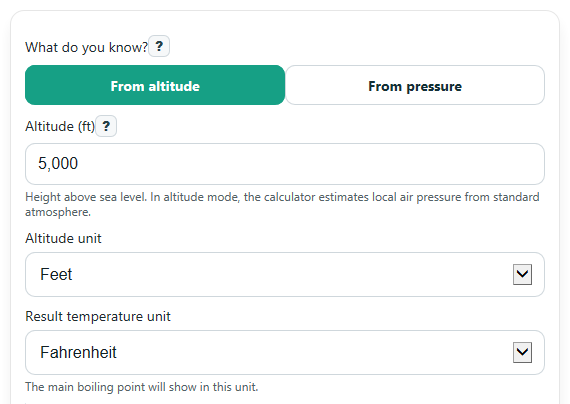
- Choose What do you know? and pick either From altitude or From pressure.
- Enter either Altitude with Altitude unit, or Air pressure with Pressure unit, then choose Result temperature unit.
- If you want cleaner display values, open Advanced options and set Rounding for temperature and Rounding for pressure.
- Click Calculate to see Boiling point, Change from sea level, and, in altitude mode, Estimated local air pressure.
- Sanity-check the answer: near sea level, water should be close to 212 F or 100 C, and higher altitude or lower pressure should give a lower boiling point.
Definitions
Boiling point: The temperature where water's vapor pressure matches the surrounding air pressure, so bubbles can form throughout the liquid [1].
Air pressure: The absolute pressure around the water. Lower air pressure means water boils at a lower temperature.
Altitude: Height above sea level. In this calculator, altitude is used to estimate air pressure with a standard atmosphere model.
Absolute pressure: Pressure measured from a perfect vacuum. This is different from gauge pressure, which ignores normal outside air pressure.
Change from sea level: The local boiling point minus the normal sea-level boiling point. A negative value means water boils cooler than at sea level.
Sea-level reference: The normal boiling point of pure water at 1 atm, which is 212 F or 100 C.
Estimated local air pressure: The pressure calculated from altitude mode before the boiling point is found.
Common mistakes and quick fixes
Mistake: Typing local height into Air pressure instead of Altitude .
Fix: If you know height above sea level, switch What do you know? to altitude mode and enter it in Altitude .
Mistake: Entering gauge pressure in Air pressure .
Fix: Use absolute surrounding pressure for Air pressure . If your reading is gauge pressure, convert it before calculating.
Mistake: Using feet while Altitude unit is set to meters, or the other way around.
Fix: Make sure the number in Altitude matches the selected Altitude unit .
Mistake: Picking the wrong Pressure unit for the number you entered.
Fix: Check whether your pressure reading is in kPa, atm, bar, mmHg, inHg, or psi, then match Pressure unit to that reading.
Mistake: Thinking Change from sea level should never be positive.
Fix: A positive Change from sea level can happen if pressure is above normal sea-level pressure, which can raise the boiling point slightly.
Mistake: Ignoring the Range note when the input is unusual.
Fix: Read Range note to see if the estimate is outside the method's best range or if weather pressure may make altitude mode less exact.
Limitations & Key Assumptions / Boundary Conditions
- This calculator is for pure water, not salt water, sugar solutions, or other liquids.
- Altitude mode uses a standard-atmosphere estimate, so real weather pressure can make the true boiling point a little higher or lower.
- The altitude-to-pressure model is limited to about -500 m to 11,000 m. Outside that range, results should not be trusted.
- The Antoine coefficient set used here is a common fit for roughly 1 C to 100 C. Outside that temperature range, the calculator should be treated as a rough estimate.
- Pressure must be absolute pressure and greater than 0. Zero or negative pressure is not physically valid for this calculation.
- Below sea level or above normal sea-level pressure, the boiling point can be slightly above 212 F, so a positive change from sea level is possible.
Methodology
Core idea
Water boils when its vapor pressure matches the surrounding pressure [2]. That means pressure is the real driver, and altitude is just a way to estimate pressure.
Formulas used
P_sat(T) = P_ambient
T_C = B / (A - log10(P_mmHg)) - C
A = 8.07131, B = 1730.63, C = 233.426
P = P0 x (1 - L x h / T0)^(g x M / (R x L))
P0 = 101325 Pa, L = 0.0065 K/m, T0 = 288.15 K
g = 9.80665 m/s^2, M = 0.0289644 kg/mol, R = 8.3144598 J/(mol x K)
drop = T_local - T_sea_level
How the calculator works
In pressure mode, the entered Air pressure is converted to mmHg, then the Antoine equation is solved for temperature in C. The result is then shown in the selected unit.
In altitude mode, the entered Altitude is first converted to meters if needed. The standard-atmosphere formula estimates local pressure, then that pressure is used in the same boiling-point calculation.
Change from sea level is calculated by subtracting the normal sea-level boiling point from the local boiling point. If the result is negative, boiling happens at a lower temperature than 212 F or 100 C. If it is positive, boiling happens at a higher temperature.
Mini example
Suppose you use altitude mode and enter 5,000 ft. First, 5,000 ft is about 1,524 m. The standard-atmosphere step gives an estimated pressure of about 84.3 kPa. Converting that pressure and solving the Antoine equation gives a boiling point of about 94.8 C, which is about 202.6 F. Compared with sea level, the change is about -5.2 C or -9.4 F.
Assumptions used
This method assumes pure water and uses a standard atmosphere for altitude mode. It also uses one common Antoine coefficient set for water, so results are best within its usual temperature range rather than far outside it.