
Choose your chemistry method, enter the needed counts, and calculate bond order with the matching arithmetic shown.
Table of contents
How to use our Bond Order Calculator
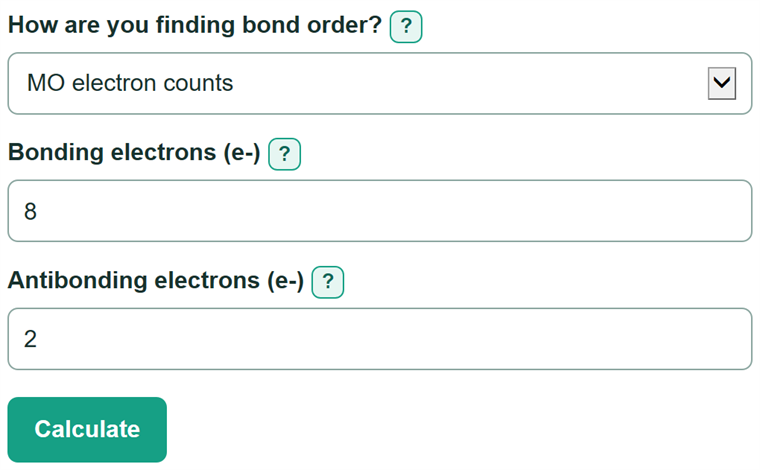
- Choose "MO electron counts" for a completed molecular orbital diagram, or choose "Resonance average" for equivalent bonds in a resonance structure.
- For the MO method, count occupied electrons in bonding orbitals and occupied electrons in antibonding orbitals, then enter each count.
- For the resonance method, enter the number of equivalent bonds and add their total bond-order units: 1 for each single bond, 2 for each double bond, and 3 for each triple bond.
- Click Calculate. Read the bond order first, then compare the displayed substitution with your written calculation.
- Check that your counts are whole numbers, that equivalent bonds are truly equivalent, and that a fractional bond order is kept instead of treated as an error.
Definitions
Bond order: A dimensionless number found from the selected chemistry method. It can be a whole number, zero, negative in the MO calculation, or a fraction.
Bonding molecular orbital: A molecular orbital where occupied electrons contribute to bonding between atoms.
Antibonding molecular orbital: A molecular orbital where occupied electrons oppose bonding. An asterisk is commonly part of its label.
Equivalent bonds: Bonds with the same average bond character in a resonance hybrid. They share the total bond-order units equally.
Bond-order units: Values added for the resonance method: 1 for a single bond, 2 for a double bond, and 3 for a triple bond.
Exact fraction: A simplified value such as 4/3. A rounded decimal such as 1.3333 is an approximation of that fraction.
Common mistakes and quick fixes
Mistake: Entering the molecule's total electrons as bonding electrons.
Fix: Count only electrons in occupied bonding molecular orbitals for the bonding-electron field.
Mistake: Leaving out occupied antibonding orbitals.
Fix: Count electrons in antibonding orbitals separately. Their labels commonly include an asterisk.
Mistake: Using MO electron counts for a resonance-average question.
Fix: Choose resonance average when the problem asks for the average bond order of equivalent bonds in a resonance hybrid.
Mistake: Treating a fraction such as 4/3 as an error.
Fix: Keep the exact fraction. A fractional bond order can be valid, especially for equivalent resonance bonds.
Mistake: Including bonds that are not equivalent in the resonance average.
Fix: Divide only among the bonds that have the same average bond character in the resonance hybrid.
Mistake: Entering a decimal or negative number for a count.
Fix: Use whole numbers of 0 or more. The equivalent-bonds count must be at least 1.
Limitations & Key Assumptions / Boundary Conditions
- The MO method requires counts from an already completed molecular orbital diagram; it does not classify orbitals as bonding or antibonding.
- The resonance method applies only to bonds that are equivalent in the resonance hybrid. Do not average unrelated bond types together.
- Bond order 0 and a negative MO result are valid mathematical outputs from the entered counts. They do not by themselves prove a molecule is stable or physically realistic.
- Bond order alone does not determine an exact bond length, bond energy, stability, or magnetic property.
- All entered counts must be non-negative whole numbers. Equivalent bonds must be at least 1 because division by zero is undefined.
Methodology
MO electron-count method
For a molecular orbital diagram, bond order is half the difference between occupied bonding electrons and occupied antibonding electrons. Each antibonding electron reduces the difference. [1]
bond order = (bonding electrons - antibonding electrons) / 2
Resonance-average method
For equivalent resonance bonds, divide the total bond-order units across that group by the number of equivalent bonds. This gives their shared average bond order. [2]
bond order = total bond-order units / equivalent bonds
Worked example
An MO diagram with 7 bonding electrons and 2 antibonding electrons gives (7 - 2) / 2 = 5/2 = 2.5. The calculator shows 5/2 and 2.5 because the fraction is exact and the decimal terminates.
Calculation limits
The calculator uses the whole-number counts you enter and reduces the resulting fraction. It can return zero or a negative mathematical result for the MO formula. It does not draw an MO diagram, determine chemical stability, or predict bond length, energy, or magnetism.