
Enter final titer, batch measurements, recovery, and price to estimate sellable product and gross revenue for one fermentation batch.
Table of contents
How to use our Fermentation Titer, Yield and Batch Revenue Calculator
- Enter the final assay concentration in Final product titer (g/L) and the actual liquid amount in Working volume (L).
- Enter Substrate consumed (kg) from the same batch, then enter Fermentation run time and choose its Run-time unit.
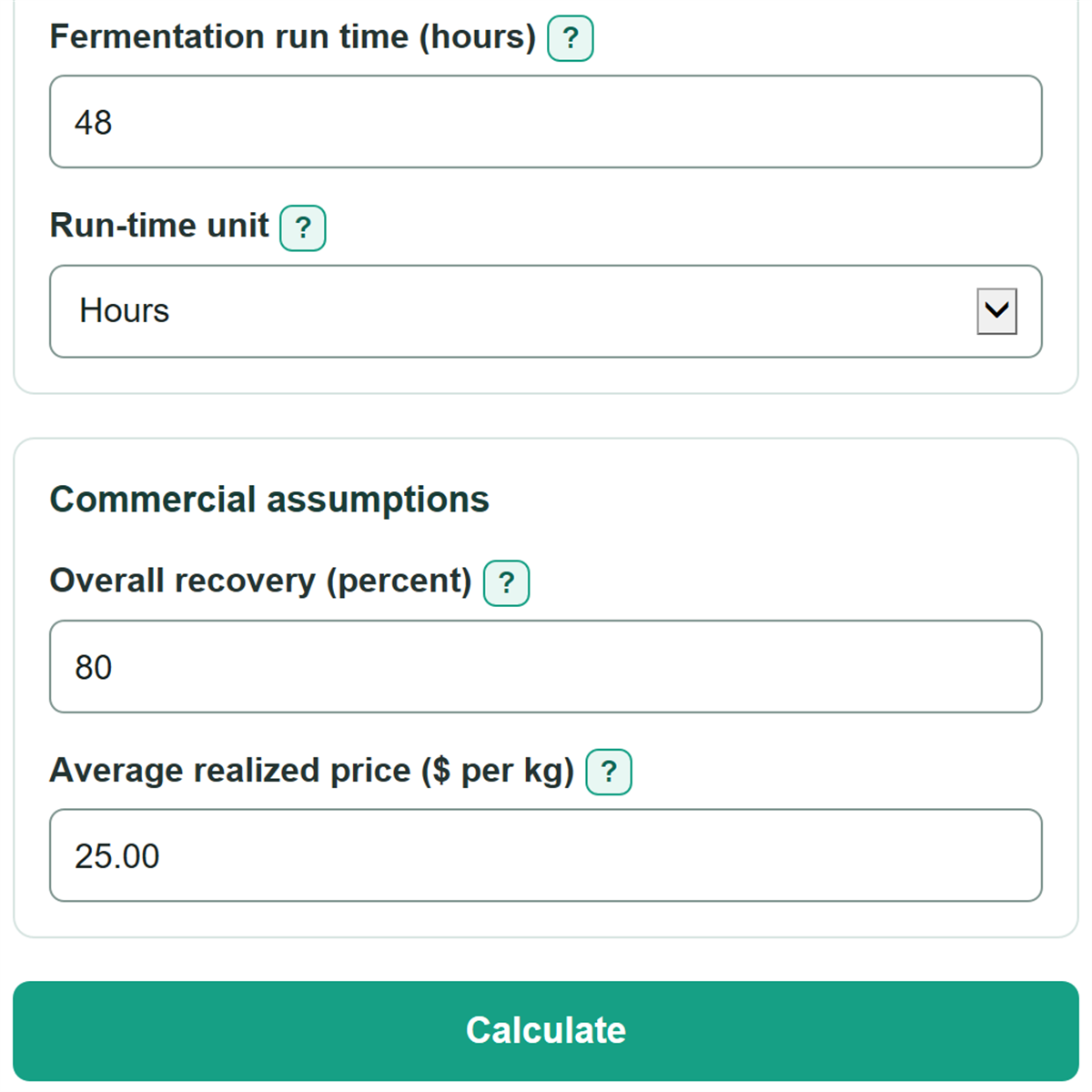
- Enter Overall recovery (percent) for expected downstream losses and Average realized price ($ per kg) for the product sold.
- Click Calculate, then check that Gross product formed in the batch is at least as large as Expected sellable product after recovery when recovery is below 100 percent.
- Use Estimated gross batch revenue as a sales-value estimate only; it does not subtract batch costs.
Definitions
Final product titer: The final measured product concentration, expressed here as grams of product per liter of fermentation liquid (g/L).
Working volume: The liquid volume actually processed in the batch, not the maximum volume printed on the vessel.
Substrate consumed: The mass of feed material used by the process during the batch. It is the denominator for product-to-substrate yield.
Overall recovery: The percent of gross product expected to remain sellable after harvest, purification, transfers, and other downstream losses.
Product-to-substrate yield: Gross product mass divided by substrate consumed, shown as grams of product per gram of consumed substrate (g/g).
Volumetric productivity: Final titer divided by fermentation time. This calculator shows the average rate in both g/L/h and g/L/day. [1]
Gross batch revenue: Sellable product mass multiplied by the entered average realized price. It is revenue before costs.
Common mistakes and quick fixes
Mistake: Using vessel capacity instead of the liquid actually processed for Working volume (L).
Fix: Enter the batch working volume from the batch record or operating setpoint.
Mistake: Entering substrate loaded instead of Substrate consumed (kg).
Fix: Use the amount actually consumed during the batch, based on a material balance or initial and final measurements.
Mistake: Typing 48 for Fermentation run time but selecting days when the record is in hours.
Fix: Match Run-time unit to the timestamps used for the entered run time.
Mistake: Treating Gross product formed in the batch as product available to sell.
Fix: Use Expected sellable product after recovery after entering a realistic Overall recovery (percent).
Mistake: Reading Estimated gross batch revenue as profit.
Fix: Treat Average realized price ($ per kg) times sellable product as revenue before feedstock, labor, utilities, overhead, and taxes.
Mistake: Entering a malformed grouped value such as 1,01 for Average realized price ($ per kg).
Fix: Use a decimal point for cents or fractions, such as 1.01, and use commas only in full thousands groups, such as 1,250.
Limitations & Key Assumptions / Boundary Conditions
- The calculation uses the final titer and reports an average productivity over the entered fermentation run time. It does not model changing rates during the batch.
- Product-to-substrate yield is only meaningful when Substrate consumed (kg) and gross product refer to the same batch and product basis.
- Overall recovery is a single combined estimate. It does not separate harvest, purification, transfer, storage, or quality-release losses.
- Expected sellable product assumes the entered recovery applies to all gross product measured by the final titer.
- Estimated gross batch revenue uses the entered price and excludes feedstock, labor, utilities, equipment, overhead, taxes, discounts, and other costs. It is not profit.
- The calculator accepts hours or days only for fermentation time. Cleaning, turnaround, and downstream processing time are not included in productivity unless they are intentionally entered as fermentation run time.
Methodology
Batch calculations
First, the calculator converts Fermentation run time to hours. A duration entered in days is multiplied by 24.
duration in hours = entered run time, or entered run time × 24 for days
Gross product is the final concentration multiplied by the liquid working volume. Dividing by 1,000 changes grams to kilograms.
gross product (kg) = final product titer (g/L) × working volume (L) / 1000
Product-to-substrate yield compares gross product mass with substrate actually consumed. The kg/kg numerical ratio is the same as g/g.
product-to-substrate yield (g/g) = gross product (kg) / substrate consumed (kg)
Average volumetric productivity divides final titer by normalized fermentation time. The daily value is the hourly value multiplied by 24. [1]
productivity (g/L/h) = final product titer (g/L) / duration (h)
productivity (g/L/day) = productivity (g/L/h) × 24
Recovery adjusts gross product to the mass expected to remain sellable. Revenue then applies the entered price to that sellable mass.
sellable product (kg) = gross product (kg) × overall recovery (percent) / 100
gross batch revenue ($) = sellable product (kg) × average realized price ($ per kg)
Worked example
With a final product titer of 12.5 g/L, a working volume of 2,000 L, and 50 kg of substrate consumed, gross product is 25 kg and yield is 0.5 g/g. Over 48 hours, productivity is about 0.2604 g/L/h, or 6.25 g/L/day. At 80 percent recovery, sellable product is 20 kg; at $25 per kg, gross batch revenue is $500.