
Enter bioreactor kLa, dissolved oxygen, and OUR to check oxygen-transfer capacity at your target dissolved-oxygen level.
Dissolved oxygen
Culture oxygen demand
Table of contents
How to use our Bioreactor Oxygen Transfer Rate, OUR and kLa Capacity Calculator
- Enter the Volumetric mass transfer coefficient, kLa from a test, vendor estimate, or process record, then choose its printed time basis in kLa time unit.
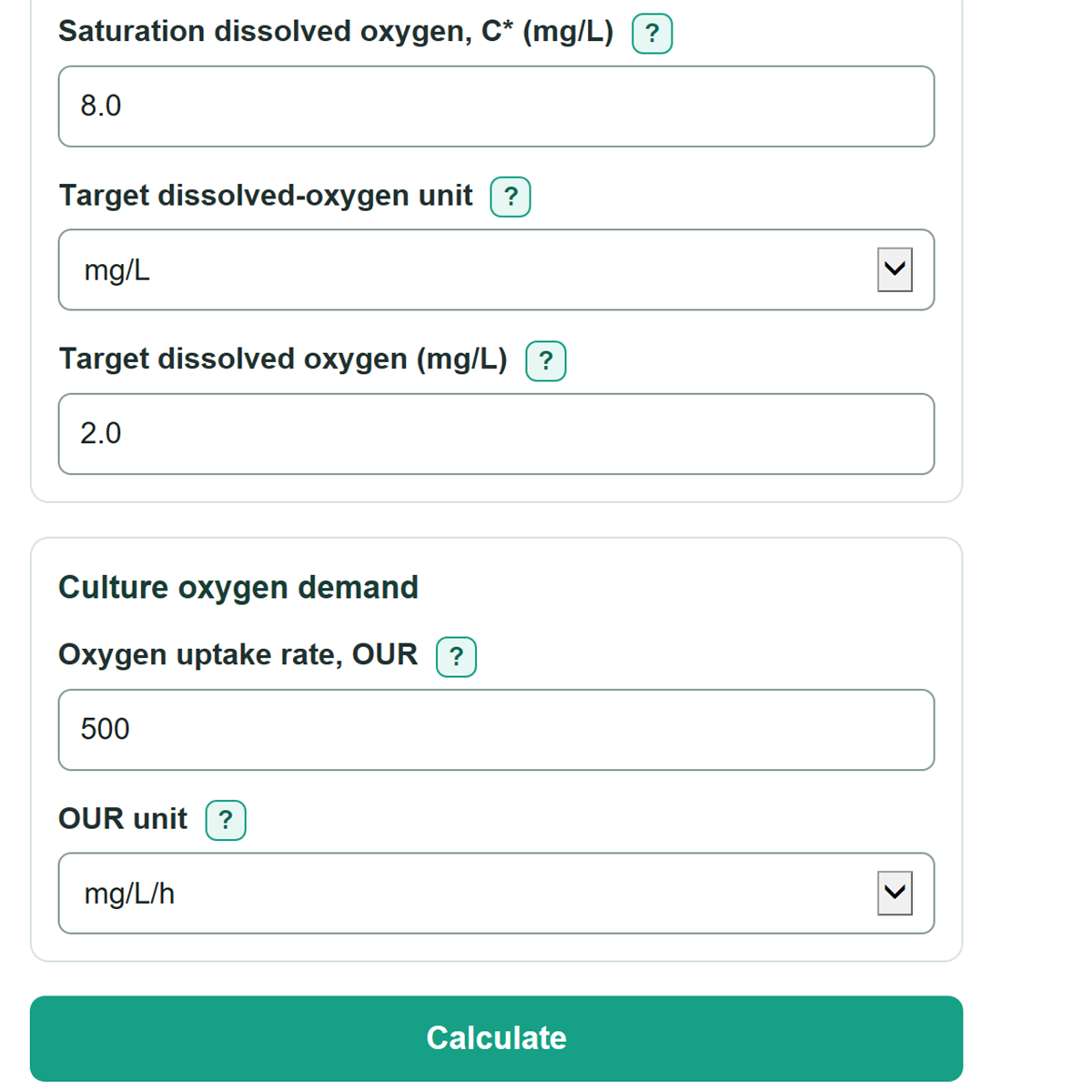
- Enter the condition-specific Saturation dissolved oxygen, C* (mg/L) for the temperature, pressure, gas composition, and liquid being assessed.
- Choose the controller basis in Target dissolved-oxygen unit, then enter the setpoint in Target dissolved oxygen.
- Enter culture demand as Oxygen uptake rate, OUR and choose the matching OUR unit.
- Click Calculate. A positive Oxygen capacity margin means modeled supply exceeds demand at the target; also check that the entered kLa and C* match the actual reactor conditions.
Definitions
kLa: Volumetric mass transfer coefficient. It describes how quickly oxygen moves from gas to liquid under stated reactor conditions; its unit is inverse time, such as 1/h.
OTR: Oxygen transfer rate, the modeled oxygen supplied to liquid per volume per time. This calculator reports mg/L/h.
OUR: Oxygen uptake rate, the oxygen demand of the culture per volume per time. At steady oxygen balance, OTR equals OUR. [1]
C*: Saturation dissolved oxygen, the dissolved-oxygen concentration the liquid approaches under the entered conditions.
Target dissolved oxygen: The controller setpoint or chosen liquid oxygen concentration, expressed as mg/L or as a percent of C*.
Oxygen capacity margin: OTR minus OUR at the target dissolved oxygen. A positive margin is modeled surplus; a negative margin is modeled shortfall.
Common mistakes and quick fixes
Mistake: Treating Volumetric mass transfer coefficient, kLa as if it were already an oxygen rate.
Fix: Enter kLa with its actual time basis in kLa time unit; the calculator combines it with the dissolved-oxygen driving force to calculate OTR at target dissolved oxygen.
Mistake: Using a clean-water or different-vessel value for Volumetric mass transfer coefficient, kLa without checking conditions.
Fix: Use a kLa measured or estimated for the applicable liquid, aeration, agitation, pressure, and gas composition.
Mistake: Entering a percent setpoint as mg/L in Target dissolved oxygen.
Fix: Set Target dissolved-oxygen unit to Percent of saturation (%) before entering a percentage, or choose mg/L for an absolute concentration.
Mistake: Comparing mmol/L/h directly with mg/L/h by choosing the wrong OUR unit.
Fix: Choose the unit printed with Oxygen uptake rate, OUR. The calculator converts mmol/L/h to mg/L/h before finding Oxygen capacity margin.
Mistake: Setting Target dissolved oxygen equal to or above Saturation dissolved oxygen, C* (mg/L).
Fix: Enter a target below C*. The model needs a positive concentration difference for oxygen transfer.
Limitations & Key Assumptions / Boundary Conditions
- The calculation uses a fixed kLa and a fixed C*. In a real reactor, both can change with agitation, gas flow, vessel geometry, pressure, gas composition, temperature, broth viscosity, cells, and antifoam.
- Use a kLa that applies to the actual process broth and operating conditions. A clean-water, vendor-estimated, or different-scale value can overstate or understate capacity.
- The model reports volumetric rates in mg/L/h. It does not calculate total oxygen transfer for the vessel because working volume is not entered.
- OUR must describe the same culture condition and time basis as the capacity check. A current OUR may be lower than a later peak OUR.
- If Calculated steady-state dissolved oxygen is shown as N/A, entered OUR exceeds Maximum modeled OTR at zero dissolved oxygen. There is no nonnegative steady-state dissolved-oxygen value in this model.
- This is a capacity estimate, not a replacement for dissolved-oxygen control data, off-gas analysis, or a validated process model.
Methodology
Calculation method
The calculator first converts kLa to 1/h, converts a percent dissolved-oxygen target to mg/L using C*, and converts mmol/L/h OUR to mg/L/h using 31.9988 mg per mmol O2.
kLa_per_h = kLa_value, kLa_value * 60, or kLa_value * 3600
target_DO_mg_L = target_DO_value or C* * target_DO_value / 100
OUR_mg_L_h = OUR_value or OUR_value * 31.9988
The oxygen-transfer model uses the difference between saturation dissolved oxygen and target dissolved oxygen as the driving force.
OTR = kLa_per_h * (C* - target_DO_mg_L)
oxygen_capacity_margin = OTR - OUR_mg_L_h
required_kLa = OUR_mg_L_h / (C* - target_DO_mg_L)
steady_state_DO = C* - OUR_mg_L_h / kLa_per_h
maximum_OTR_at_zero_DO = kLa_per_h * C*
Worked example
With kLa = 100 1/h, C* = 8 mg/L, target dissolved oxygen = 2 mg/L, and OUR = 500 mg/L/h, the driving force is 6 mg/L. OTR is 600 mg/L/h, so the oxygen capacity margin is +100 mg/L/h. The kLa needed at that target is about 83.3 1/h, and the calculated steady-state dissolved oxygen is 3 mg/L.
The calculator blocks targets at or above C* because the driving force would be zero or negative. It also shows no physical steady-state dissolved-oxygen value when demand is greater than the modeled maximum OTR.