
Enter annual waste, unit costs, recovery yield, and installed cost to estimate solvent savings, residue, and equipment payback.
Advanced options
Calculation details
| End of year | Cumulative net savings after equipment cost |
|---|---|
| 1 | |
| 2 | |
| 3 | |
| 4 | |
| 5 |
Table of contents
How to use our Solvent Recovery Yield, Recycle Savings and Payback Calculator
- Enter the annual gallons in Waste solvent processed each year from waste manifests, logs, or annual drum records.
- Copy the per-gallon rates from invoices into New solvent cost and Waste solvent disposal cost; divide a drum total by its actual gallons before entering it.
- Enter Expected recovery yield from a vendor test, pilot batch, or past production record, then enter the full up-front amount in Installed equipment cost.
- Open Advanced options only if still-bottom waste has a different disposal rate, the recycler has annual operating costs, or fixed disposal fees will truly be avoided.
- Click Calculate and compare Estimated net savings each year with the quote. Check that recovered gallons and residue gallons add up to the waste solvent processed each year.
Definitions
Recovery yield: The percent of processed waste solvent expected to come back as usable solvent.
Still bottoms: The unrecovered liquid or residue left after recycling. It may still need disposal.
Variable disposal cost: A disposal charge that changes with gallons shipped off-site.
Fixed disposal fees avoided: Pickup, manifest, or minimum charges that recovery will actually remove from the annual bill.
Annual net savings: New-solvent purchase savings plus disposal savings and avoided fixed fees, minus annual recycler operating cost.
Simple payback time: The time for annual net savings to equal the installed equipment cost. It does not include financing, taxes, or changing prices. [1]
Common mistakes and quick fixes
Mistake: Entering fresh-solvent purchases instead of the gallons in Waste solvent processed each year.
Fix: Use the annual spent-solvent volume from waste records or manifests.
Mistake: Entering a full drum price in New solvent cost or Waste solvent disposal cost.
Fix: Divide the invoice amount by the actual gallons in that drum to get $ per US gal.
Mistake: Using contamination percentage as Expected recovery yield.
Fix: Enter the percent of processed liquid expected to return as usable solvent, from 0% through 100%.
Mistake: Leaving out installation, freight, or training from Installed equipment cost.
Fix: Include every one-time cost that the savings need to repay.
Mistake: Treating all waste as eliminated after recovery.
Fix: Review Still-bottom residue each year and enter Still-bottom disposal cost ($ per US gal) if that residue has a different disposal rate.
Mistake: Adding annual electricity or maintenance to Installed equipment cost.
Fix: Put repeating costs in Recycler operating cost each year ($) so they reduce annual savings.
Limitations & Key Assumptions / Boundary Conditions
- The calculation assumes every recovered gallon can replace one gallon of new solvent at the entered New solvent cost.
- Annual waste volume, recovery yield, unit prices, and operating costs are assumed to stay the same through the five-year cumulative savings amounts.
- A blank Still-bottom disposal cost ($ per US gal) uses the Waste solvent disposal cost. Enter a separate rate when residue is billed differently.
- Simple payback is unavailable when Estimated net savings each year is zero or negative because the investment does not repay itself under the entered conditions.
- The estimate excludes financing, interest, taxes, depreciation, resale value, downtime, permit costs, insurance, and changes in solvent mix or recycler performance.
- Use actual waste records and vendor test data. Do not assume a drum size or treat a contamination percentage as Expected recovery yield.
Methodology
Calculation method
The calculator first changes Expected recovery yield from a percent into a fraction, then splits the annual feed into recovered solvent and still-bottom residue.
recovered gallons = waste solvent processed each year * recovery yield / 100
residue gallons = waste solvent processed each year - recovered gallons
Recovered solvent is valued at the entered New solvent cost. Variable disposal savings compare disposal before recovery with disposal of the remaining residue. If Still-bottom disposal cost ($ per US gal) is blank, the Waste solvent disposal cost is used for the residue.
annual net savings = purchase savings + variable disposal savings + fixed disposal fees avoided - recycler operating cost each year
Simple payback divides Installed equipment cost by positive annual net savings and converts years to months. This is a simple payback calculation, meaning it compares the initial investment with savings without discounting future money. [1]
simple payback months = installed equipment cost / annual net savings * 12
Worked example
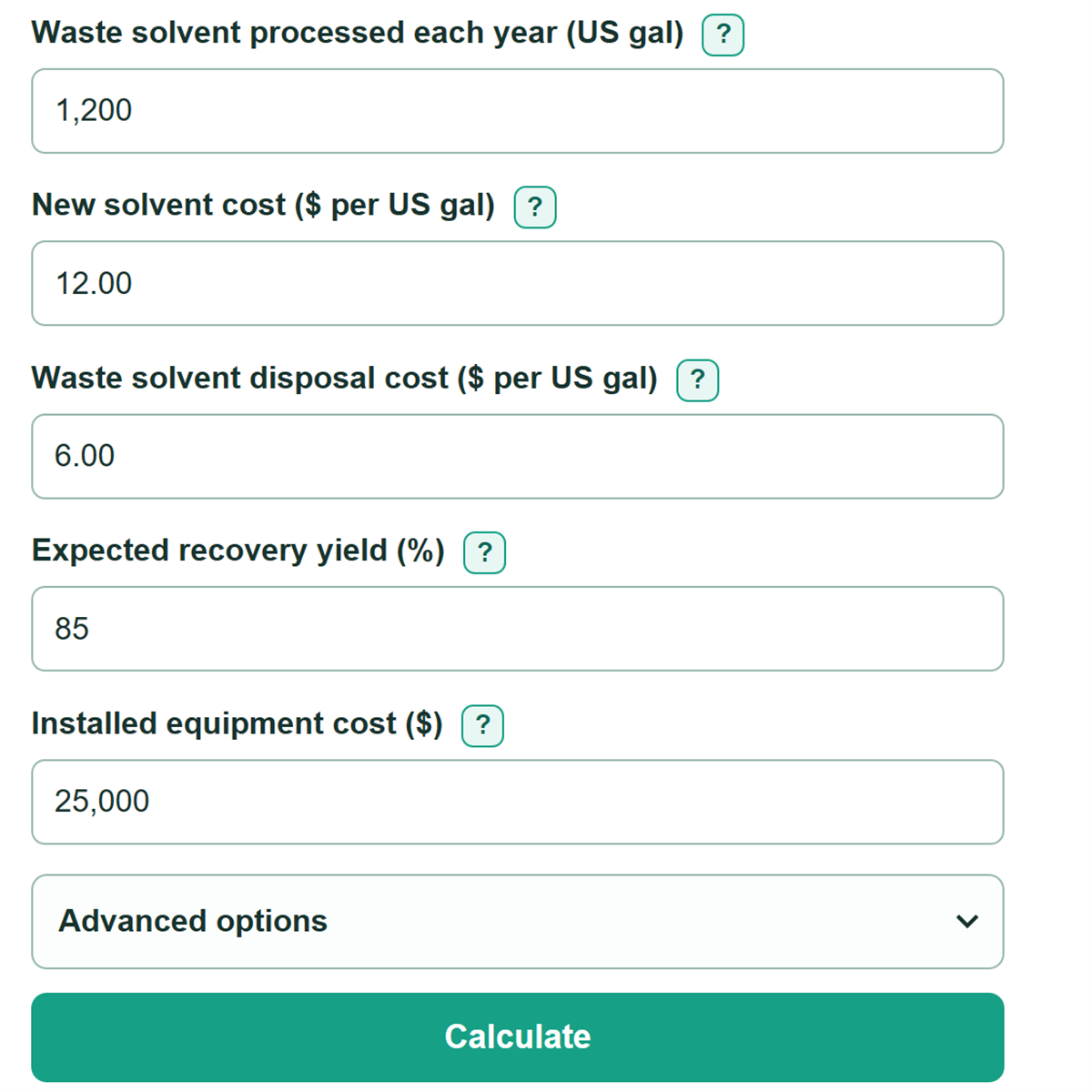
For 1,200 US gal per year at an 85% recovery yield, the calculator estimates 1,020 recovered gallons and 180 gallons of residue. At $12 per recovered gallon and $6 disposal per gallon, purchase savings are $12,240 and variable disposal savings are $6,120. With no added annual costs and a $25,000 installed cost, annual net savings are $18,360 and simple payback is about 16.3 months.
Calculation scope
Five-year cumulative net savings subtracts the installed cost once and adds the same annual net savings for each year. It is a planning estimate, so actual results can change when volume, prices, yield, residue handling, or operating costs change.