
Calculate a round bass reflex port length or estimate box tuning using net volume, port size, port count, and a target frequency.
Advanced options
Table of contents
How to use our Bass Reflex Port Length and Enclosure Tuning Calculator
- Choose What do you want to find? Select Find port length for a new design or Find box tuning for an existing port.
- Enter Net box volume as the inside air space in cubic feet after subtracting the driver, bracing, and port displacement when known.
- Enter the clear Inside port diameter and Number of matching ports. Use the inside diameter, not the pipe radius or outside diameter.
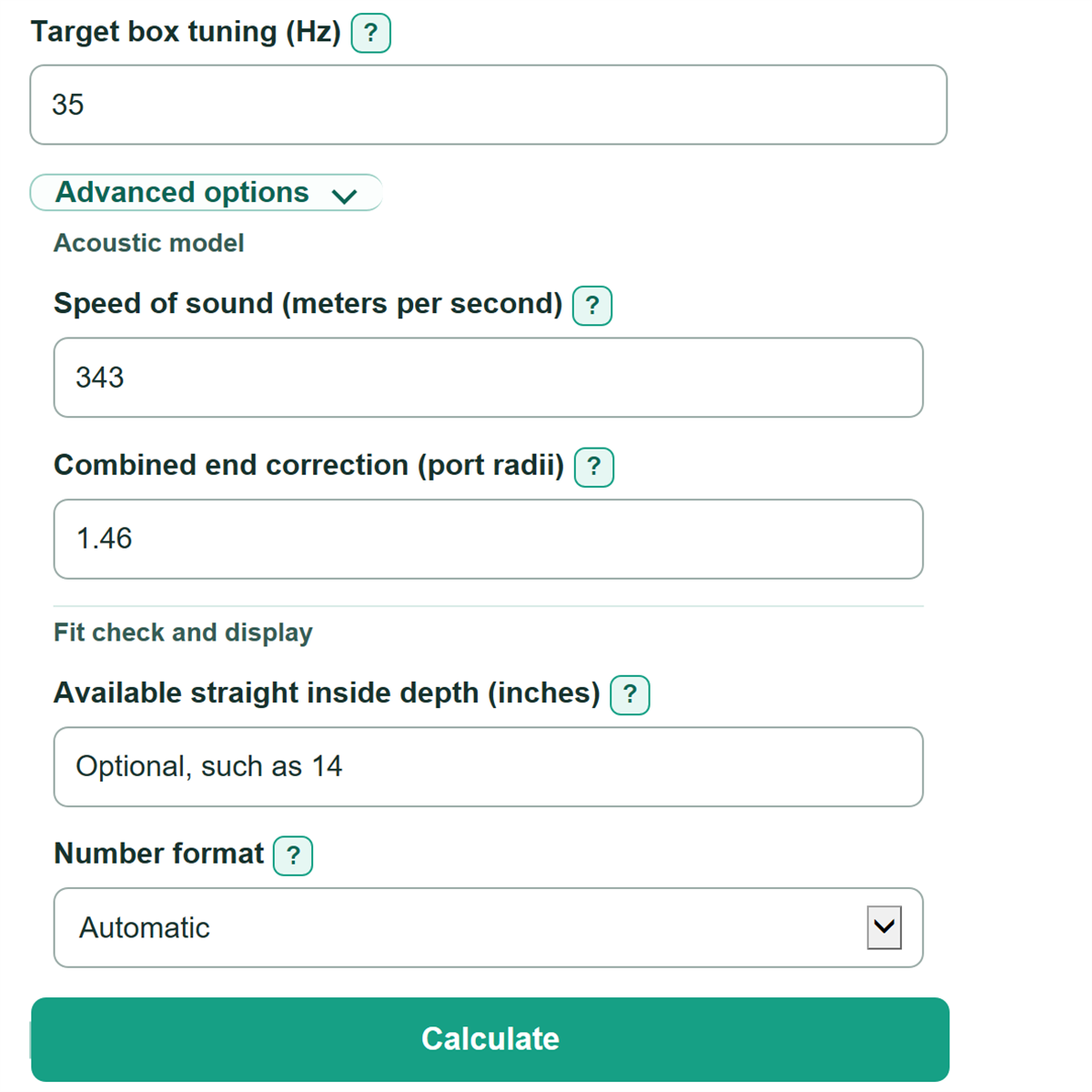
- Enter Target box tuning or Physical port length, depending on the selected calculation. Add Available straight inside depth (inches) in Advanced options if you want the fit check.
- Check that the primary estimate has the expected units and that Straight-run space left, when shown, is positive if the port must fit without a bend.
Definitions
Bass reflex enclosure: A speaker box with a port that uses the air in the box and port as a resonator.
Net box volume: The air volume inside the finished enclosure after subtracting space taken by parts inside it.
Inside port diameter: The clear width across a round port opening. It sets the opening area.
Target box tuning: The desired resonance frequency of the box and port, measured in hertz (Hz).
Physical port length: The measured material length of each port, from one opening to the other along its centerline.
End correction: Extra acoustic length caused by moving air extending beyond a port opening. The calculator adds it to physical length before estimating tuning.
Straight-run space left: Available straight inside depth minus the physical port length. A negative number means the port is longer than that depth.
Common mistakes and quick fixes
Mistake: Entering the outside cabinet size as Net box volume.
Fix: Use the remaining inside air volume after subtracting known driver, bracing, and port displacement.
Mistake: Entering a port radius in Inside port diameter.
Fix: Measure all the way across the clear inside opening. Diameter is twice the radius.
Mistake: Leaving Number of matching ports at 1 when the box has two equal ports.
Fix: Enter the full whole-number count of ports with the same diameter and physical length.
Mistake: Using only the visible straight section for Physical port length on a folded port.
Fix: Measure the complete port path along its centerline, including bent sections.
Mistake: Treating a negative Straight-run space left as zero.
Fix: A negative value means the port exceeds the entered straight depth. Plan a bend or change the enclosure or port design.
Limitations & Key Assumptions / Boundary Conditions
- This is a simplified Helmholtz-resonator estimate for matching round ports. It does not model slot ports, ports with unequal dimensions, or ports with different lengths.
- Use net inside air volume. Using outside cabinet volume or skipping driver, bracing, and port displacement can shift the estimate.
- The default sound speed of 343 meters per second is an approximate value for air near 20 C. Different air conditions change the calculation slightly.
- The default combined end correction of 1.46 port radii is a simplified assumption. Flares, nearby walls, port shape, and how each end meets the enclosure can change effective length.
- The straight-run check compares only port length and entered depth. It does not reserve space for bends, flares, wall clearance, or air flow near the inner opening.
- Actual measured tuning can differ because of driver behavior, damping material, cabinet leaks, construction details, and measurement method.
Methodology
Calculation method
The calculator converts the entered inches and cubic feet to meters and cubic meters, then uses the Helmholtz resonator relationship for the box air volume and the combined opening area of matching round ports.
r = d x 0.0254 / 2
In this line, r is port radius in meters and d is inside port diameter in inches.
A = n x π x r^2
A is combined port area in square meters, and n is the number of matching ports.
L_eff = c^2 x A / (4 x π^2 x f^2 x V)
L_eff is required effective port length, c is speed of sound, f is target box tuning in Hz, and V is net box volume in cubic meters.
L_physical = (L_eff - k x r) / 0.0254
k is the combined end correction in port radii. The calculator stops and shows an error if this produces a zero or negative physical port length.
Existing-port tuning
For an existing port, the calculator first adds the end correction to its measured length, then solves for frequency.
f = c / (2 x π) x sqrt(A / (V x L_eff))
Mini-example
With a 2 cubic foot net box, one 4 inch inside-diameter port, a 35 Hz target, sound speed of 343 meters per second, and an end correction of 1.46 radii, the estimated physical port length is about 10.79 inches. If the available straight inside depth is 9 inches, straight-run space left is about -1.79 inches.
Displayed assumptions
Blank advanced sound speed and end-correction fields use 343 meters per second and 1.46 port radii. The results card repeats the acoustic assumptions used so they remain visible after calculation.