
Calculate a starting delay, crossover phase gap, and AVR distance gap for one subwoofer and a reference main speaker.
Advanced options
Calculation details
Table of contents
How to use our Subwoofer Phase and Delay Alignment Calculator
- Measure from your main listening position to the reference main speaker and enter Main speaker distance. Enter decimal feet or a tape-measure form such as 10 ft 6 in.
- Measure to the subwoofer driver or acoustic center and enter Subwoofer distance. Use physical measurements unless you intentionally want to compare AVR-reported distances.
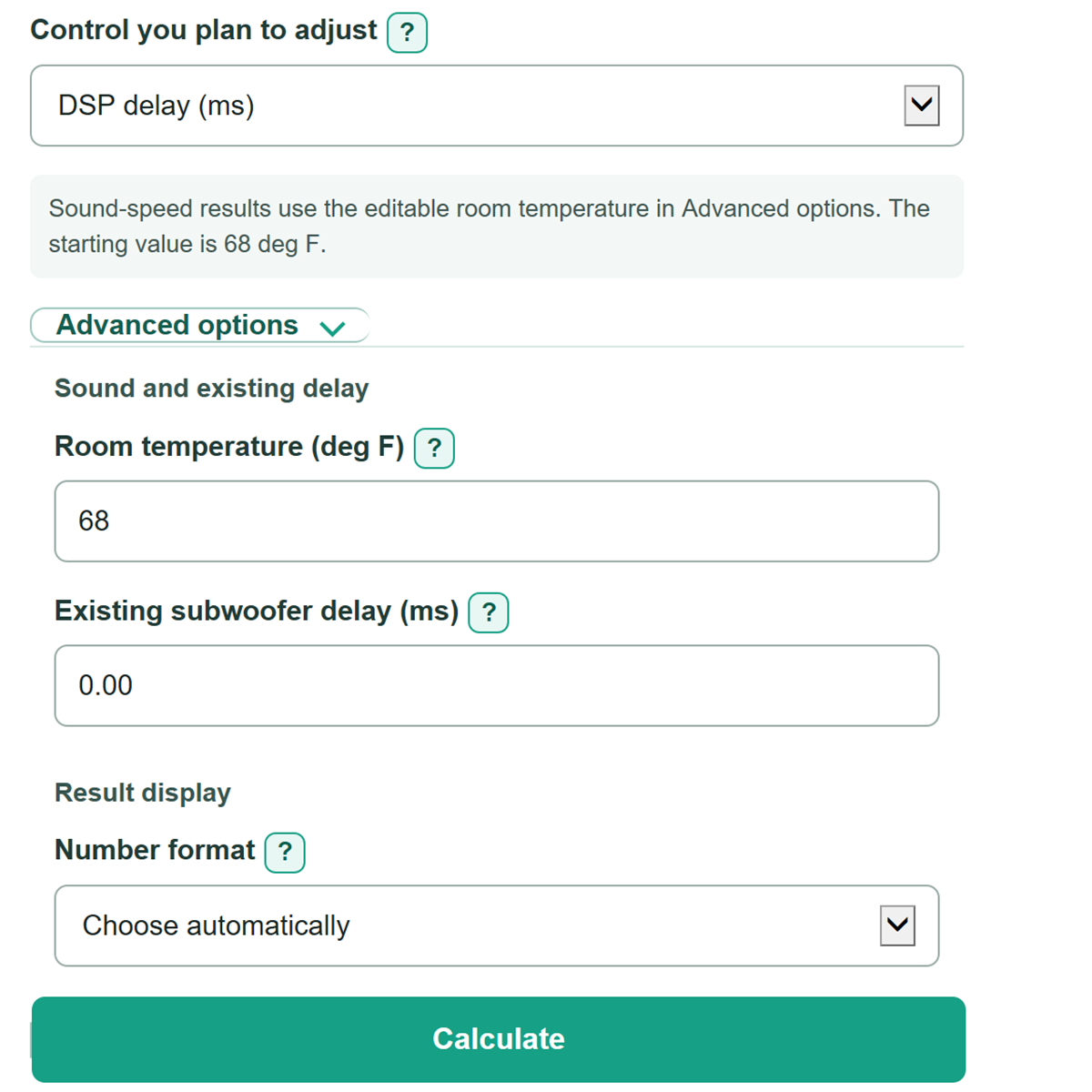
- Copy the crossover into Crossover frequency, then choose the equipment control under Control you plan to adjust.
- Open Advanced options only if needed. Enter Existing subwoofer delay (ms) if a DSP or subwoofer app already delays the subwoofer channel.
- Calculate, then use the named earlier source and Delay to add to the earlier source as a starting setting. Sanity-check that the signed arrival gap agrees with which source is farther or already delayed, then verify near the crossover in the room.
Definitions
Acoustic center: The approximate point on a speaker that sound seems to come from for timing purposes, often near the driver.
Crossover frequency: The frequency where the main speaker and subwoofer are intended to overlap and blend. The phase result is calculated at this one frequency.
Arrival gap: The signed difference between modeled subwoofer arrival time and main-speaker arrival time. A positive value means the subwoofer is later.
Compensating delay: A nonnegative amount of time added to the source that arrives earlier so the modeled arrivals match.
Phase gap: The timing difference expressed as degrees of one cycle at the crossover frequency. It is wrapped from -180 degrees up to, but not including, 180 degrees.
Polarity: A Normal or Invert setting that reverses waveform direction by 180 degrees. It is different from a variable phase dial and from time delay.
Equivalent AVR distance gap: The timing mismatch expressed in feet using the calculator's modeled speed of sound. It is a comparison value, not a command to replace an AVR distance setting.
Common mistakes and quick fixes
Mistake: Entering an AVR speaker-distance number as if it were a tape measurement in Main speaker distance or Subwoofer distance.
Fix: AVR distance can include processing latency. Use tape measurements for a geometric estimate, or use AVR values only when you mean to compare those reported paths.
Mistake: Typing a feet-and-inches value with 12 or more inches in Main speaker distance.
Fix: Convert 12 inches into one more foot. For example, enter 10 ft 6 in, not 10 ft 18 in.
Mistake: Using the wrong setting for Crossover frequency.
Fix: Copy the actual bass-management crossover between the main speakers and subwoofer. Wrapped phase gap at the crossover applies only at that entered frequency.
Mistake: Putting an AVR distance value into Existing subwoofer delay (ms).
Fix: Enter only a known electronic delay in milliseconds from a DSP, processor, or subwoofer app. Leave the field blank when no separate delay is known.
Mistake: Treating Wrapped phase gap at the crossover as a phase-dial setting that works at every frequency.
Fix: Use it as a timing-based estimate at the chosen crossover, then check the phase dial or polarity by measuring or listening around that crossover.
Mistake: Trying to apply a negative value instead of following Source that should receive the delay.
Fix: Add the displayed nonnegative delay to the earlier source. Delay can make a source later, not earlier.
Limitations & Key Assumptions / Boundary Conditions
- This is a geometric starting estimate for one subwoofer and one reference main speaker at one listening position. It does not find the best setting for several subwoofers or several seats.
- The speed-of-sound calculation uses a simplified dry-air model based on Room temperature (deg F). Humidity, air pressure, airflow, and local room conditions are not included.
- Physical distance does not include crossover-filter phase shift, amplifier and DSP latency, subwoofer internal processing, driver behavior, or room reflections. These can change the best final setting.
- An AVR speaker-distance value may include electronic timing adjustment, so it can differ from a tape measurement. Equivalent AVR distance gap is only a timing comparison.
- Wrapped phase gap at the crossover is valid only at the entered Crossover frequency. A phase dial may not act as a pure time delay across frequencies.
- Use measurements around the crossover when possible. If only listening is available, compare settings at the main seat and try Normal and Invert polarity where the equipment permits it.
Methodology
Calculation
The calculator converts the entered room temperature to absolute temperature, estimates dry-air sound speed, and uses that same speed for every distance and time conversion.
temperature_c = (room_temperature_f - 32) * 5 / 9
temperature_k = temperature_c + 273.15
speed_of_sound_m_s = sqrt(1.4 * 287.05 * temperature_k)
speed_of_sound_ft_ms = speed_of_sound_m_s * 3.280839895013123 / 1000
The physical path difference is subwoofer distance minus main-speaker distance. Existing subwoofer delay is added only when it is entered; a blank field counts as 0 ms.
measured_path_gap_ft = subwoofer_distance_ft - main_distance_ft
arrival_gap_ms = measured_path_gap_ft / speed_of_sound_ft_ms + existing_subwoofer_delay_ms
A positive arrival gap means the subwoofer is later. The delay recommendation uses the absolute value, then names the earlier source so the recommended delay is never negative.
compensating_delay_ms = abs(arrival_gap_ms)
equivalent_avr_distance_gap_ft = compensating_delay_ms * speed_of_sound_ft_ms
Phase is calculated from arrival time and the entered crossover. The final modulo step keeps the displayed phase gap within the signed range from -180 degrees through less than 180 degrees.
phase_raw_deg = arrival_gap_ms * crossover_frequency_hz * 0.36
phase_gap_deg = ((phase_raw_deg + 180) mod 360) - 180
Worked example
With a 10 ft main-speaker distance, a 14 ft subwoofer distance, 68 deg F room temperature, no existing subwoofer delay, and an 80 Hz crossover, the modeled path gap is 4 ft. The modeled arrival gap is about 3.552 ms, so the main speaker path is earlier and receives about 3.552 ms of delay. The phase gap at 80 Hz is about +102.3 degrees. The editable 80 Hz default is a common crossover reference supported by the cited subwoofer specification. [2]