
Enter wet batch size, solids, dose method, and prices to calculate a two-component recipe and wet-basis batch cost.
Advanced options
Table of contents
How to use our Latex and Polymer Solids Blend, Letdown and Batch Cost Calculator
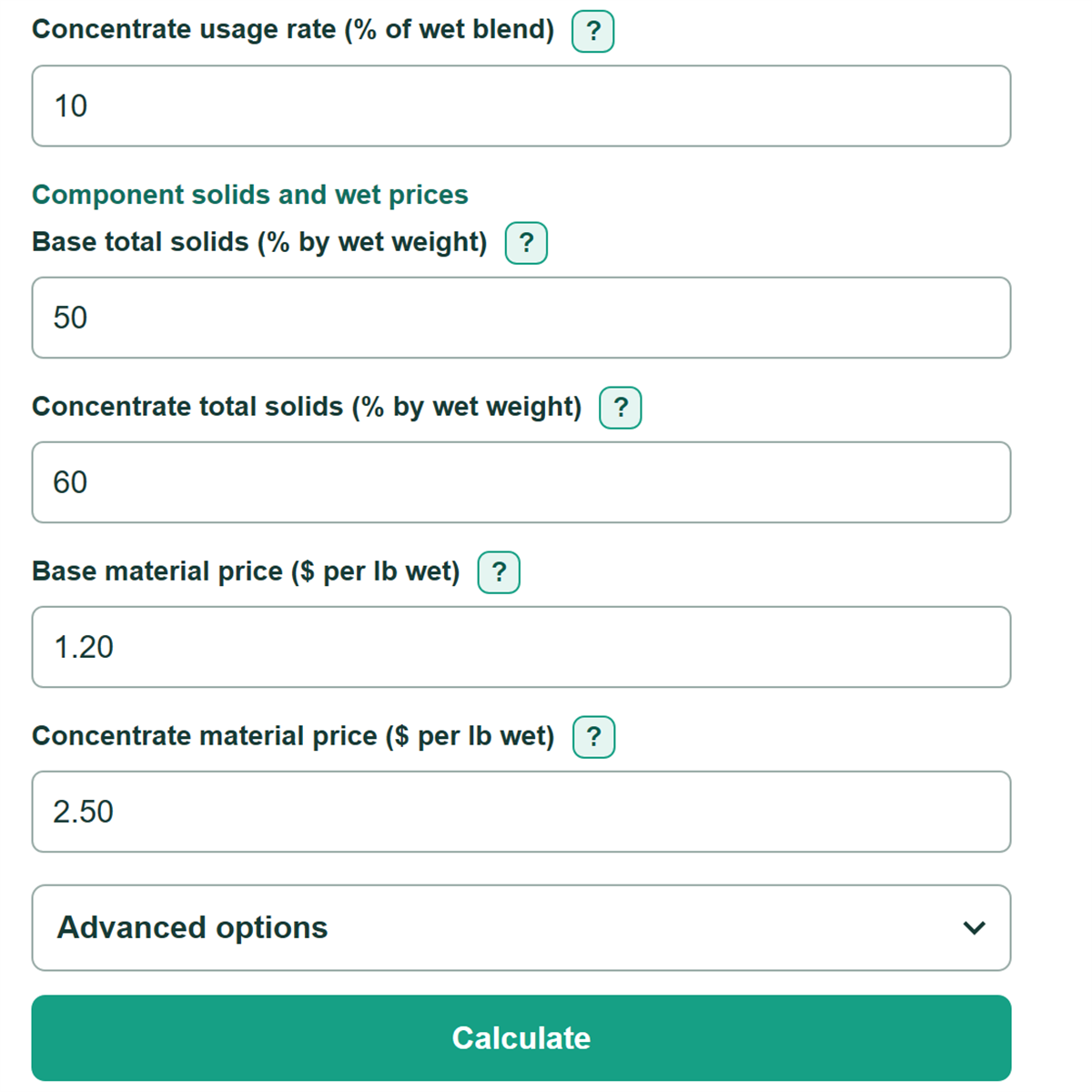
- Choose how to set the concentrate amount: usage rate, letdown ratio, or target final solids.
- Enter the Target wet batch size and copy Base total solids and Concentrate total solids from the applicable technical data sheet, certificate, or label.
- Enter the two wet-material prices from a quote, purchase order, or inventory cost record.
- Open Advanced options only if you need to add a Fixed batch charge or Processing charge.
- Click Calculate, then check that Concentrate wet addition plus Base wet addition equals the planned batch size and that Final blend solids fits your formula target.
Definitions
Wet blend: The combined liquid or slurry mass of base and concentrate before drying, measured here in lb.
Total solids: The portion of a wet material that remains as dry solids, expressed as a percent of that material's wet weight.
Concentrate usage rate: Concentrate wet mass divided by total wet blend mass, expressed as a percent.
Letdown ratio: Pounds of base used for each 1 lb of concentrate. A ratio of 9 means 9 lb base per 1 lb concentrate.
Final blend solids: Total dry solids in the finished blend divided by total wet blend mass, expressed as a percent.
Wet-basis price: Cost per lb of material as supplied, including its water or other non-solids portion.
Common mistakes and quick fixes
Mistake: Entering Concentrate usage rate as a percent of the base instead of a percent of the complete wet blend.
Fix: For a blend with 100 lb concentrate in 1,000 lb total wet blend, enter 10 for Concentrate usage rate.
Mistake: Treating Letdown ratio as total blend lb per concentrate lb.
Fix: Enter only base lb per concentrate lb in Letdown ratio. A 9:1 base-to-concentrate mix has a 10% concentrate share.
Mistake: Using active ingredient content in Base total solids or Concentrate total solids.
Fix: Use total solids by wet weight from the product documentation for both solids inputs.
Mistake: Entering a dry-solids price in Base material price or Concentrate material price.
Fix: These fields require $ per lb wet. Convert a dry-solids quote before using it, or obtain the wet-basis price.
Mistake: Entering gallons as Target wet batch size.
Fix: Enter lb only. Convert volume to wet pounds first using a documented product density.
Mistake: Putting setup cost into Processing charge and Fixed batch charge at the same time.
Fix: Check Choose how to set the concentrate amount and then recalculate. Put once-per-batch costs in Fixed batch charge and costs that scale with wet batch pounds in Processing charge.
Limitations & Key Assumptions / Boundary Conditions
- The calculation includes exactly two wet components: one base and one concentrate.
- All quantities use wet pounds. Gallons cannot be used unless they are first converted to pounds with a documented density.
- Solids inputs must be total solids by wet weight. Active ingredient, volatile content, or another product-specific percentage may not be interchangeable with total solids.
- Target final solids can only fall between the two component solids percentages. If both component solids values are equal, the target cannot determine the mix ratio.
- Material prices must be on a wet $ per lb basis. Fixed batch charges apply once per batch, while Processing charge scales with total wet batch mass.
- The worksheet does not predict compatibility, dispersion, viscosity, drying behavior, stability, regulatory compliance, or final product performance.
Methodology
How the recipe is calculated
The selected dose method first sets the concentrate fraction, meaning the part of the total wet blend that is concentrate. Only one dose method is used for each calculation.
concentrate fraction = usage rate / 100
concentrate fraction = 1 / (letdown ratio + 1)
concentrate fraction = (target final solids - base total solids) / (concentrate total solids - base total solids)
Wet additions are then calculated from the planned total wet batch mass.
concentrate wet lb = target wet batch lb * concentrate fraction
base wet lb = target wet batch lb - concentrate wet lb
Each component's dry solids equal its wet addition multiplied by its total-solids percentage. The final blend solids percentage is total dry solids divided by total wet batch mass.
total dry lb = concentrate wet lb * concentrate solids / 100 + base wet lb * base solids / 100
final blend solids = 100 * total dry lb / target wet batch lb
Cost calculation
Component material cost uses each wet addition and its own wet-basis price. The optional processing charge scales with batch mass, while the optional fixed charge is added once.
material cost = base wet lb * base price + concentrate wet lb * concentrate price
total batch cost = material cost + target wet batch lb * processing charge + fixed batch charge
batch cost per lb = total batch cost / target wet batch lb
Worked example
For a 1,000 lb batch with 50% base solids, 70% concentrate solids, and a 55% final-solids target, the concentrate fraction is (55 - 50) / (70 - 50) = 0.25. The recipe is 250 lb concentrate and 750 lb base. With prices of $3.00 per lb concentrate and $1.10 per lb base, material cost is $1,575. Adding a $200 processing charge and $100 fixed charge gives a Total batch cost of $1,875, or $1.875 per lb of wet blend.