
Estimate resin to stage for a fiberglass infusion from dry fiber mass, laminate area, consumable uptake, and feed-line hold-up.
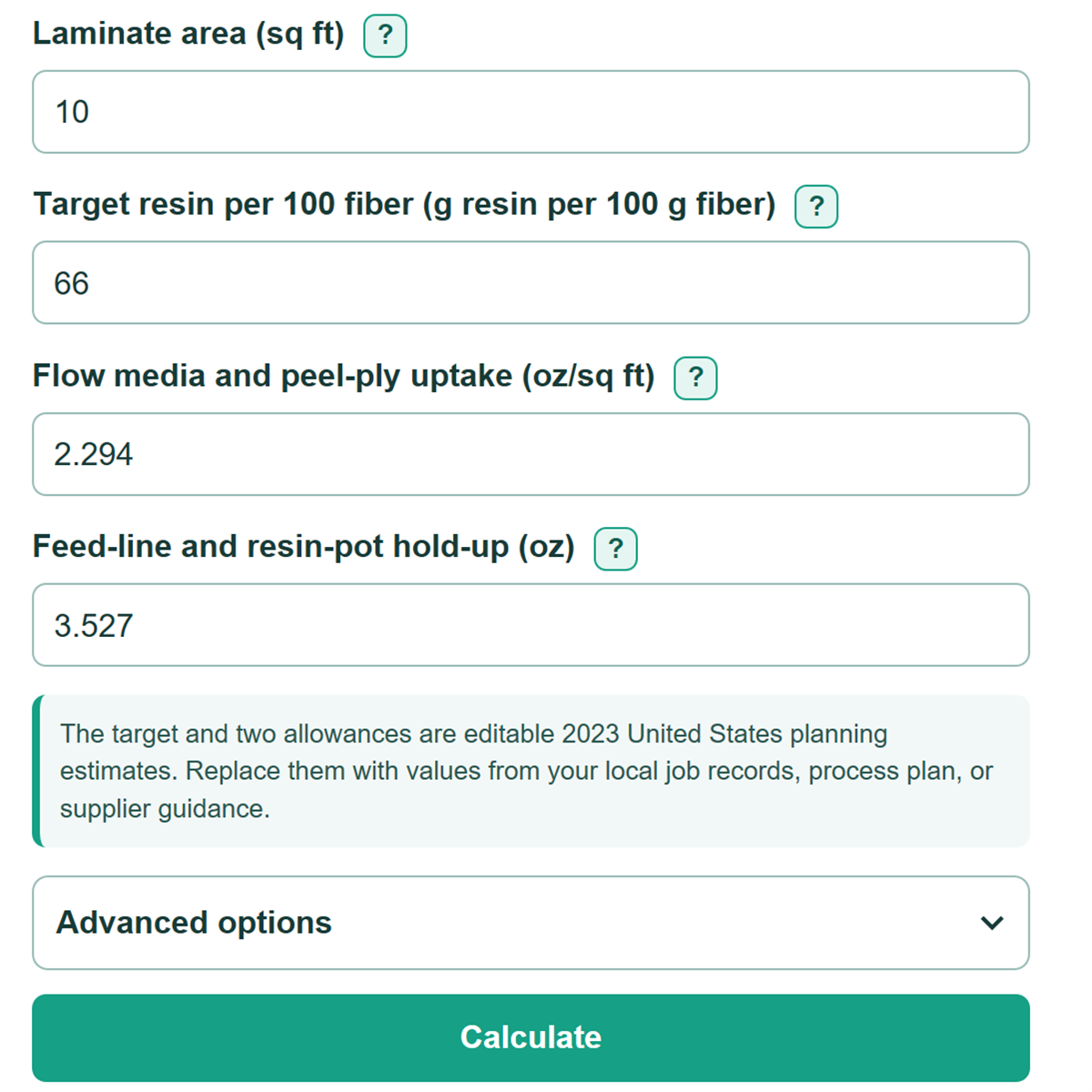
The target and two allowances are editable 2023 United States planning estimates. Replace them with values from your local job records, process plan, or supplier guidance.
Advanced options
Table of contents
How to use our Fiberglass Resin Infusion Calculator
- Choose Input units that match your cut list, drawing, and supplier price.
- Enter the total Dry fiber mass for the cut reinforcement stack and the net Laminate area covered by flow media and peel ply.
- Check Target resin per 100 fiber, Flow media and peel-ply uptake, and Feed-line and resin-pot hold-up. Replace the planning defaults with values from a validated job setup when available.
- Open Advanced options only if you want volume or cost, then enter Resin density (g/cm3) and/or Resin price ($ per lb in US mode; $ per kg in metric mode).
- Click Calculate. Check that the itemized amounts add up to Total resin to stage and compare the total with a prior similar infusion or a small trial setup before mixing.
Definitions
Dry fiber mass: The weight of all dry reinforcement in the cut laminate stack, before resin is added.
Target resin per 100 fiber: Grams of resin planned for each 100 g of dry fiber. A value of 66 means 66 g resin per 100 g fiber, which is a mass-based plan.
Laminate wet-out resin: The resin calculated for the reinforcement itself from dry fiber mass and the target resin amount.
Flow media and peel-ply uptake: Resin absorbed by those infusion consumables over the laminate area. It is separate from resin inside the laminate.
Feed-line and resin-pot hold-up: Resin expected to remain in the feed line and resin pot after an infusion. It is included once per infusion.
Resin density: Resin mass per volume, in g/cm3. One g/cm3 equals one g/mL, so density converts resin mass into an estimated volume.
Fiber volume fraction: The percentage of the finished composite volume occupied by fiber. It is different from the fiber-to-resin mass plan used here because fiber and resin can have different densities.
Planning defaults: The starting target, consumable uptake, and hold-up values come from a resin-infusion planning guide and should be replaced with validated job values when possible. [1]
Common mistakes and quick fixes
Mistake: Entering fabric areal weight, such as 6 oz/yd2, as Dry fiber mass.
Fix: Add the mass of all cut dry fabric pieces or weigh the complete dry stack, then enter that total as Dry fiber mass.
Mistake: Treating Target resin per 100 fiber as fiber volume percentage.
Fix: Enter grams of resin planned for each 100 g of dry fiber. This calculator uses a fiber-to-resin mass plan, not fiber volume fraction.
Mistake: Calculating only Laminate wet-out resin and ignoring Flow media and peel-ply uptake.
Fix: Measure or estimate the covered Laminate area and enter the uptake for the actual consumable stack.
Mistake: Leaving Feed-line and resin-pot hold-up at zero because it is not part of the panel.
Fix: Include the resin expected to remain in the feed line and pot once for each infusion.
Mistake: Using Resin density (g/cm3) as a hardener mix ratio.
Fix: Use Resin density (g/cm3) only for Estimated total resin volume. Follow the resin manufacturer's instructions for the required mix ratio.
Mistake: Entering a package total instead of Resin price ($ per lb in US mode; $ per kg in metric mode).
Fix: Divide the resin-only package price by its resin weight first, then enter the price per lb or per kg shown for the selected Input units.
Limitations & Key Assumptions / Boundary Conditions
- The result is a resin staging estimate, not a hardener, catalyst, or cure recipe. Follow the exact resin product technical data sheet and safety data sheet for mixing and handling.
- Target resin per 100 fiber, Flow media and peel-ply uptake, and Feed-line and resin-pot hold-up are editable planning estimates. Actual use can change with fabric, flow media, peel ply, line length, pot size, leaks, and process control.
- Laminate area may be zero for a valid calculation, which makes Flow media and peel-ply resin zero. Dry fiber mass may also be zero, which makes Laminate wet-out resin zero.
- Estimated total resin volume appears only when Resin density (g/cm3) is entered and greater than zero. Use the density for the specific resin product and temperature range stated by its manufacturer.
- Estimated resin material cost covers resin only. It excludes hardener, catalyst, shipping, tax, consumables, labor, and waste not captured by the entered allowances.
- The calculator does not calculate fiber volume fraction, cured laminate thickness, vacuum quality, flow time, or whether a given resin quantity can be mixed safely in one batch.
Methodology
Calculation method
The calculator converts US entries to grams and square meters internally, calculates three separate resin uses, then converts the displayed answers back to the selected input system. The resin target is a mass plan: it does not calculate fiber volume fraction.
laminate_resin_mass_g = dry_fiber_mass_g * target_resin_per_100_fiber / 100flow_media_peel_ply_resin_mass_g = laminate_area_m2 * flow_media_peel_ply_uptake_g_m2total_resin_mass_g = laminate_resin_mass_g + flow_media_peel_ply_resin_mass_g + feed_line_pot_hold_up_gLaminate wet-out resin depends on dry fiber mass. Flow-media and peel-ply resin depends on area. Feed-line and resin-pot hold-up is a fixed amount added once, so the plan does not hide these different uses inside one general waste percentage.
Optional volume and cost
total_resin_volume_ml = total_resin_mass_g / resin_densityestimated_resin_cost = total_resin_mass_g / price_mass_unit * resin_priceFor US pricing, price_mass_unit is 453.59237 g per lb. For metric pricing, it is 1,000 g per kg. Volume is calculated only with a supplied density greater than zero, and cost is calculated only with a supplied price of zero or more.
Worked example
With 2,000 g dry fiber, 2 m2 laminate area, a 50 g per 100 g target, 500 g/m2 consumable uptake, and 50 g hold-up, laminate wet-out resin is 1,000 g, consumable resin is 1,000 g, and hold-up is 50 g. Total resin to stage is 2,050 g. At 1.025 g/cm3, estimated volume is 2,000 mL. At $12 per kg, estimated resin material cost is $24.60.
Planning values
The default 66 g resin per 100 g fiber, 700 g/m2 flow-media and peel-ply uptake, and 100 g feed-line and resin-pot hold-up are editable planning values from the cited resin-infusion guide. They are starting values, not universal settings. [1]