
Calculate blended coating VOC content and estimated VOC emissions from your recipe, material use, and optional cleanup solvent record.
Advanced options
Cleanup or purge solvent
Table of contents
How to use our Coating VOC Emissions Calculator
- Choose Estimate period: One job, One hour, or One year. Use the period that matches your material-use record.
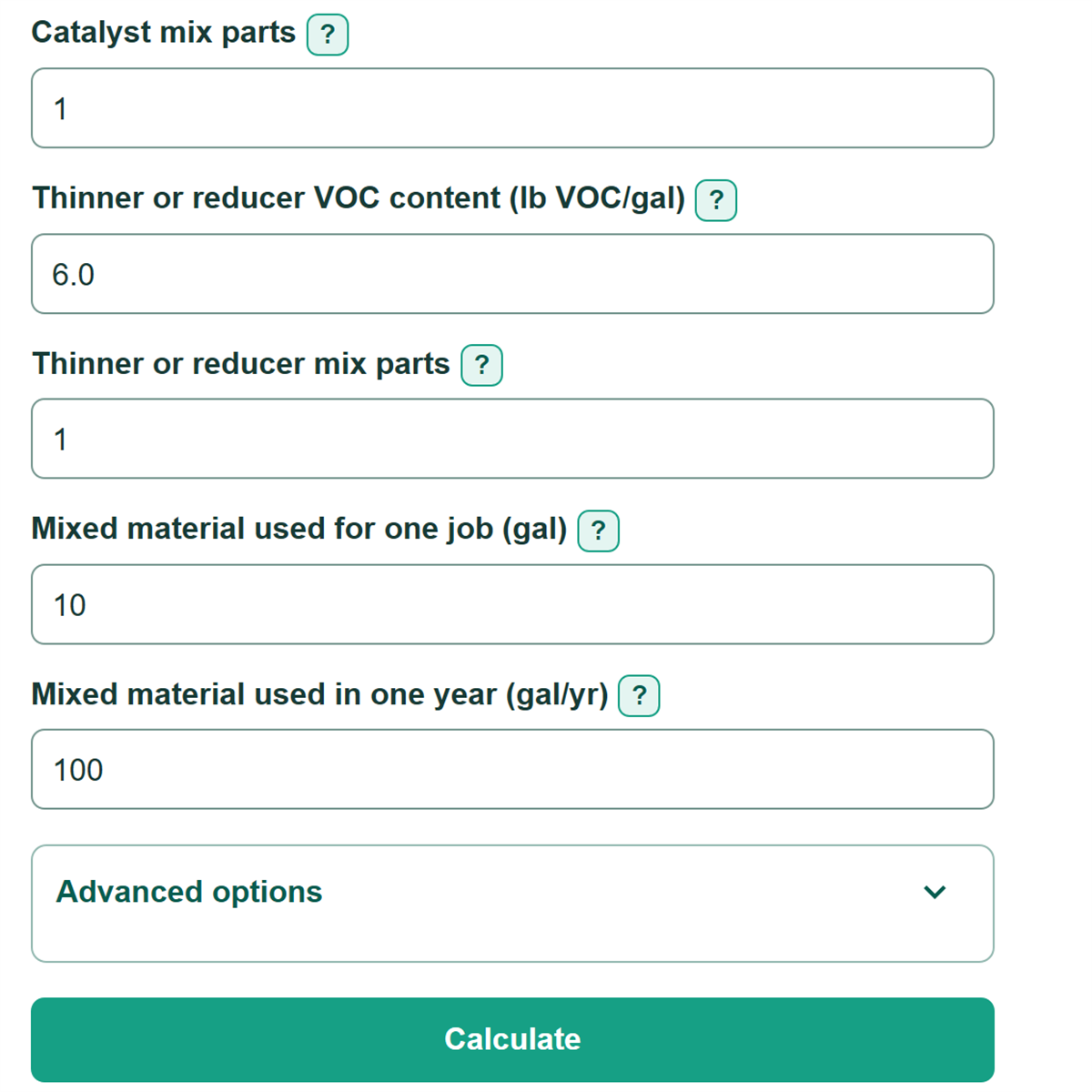
- Copy each product's as-supplied VOC value into Coating VOC content, Catalyst VOC content, and Thinner or reducer VOC content.
- Enter the matching recipe numbers in Coating mix parts, Catalyst mix parts, and Thinner or reducer mix parts. Enter 0 parts for a product that is not used.
- Enter total mixed material used for the selected period, not gallons for each recipe component. Add cleanup data in Advanced options only when you have a complete solvent record.
- Check that As-applied VOC content is believable for the products and recipe entered, then use Estimated VOC emitted for selected period as an inventory or planning estimate.
Definitions
VOC: Volatile organic compounds, which are carbon-containing chemicals that can evaporate into air from coatings and solvents.
As-applied VOC content: VOC mass per gallon after the coating, catalyst, and thinner or reducer are mixed in the entered recipe.
Mix parts: Relative amounts in a recipe, usually parts by volume. A 4:1:1 recipe has 6 total parts.
Cleanup or purge solvent: Solvent used to clean equipment or clear lines, counted separately from mixed coating material.
Reclaimed solvent: Cleanup or purge solvent recorded as recovered. The calculator subtracts reclaimed gallons from used gallons before estimating cleanup-solvent VOC.
Short ton: A US short ton equals 2,000 pounds.
Common mistakes and quick fixes
Mistake: Entering a regulatory less-water or less-exempt-compounds value in Coating VOC content.
Fix: Use the product's as-supplied lb VOC/gal value for Coating VOC content, Catalyst VOC content, and Thinner or reducer VOC content.
Mistake: Treating Mixed material used in one year as gallons of coating alone.
Fix: Enter total gallons of the fully mixed material. The calculator splits that amount using Coating mix parts, Catalyst mix parts, and Thinner or reducer mix parts.
Mistake: Leaving Catalyst VOC content blank while Catalyst mix parts is greater than 0.
Fix: Enter the catalyst's VOC content or change Catalyst mix parts to 0 if no catalyst is used.
Mistake: Entering Cleanup or purge solvent used for selected period without Cleanup or purge solvent VOC content.
Fix: Check Estimate period and then recalculate. Enter both values for a cleanup record, or clear both fields if cleanup solvent is not included.
Mistake: Entering more Cleanup or purge solvent reclaimed for selected period than Cleanup or purge solvent used for selected period.
Fix: Check Estimate period and then recalculate. Check that both entries cover the same selected period and that reclaimed gallons do not exceed used gallons.
Mistake: Using Estimated VOC emitted for selected period as a compliance decision.
Fix: Compare As-applied VOC content only with the applicable coating-category limit on the same VOC basis, and verify permit requirements separately.
Limitations & Key Assumptions / Boundary Conditions
- This is a mass-balance estimate. It assumes VOC included in the entered mixed coating and net cleanup solvent is emitted during the selected period.
- Use as-supplied VOC values that match the product documents. Regulatory VOC values may use a different basis, such as less water or less exempt compounds.
- The result does not determine compliance, permit applicability, reporting requirements, fees, coating-category limits, or control-device performance.
- Transfer efficiency, capture efficiency, destruction efficiency, overspray, water, exempt compounds, and hazardous air pollutants are not calculated.
- Cleanup solvent is included only when both its VOC content and gallons used are entered. Reclaimed gallons reduce the cleanup estimate only as recorded.
- Each selected period is calculated from its own material-use entry. The calculator does not convert jobs or hours into annual use.
Methodology
Recipe calculation
The calculator adds the three recipe-part entries, then uses each product's share of those parts to find the VOC content of one gallon of mixed coating.
total_mix_parts = coating_parts + catalyst_parts + thinner_parts
as_applied_voc_lb_per_gal = (coating_voc_lb_per_gal * coating_parts + catalyst_voc_lb_per_gal * catalyst_parts + thinner_voc_lb_per_gal * thinner_parts) / total_mix_parts
A component with 0 mix parts contributes no VOC and does not need a VOC value. Total mix parts must be greater than 0.
Emissions calculation
The selected mixed-material use is multiplied by the as-applied VOC content. This gives VOC from the mixed coating recipe for the selected period.
recipe_voc_lb = selected_material_use_gal * as_applied_voc_lb_per_gal
If a complete cleanup or purge-solvent record is entered, the calculator subtracts reclaimed gallons before adding the solvent's VOC contribution.
cleanup_solvent_voc_lb = (cleanup_solvent_used_gal - cleanup_solvent_reclaimed_gal) * cleanup_solvent_voc_lb_per_gal
estimated_voc_emitted_lb = recipe_voc_lb + cleanup_solvent_voc_lb
For One year, the calculator also divides annual pounds by 2,000 to show US short tons.
annual_voc_tons = estimated_voc_emitted_lb / 2000
Worked example
For a 4:1:
1 recipe with coating at 3.0 lb VOC/gal, catalyst at 1.0 lb VOC/gal, and thinner at 6.0 lb VOC/gal, the mixed VOC content is (3.0 x 4 + 1.0 x 1 + 6.0 x 1) / 6 = 3.1667 lb VOC/gal. If 100 gallons are used in one year, recipe VOC is 316.67 lb. Adding 10 gallons of cleanup solvent at 5.0 lb VOC/gal with 2 gallons reclaimed adds 40 lb, for 356.67 lb total, or about 0.1783 short tons.