
Calculate dry-film PVC, compare it with a measured or estimated CPVC, and see the PVC-to-CPVC ratio for your coating formulation.
Table of contents
How to use our Paint Pigment Volume Concentration and Critical PVC Calculator
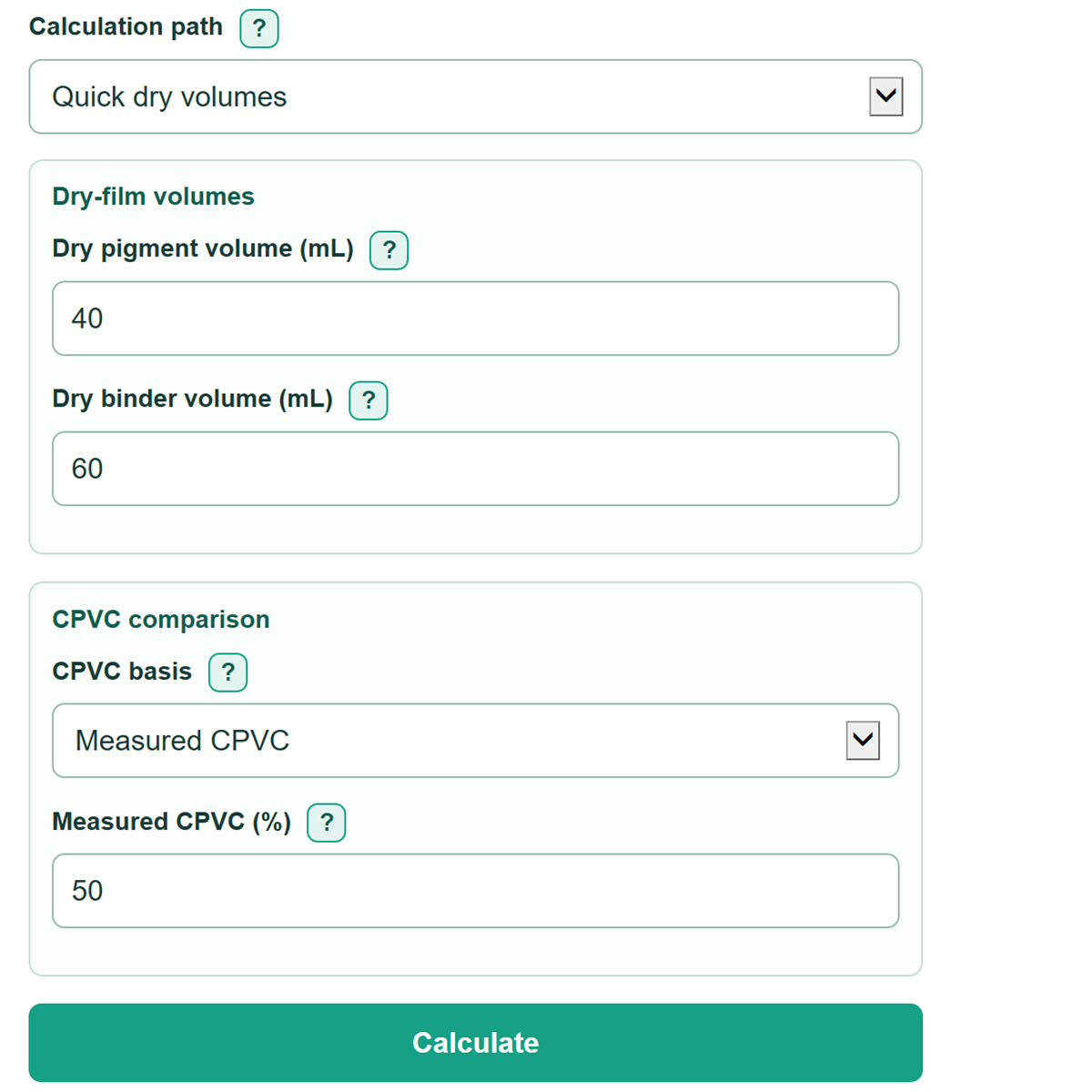
- Choose Calculation path. Select Quick dry volumes when you already know dry-film volumes, or From formulation data when you have masses and supplied-binder properties.
- Enter the visible pigment and binder values. In Quick dry volumes, use only Dry pigment volume (mL) and Dry binder volume (mL).
- Choose a CPVC basis. Enter Measured CPVC (%) from relevant testing, or use the oil-absorption fields for an estimate.
- Click Calculate. Read Dry-film PVC, CPVC used for comparison, and PVC compared with CPVC together.
- Sanity-check the dry volumes used. They should match your formulation worksheet and should not include solvent or other material that evaporates before the film dries.
Definitions
Dry-film PVC: Pigment volume divided by the combined volume of pigment and dry binder, expressed as a percent. PVC uses material remaining after volatile material leaves the coating. [1]
CPVC: Critical pigment volume concentration, a comparison point where there may no longer be enough binder to fill the spaces around pigment particles. Its practical value depends on the materials and formulation. [1]
Lambda: The PVC-to-CPVC ratio. A value below 1 means PVC is below the selected CPVC; 1 or more means PVC is at or above it.
Oil absorption: Liquid uptake reported as grams of oil per 100 grams of pigment. This calculator converts that liquid mass to volume for a simplified CPVC estimate.
g/cc: Grams per cubic centimeter, a density unit. One cubic centimeter equals one milliliter.
Binder solids by mass: The percent of supplied binder mass treated as nonvolatile material in the formulation-data conversion.
Common mistakes and quick fixes
Mistake: Entering wet or supplied binder volume as Dry binder volume (mL).
Fix: Use resin-solids volume only, or choose From formulation data and enter Supplied binder mass (g) with its properties.
Mistake: Using a pigment-to-binder mass ratio instead of Dry pigment volume (mL) and Dry binder volume (mL).
Fix: PVC is volume-based. Convert mass to volume with density when needed.
Mistake: Entering the density of dry resin into Supplied binder density (g/cc).
Fix: Enter the density of the full binder as supplied, including its volatile portion.
Mistake: Treating Oil absorption (g oil per 100 g pigment) as a measured critical point.
Fix: Read an oil-based value as an estimate and check CPVC basis status before using it for a formulation decision.
Mistake: Reading a PVC compared with CPVC ratio near or above 1 as a full performance prediction.
Fix: Use it as a composition comparison only; confirm coating properties with relevant formulation and film testing.
Limitations & Key Assumptions / Boundary Conditions
- PVC is calculated from dry pigment and dry binder volumes only. Solvent, water, and other volatile material do not belong in the dry-film total.
- The formulation-data path treats all binder material outside Binder solids by mass as solvent and removes its volume using Solvent density (g/cc). Real supplied binders can contain components that do not follow this simplified split.
- An oil-absorption CPVC estimate is a comparison aid. It is not a lab-confirmed, formulation-specific CPVC.
- Measured CPVC is only as relevant as the pigment, binder, dispersion, and test conditions behind the supplied value.
- A PVC-to-CPVC ratio does not by itself predict gloss, adhesion, porosity, durability, or other coating properties.
- The calculator blocks inputs that imply a negative dry binder volume because that combination is physically inconsistent within this model.
Methodology
Dry-film volume calculation
Quick dry volumes uses the entered dry pigment and dry binder volumes directly. In formulation-data mode, pigment mass is converted with pigment density. Supplied binder volume is calculated first, then the estimated solvent volume is removed.
dry pigment volume (mL) = pigment mass (g) / pigment density (g/cc)
dry binder volume (mL) = supplied binder mass / supplied binder density - supplied binder mass x (1 - binder solids by mass / 100) / solvent density
PVC and CPVC comparison
Dry-film PVC is the pigment share of total dry-film volume. The selected CPVC is either the entered measured value or the oil-absorption estimate. Lambda divides PVC by CPVC. PVC is commonly used to describe the pigment-to-binder volume balance in a dry coating film. [1]
PVC (%) = dry pigment volume / (dry pigment volume + dry binder volume) x 100
estimated CPVC (%) = (100 / pigment density) / ((100 / pigment density) + (oil absorption / estimate liquid density)) x 100
lambda = PVC / CPVC
Worked example
With 40 mL of dry pigment and 60 mL of dry binder, total dry-film volume is 100 mL. PVC is 40%. If measured CPVC is 50%, lambda is 40 / 50 = 0.8, so the PVC is below the selected CPVC.
Calculation scope
The oil-absorption method compares the volume of 100 g of pigment with the volume of liquid represented by its oil absorption. The formulation-data path assumes the non-solids portion of supplied binder is solvent. Values that produce zero or negative required volumes, invalid percentages, or a negative dry binder volume are rejected.