
Calculate how much of one PCR or qPCR reagent to prepare after counting wells, pipetting overage, and fixed dead volume.
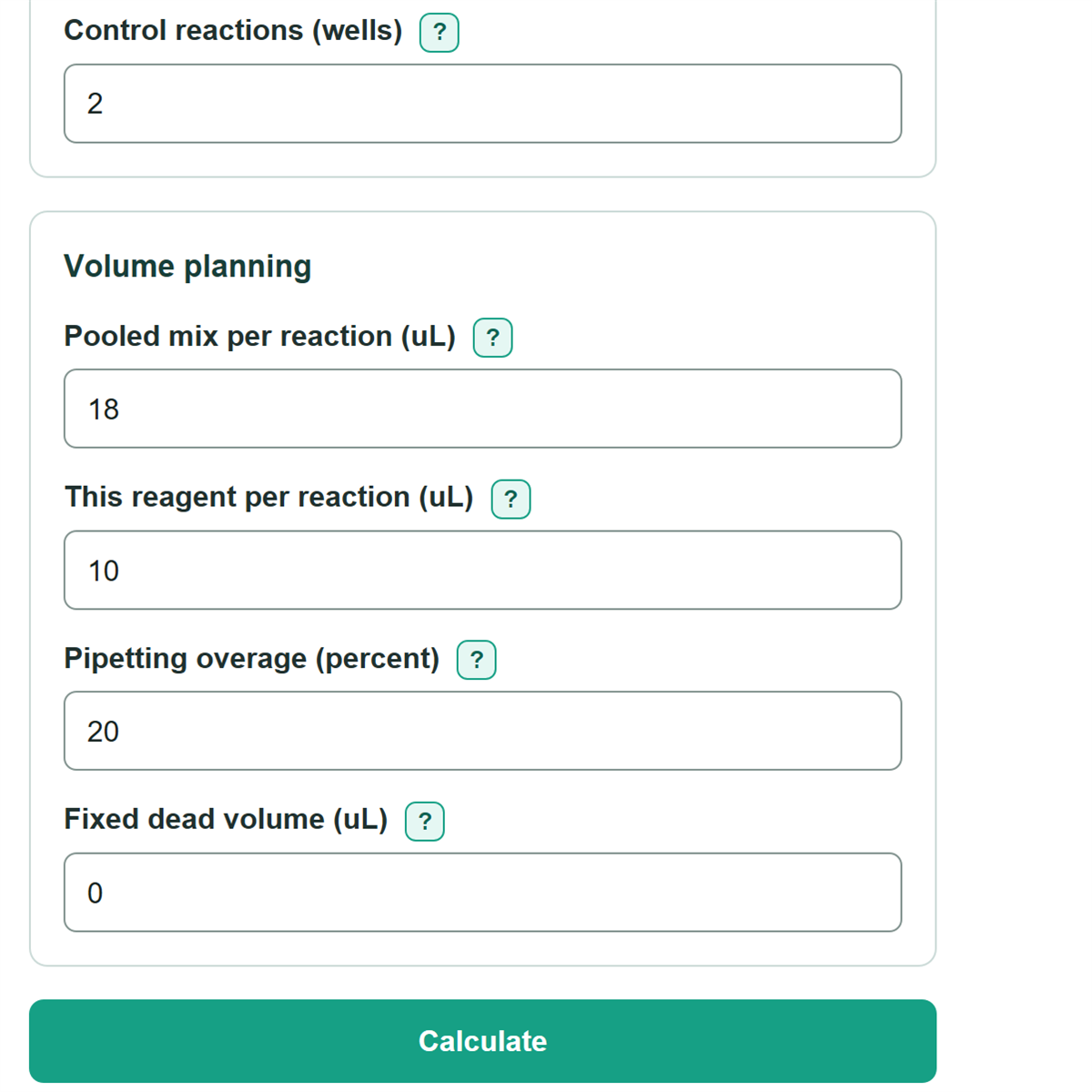
Volume planning
Pipette this amount of the selected reagent into the pooled mix, subject to your validated protocol and pipette limits.
This is the shared mix volume before separately added template or sample.
Check this count against the plate map before preparing reagents.
Fixed dead volume can make this a fractional number of reaction-sized portions.
This is the reagent amount above the exact requirement for the planned wells.
Table of contents
How to use our Reagent Volume, Replicates, Dead Volume and Overage Calculator
- Enter Samples, then enter the number of Dilutions or conditions per sample and Technical replicates shown on the plate plan.
- Enter total Standard reactions and Control reactions as wells, including any replicates already planned for those wells.
- Copy the shared master-mix dispense amount into Pooled mix per reaction. Do not include template or sample if it is added separately.
- Enter the selected component's recipe amount in This reagent per reaction, then add the protocol's Pipetting overage and any labware Fixed dead volume.
- Click Calculate, then compare Planned reaction wells with the plate map and confirm that Reagent volume to prepare fits your validated recipe and pipette limits.
Definitions
Technical replicates: Repeated reaction wells for the same sample and condition.
Pooled mix: The shared PCR or qPCR mixture dispensed to wells before separately added sample or template.
Pipetting overage: A percentage added to the planned reaction volume to allow for transfer and dispensing loss.
Fixed dead volume: A set amount of pooled mix left behind in a reservoir, trough, tube, or source well.
Reaction-sized portion: One Pooled mix per reaction amount. It can be fractional because fixed dead volume is converted into portions.
Common mistakes and quick fixes
Mistake: Entering the number of sample tubes in Samples but forgetting Technical replicates.
Fix: Enter each repeated well in Technical replicates; the calculator multiplies Samples, Dilutions or conditions per sample, and Technical replicates.
Mistake: Entering standard concentrations instead of the number of Standard reactions.
Fix: Enter the total standard wells, including their replicates, in Standard reactions.
Mistake: Including separately added template in Pooled mix per reaction.
Fix: Use only the shared mix dispensed from the pooled source in Pooled mix per reaction.
Mistake: Setting This reagent per reaction higher than Pooled mix per reaction.
Fix: Check the per-reaction recipe. One reagent cannot take up more volume than the whole pooled mix.
Mistake: Treating Fixed dead volume as another percentage.
Fix: Enter Pipetting overage as a percent and Fixed dead volume as the measured or specified uL left in the source vessel.
Mistake: Using Reagent volume to prepare as the final instruction without checking its size.
Fix: If Reagent volume to prepare is below 1 uL, use your lab's validated approach for small-volume handling before preparing the run.
Limitations & Key Assumptions / Boundary Conditions
- This calculator scales one selected reagent at a time. Run it separately for every pooled component in the recipe.
- It assumes the selected reagent makes up the same fraction of fixed dead volume as it does of each pooled reaction.
- Use only the shared pooled dispense volume for Pooled mix per reaction. Template, sample, or another separately added material is outside this calculation.
- Pipetting overage and Fixed dead volume must come from the validated protocol, lab SOP, labware specification, or a measured local value.
- The math does not check reagent compatibility, concentration, contamination risk, plate capacity, pipette accuracy, or whether a small calculated volume is practical to dispense.
- Whole-well counts are required. A plan with no sample, standard, or control wells is an error.
Methodology
Calculation method
The calculator first counts sample wells, then adds separately planned standard and control wells.
sample_reactions = samples * dilutions_or_conditions_per_sample * technical_replicates
planned_reactions = sample_reactions + standard_reactions + control_reactions
Percent overage grows with the number of planned wells. Fixed dead volume is added once, then converted to reaction-sized portions using the shared pooled volume.
prepared_reaction_equivalents = planned_reactions * (1 + pipetting_overage / 100) + fixed_dead_volume / pooled_mix_per_reaction
The selected reagent is scaled by its per-reaction amount. The total pooled mix is scaled by the full shared pooled amount.
reagent_volume_to_prepare = this_reagent_per_reaction * prepared_reaction_equivalents
total_pooled_mix_volume = pooled_mix_per_reaction * prepared_reaction_equivalents
extra_reagent_volume = reagent_volume_to_prepare - (this_reagent_per_reaction * planned_reactions)
Worked example
For 8 samples, 1 condition, 3 technical replicates, and 2 control wells, there are 26 planned reaction wells. With 20% overage, no dead volume, 18 uL pooled mix per reaction, and 10 uL of the selected reagent per reaction, the calculator prepares 31.2 reaction-sized portions. That requires 312 uL of the reagent and 561.6 uL total pooled mix.
Assumptions and limits
The calculation treats overage as proportional to planned reactions and dead volume as a fixed pooled-mix loss. It does not round volumes to a pipette increment, so apply the rounding rules and minimum-volume practices in your validated laboratory procedure.