
Calculate the concentrated stock volume or mass needed to prepare a target acid or base solution in M, N, or percent.
Table of contents
How to use our Concentrated Acid or Base Solution Preparation Calculator
- Choose the concentration basis written in your protocol: molarity, normality, % w/w, % w/v, or % v/v.
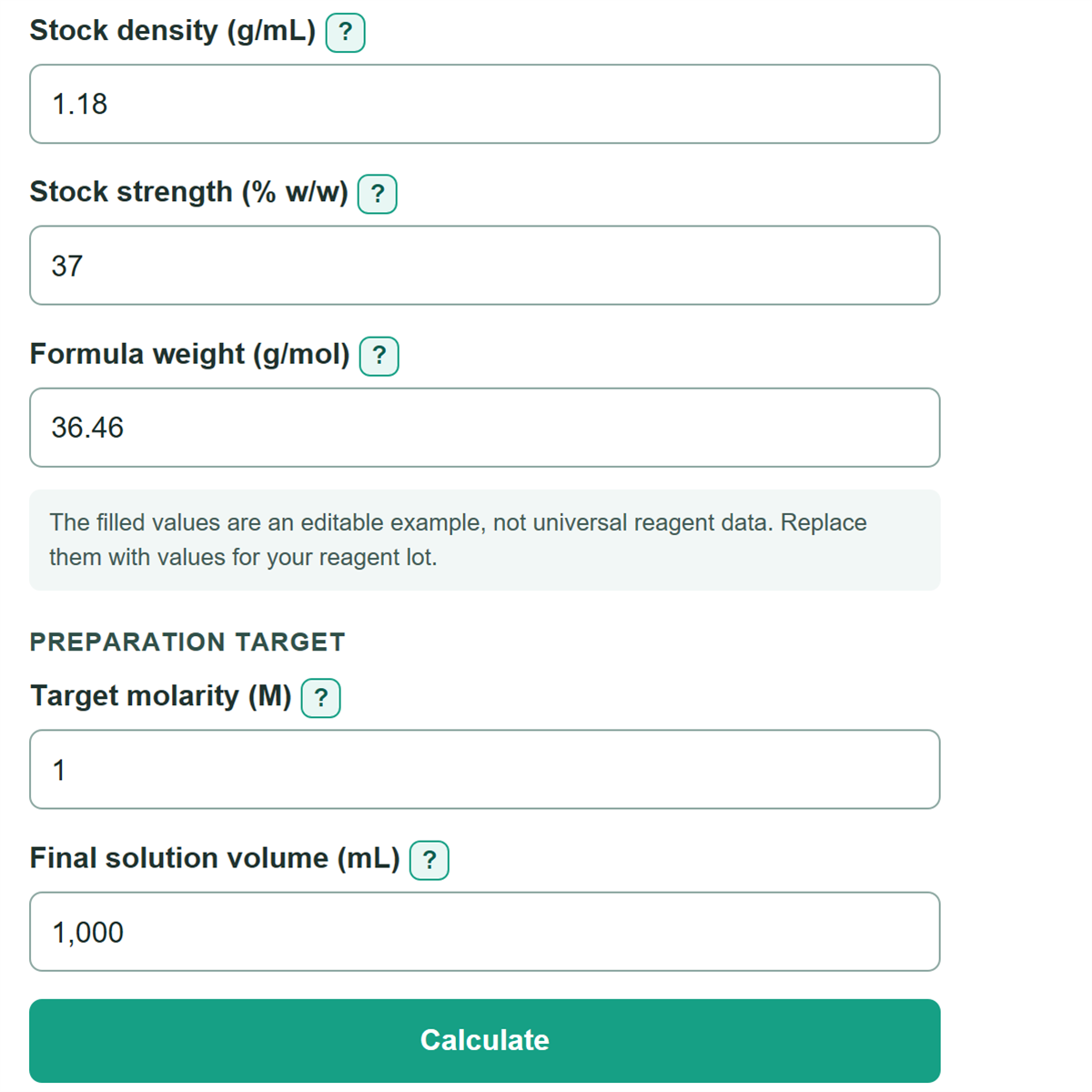
- For modes that use stock properties, copy Stock density and Stock strength from the reagent label or lot-specific Certificate of Analysis. Enter Formula weight for molarity or normality.
- Enter the target concentration and the completed Final solution volume or Final solution mass. These are final amounts, not the amount of water to add.
- Select Calculate. Measure the stated Concentrated stock to measure or Concentrated stock mass needed using suitable lab equipment.
- Sanity-check that the calculated stock amount is less than or equal to the final batch amount, then prepare safely and bring the completed mixture to the stated final volume or mass.
Definitions
Molarity (M): Moles of the named acid or base in 1 liter of completed solution.
Normality (N): Reactive equivalents in 1 liter of completed solution. Its value depends on the specific reaction and the entered reactive equivalents per mole.
Stock density (g/mL): Mass of 1 mL of the concentrated reagent solution. It converts stock mass into stock volume.
Stock strength (% w/w): Grams of active acid or base per 100 g of concentrated stock solution.
Formula weight (g/mol): Mass of 1 mole of the chemical basis used for the assay and calculation.
% w/w: Grams of active chemical per 100 g of completed solution. [1]
% w/v: Grams of active chemical per 100 mL of completed solution. [1]
% v/v: In this calculator, mL of concentrated stock per 100 mL of completed solution.
Common mistakes and quick fixes
Mistake: Entering a bottle label stated as % w/w into Target concentration for a % w/v or % v/v preparation.
Fix: Check the selected preparation basis first. Stock strength is always % w/w, while Target concentration follows the selected mode.
Mistake: Treating Final solution volume as the volume of water to add.
Fix: Add the calculated stock to some diluent, then adjust the completed mixture to the entered Final solution volume.
Mistake: Using a general density value that does not match the reagent bottle.
Fix: Replace Stock density and Stock strength with values from the matching reagent label or lot-specific Certificate of Analysis.
Mistake: Entering the wrong Formula weight for the chemical basis named on the assay.
Fix: Confirm that Formula weight matches the exact acid or base named by the stock documentation before calculating molarity or normality.
Mistake: Assuming Reactive equivalents per mole is always 1.
Fix: Use the reaction equation or validated method to set Reactive equivalents per mole before relying on Target normality or Calculated stock normality.
Mistake: Reading % v/v as pure active chemical volume.
Fix: In the Stock volume per final volume (% v/v) mode, Target concentration means concentrated stock volume per completed final solution volume.
Limitations & Key Assumptions / Boundary Conditions
- This calculator plans quantities only. Follow the approved laboratory procedure, hazard review, required protective equipment, and trained supervision rules for the reagent.
- Results depend directly on the entered Stock density, Stock strength, Formula weight, and, for normality, Reactive equivalents per mole. Reagent lot, temperature, assay basis, and reaction can change those values.
- Final solution volume is the completed mixture volume. The calculator does not estimate water volume because liquid volumes can change after mixing.
- The % w/w path uses final solution mass and does not convert that mass to volume. Doing so would require the final solution density.
- The % v/v path treats the target as concentrated stock volume per final solution volume. It does not calculate the volume of pure active chemical in the stock.
- The calculation checks dilution limits but does not model heat release, solubility, purity other than the entered stock strength, chemical compatibility, or measurement uncertainty.
Methodology
Calculation method
The calculator first converts the stock label values into a mass fraction. For molarity and normality, it then derives the stock molarity from density, strength, and formula weight.
stock fraction = Stock strength / 100
calculated stock molarity = 10 x Stock density x Stock strength / Formula weight
For molarity, the required stock volume is the target molarity times the completed final volume, divided by calculated stock molarity.
Concentrated stock to measure (mL) = Target molarity x Final solution volume (mL) / calculated stock molarity
For normality, calculated stock molarity is multiplied by the reaction-specific equivalents factor before the same dilution calculation is applied.
calculated stock normality = calculated stock molarity x Reactive equivalents per mole
Concentrated stock to measure (mL) = Target normality x Final solution volume (mL) / calculated stock normality
For % w/w, the calculator finds active chemical mass from final solution mass, then divides by the stock fraction. For % w/v, it finds active chemical mass from final solution volume. Percent concentration uses a denominator of 100. [1]
active mass for % w/w (g) = Target concentration x Final solution mass (g) / 100
active mass for % w/v (g) = Target concentration x Final solution volume (mL) / 100
Concentrated stock mass needed (g) = active acid or base mass (g) / stock fraction
Concentrated stock to measure (mL) = Concentrated stock mass needed (g) / Stock density (g/mL)
For % v/v, the stated target is directly the concentrated stock volume in each 100 mL of completed solution.
Concentrated stock to measure (mL) = Target concentration x Final solution volume (mL) / 100
Worked example
For a 1 M, 1,000 mL preparation using stock density 1.18 g/mL, stock strength 37% w/w, and formula weight 36.46 g/mol, calculated stock molarity is about 11.975 mol/L. The required concentrated stock volume is about 83.51 mL. Transfer that amount safely, then bring the completed mixture to 1,000 mL rather than adding it to 1,000 mL of water.