
Calculate reagent volume, plate count, whole kits, and kit purchase cost from your planned wells and assay protocol.
Table of contents
How to use our Microplate Reagent Volume and Kit Cost Calculator
- Enter Wells to run (wells) from the plate map, including samples, controls, blanks, standards, and replicates.
- Choose Plate format (wells per plate) for the physical plate you will use.
- Enter Extra to prepare (percent) and Fixed extra volume (uL) only if they are specified by your SOP or validated workflow.
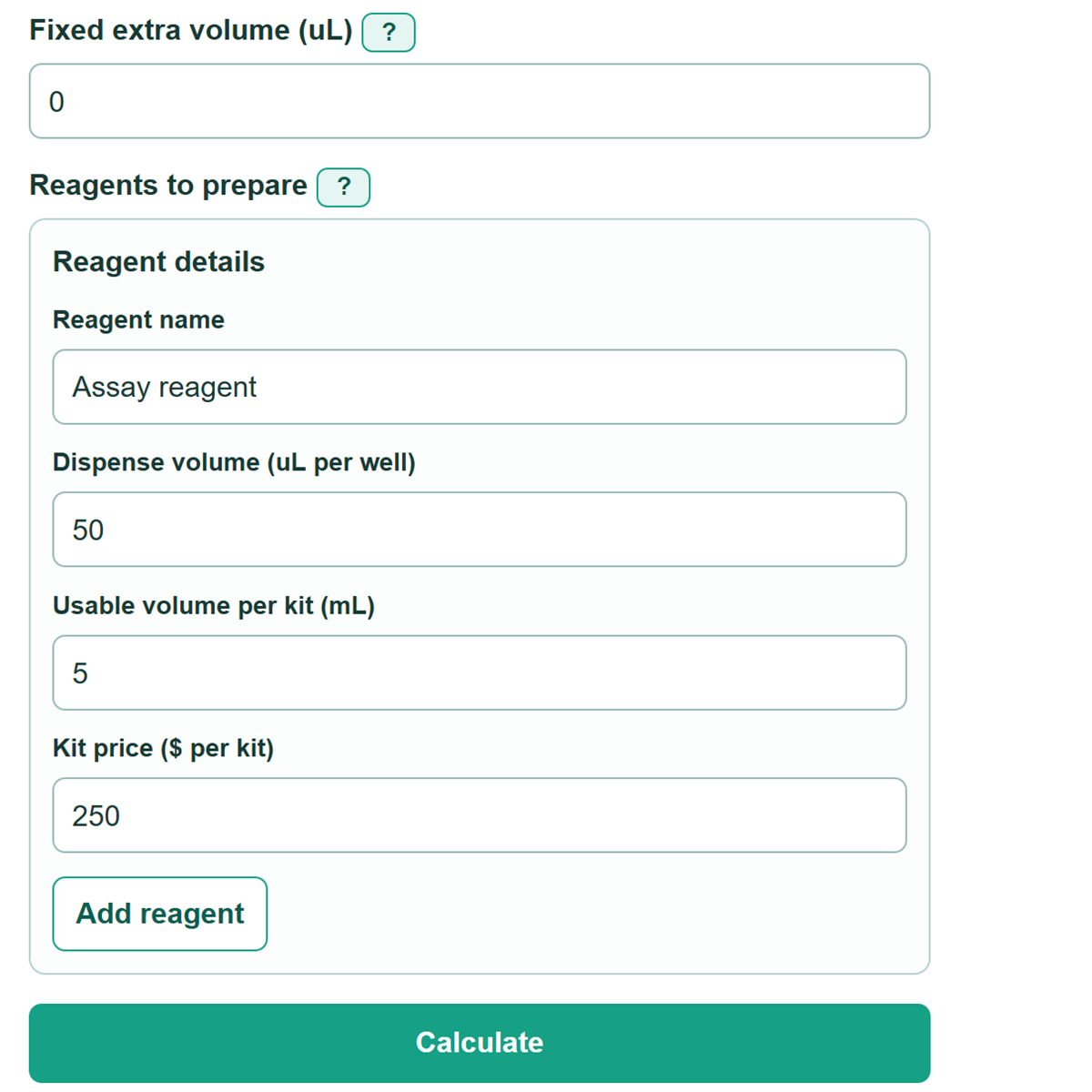
- For each item under Reagents to prepare, enter its per-well dispense, usable kit volume, and kit price, then add another row for any separately purchased reagent.
- Click Calculate and check each reagent row: its prepared volume should match the protocol dispense multiplied by planned wells, plus the extra preparation allowance.
Definitions
Wells to run: The wells that will receive a reagent in this run, including assay wells and any controls, blanks, or standards.
Plate format: The number of usable wells on one physical plate, such as 96 or 384. A partly used plate still counts as one plate.
Extra to prepare: A percentage added to calculated reagent use to cover the allowance stated in a workflow.
Fixed extra volume: A set uL amount added to each reagent row after percentage extra, often for a known dead volume or reservoir loss.
Usable volume per kit: The amount of a specific reagent that can actually be used from one kit, entered in mL.
Whole kits required: The number of kits after rounding each reagent's need up to a purchasable whole kit.
Common mistakes and quick fixes
Mistake: Entering 96 in Wells to run (wells) because the plate holds 96 wells, even though only 70 wells will be used.
Fix: Enter the actual count from the plate map. Use Plate format (wells per plate) only for plate capacity.
Mistake: Entering total volume for a whole plate in the dispense field under Reagents to prepare.
Fix: Enter the protocol amount in uL per well. The calculator multiplies it by Wells to run (wells).
Mistake: Treating Extra to prepare (percent) and Fixed extra volume (uL) as the same allowance.
Fix: Use the percent for volume that scales with wells and the fixed amount for a known reservoir or dead-volume allowance per reagent.
Mistake: Entering the kit's listed assay count as usable volume in Reagents to prepare.
Fix: Enter the usable reagent volume in mL per kit from the insert, inventory record, or protocol for that specific reagent step.
Mistake: Multiplying partial kit use by price and expecting a fractional Total kit purchase cost.
Fix: Use the whole purchasable kit price. Whole kits required rounds each reagent up before cost is added.
Limitations & Key Assumptions / Boundary Conditions
- This is a planning calculation. Use the dispense volume, preparation allowance, and usable kit volume from the assay protocol, SOP, kit insert, or validated workflow.
- The fixed extra volume is added once to every reagent row. Enter 0 if no separate fixed allowance applies.
- Kit count is calculated separately for each reagent row and rounded up. It does not assume that different reagents can share a kit or that a kit's advertised assay count fits every protocol.
- Kit purchase cost includes only the entered reagent kits. It excludes plates, tips, reservoirs, cells, media, shipping, tax, labor, and other consumables.
- A prepared volume below 1 uL may be hard to pipette accurately. Confirm feasibility with the lab's validated equipment and workflow.
- The calculator does not check reagent stability, mixing order, storage conditions, or whether an assay recipe is scientifically appropriate.
Methodology
Calculation steps
Plate count rounds up because any remaining wells require another physical plate.
plates needed = ceil(wells to run / wells per plate)
For each reagent row, the calculator first scales the per-well dispense by planned wells, then adds percentage extra and the fixed extra volume.
prepared volume (uL) = wells to run * dispense (uL per well) * (1 + extra percent / 100) + fixed extra volume (uL)
Usable kit volume is converted from mL to uL using 1 mL = 1,000 uL. Each reagent's kit requirement rounds up to a whole kit before its cost is added.
kits for one reagent = ceil(prepared volume (uL) / (usable kit volume (mL) * 1000))
total kit purchase cost = sum(kits for each reagent * kit price)
Worked example
For 100 wells on a 96-well plate, a reagent dispensed at 50 uL per well with 10% extra and 100 uL fixed extra needs 5,600 uL. A kit with 5 mL usable volume contains 5,000 uL, so this reagent requires 2 kits. At $250 per kit, its purchase cost is $500. The run also needs 2 plates because 100 divided by 96 rounds up.