
Compare alum and ferric chloride feed, chemical sludge, and annual variable cost for your soluble reactive phosphorus removal target.
Advanced options
Table of contents
How to use our Ferric and Alum Phosphorus Removal Calculator
- Choose How to set the chemical dose. Use planning mode for an early estimate, or choose jar-test mode when both chemical doses have been tested or validated at your plant.
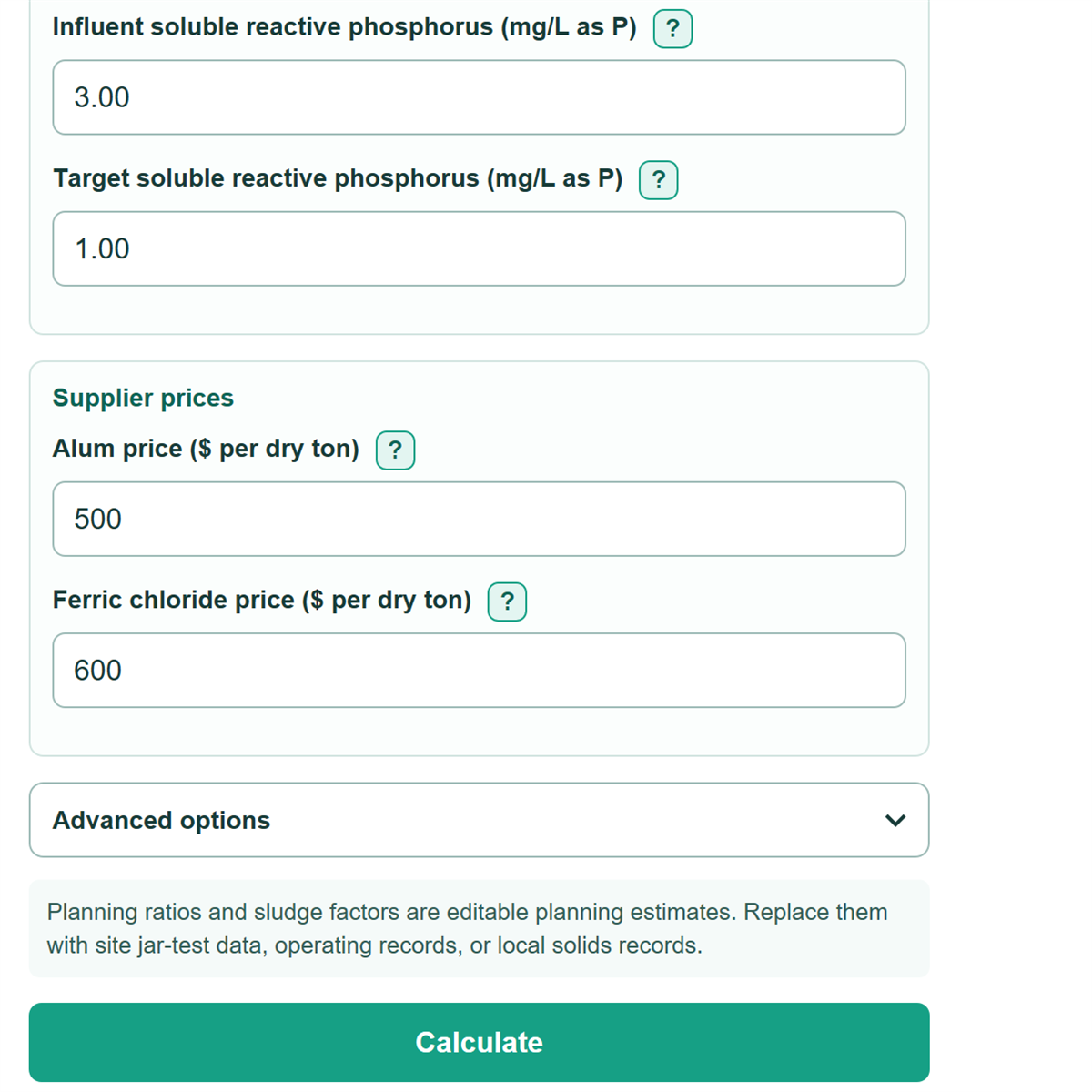
- Enter Average treated flow (MGD), Influent soluble reactive phosphorus (mg/L as P), and a lower Target soluble reactive phosphorus (mg/L as P).
- Enter supplier quotes in Alum price ($ per dry ton) and Ferric chloride price ($ per dry ton). Both prices must use dry chemical equivalents.
- Open Advanced options to replace planning ratios or sludge factors with site data. Add Incremental sludge-management cost ($ per dry ton) if you know the variable cost of handling added dry solids.
- Click Calculate, then check that the dose used is realistic against plant or jar-test records. Compare the annual variable costs, feeds, and incremental chemical sludge before choosing an option.
Definitions
Soluble reactive phosphorus (SRP): The phosphorus form measured by an SRP or orthophosphate test, reported here as phosphorus, or P.
MGD: Million gallons per day, a flow unit used to estimate daily and annual chemical use.
Dry equivalent: Chemical mass as dry alum or dry ferric chloride, even if the delivered product is a liquid solution.
Planning ratio: Moles of aluminum or iron used per mole of phosphorus removed. It is a screening assumption, not a final feed setting.
Jar-test dose: A chemical dose measured in a controlled test using site water. In jar-test mode, it replaces the planning dose.
Incremental chemical sludge: Estimated added dry solids from chemical phosphorus removal. It does not include all solids already produced by the plant.
Annual variable-cost difference: Ferric chloride annual variable cost minus alum annual variable cost. A positive value means ferric chloride costs more under the entered assumptions.
Common mistakes and quick fixes
Mistake: Entering total phosphorus for Influent soluble reactive phosphorus (mg/L as P) without confirming that the dose basis also uses total phosphorus.
Fix: Use soluble reactive phosphorus or orthophosphate reported as P, or use a dose basis developed for the water-quality measurement entered.
Mistake: Setting Target soluble reactive phosphorus (mg/L as P) equal to or above the influent value.
Fix: Enter a target lower than Influent soluble reactive phosphorus (mg/L as P) ; this calculator needs a positive removal amount.
Mistake: Copying a liquid-product quote into Alum price ($ per dry ton) or Ferric chloride price ($ per dry ton) .
Fix: Convert the supplier quote to the dry equivalent of the named chemical before entering it.
Mistake: Entering active metal dose instead of dry chemical dose in Alum jar-test dose (mg/L as dry alum) or Ferric chloride jar-test dose (mg/L as dry ferric chloride) .
Fix: Enter the validated dose as the dry chemical named in the label, or convert the record before use.
Mistake: Reading Alum incremental chemical sludge or Ferric incremental chemical sludge as all sludge produced by the plant.
Fix: Treat these as estimated added chemical solids linked to phosphorus removal, not total plant sludge.
Mistake: Treating a blank Incremental sludge-management cost ($ per dry ton) as a full operating-cost comparison.
Fix: A blank value makes annual variable cost chemical-only; enter a variable dry-ton cost when sludge handling should affect the comparison.
Limitations & Key Assumptions / Boundary Conditions
- The planning-dose mode is a screening estimate. Actual chemical demand can change with pH, alkalinity, competing solids, mixing, temperature, phosphorus form, polymer use, and the required residual phosphorus level.
- Use site jar testing or validated operating data before setting a feed pump or ordering chemical.
- All feed and price calculations use dry alum and dry ferric chloride equivalents. The calculator does not convert results to liquid gallons because supplier concentration and density are not entered.
- Annual costs include chemical purchase and, when entered, incremental sludge-management cost. They exclude capital equipment, tanks, pumps, containment, labor, power, alkalinity adjustment, polymer, fixed contract charges, and other plant costs.
- Sludge estimates are incremental chemical sludge only. Actual hauled wet tons depend on dewatering performance and cake solids, which are outside this calculation.
- The calculation uses average flow for 365 days. Seasonal flow, influent phosphorus, and dose changes can make annual use differ from this estimate.
Methodology
Calculation method
The calculator first finds the soluble reactive phosphorus concentration that must be removed. It blocks calculation when the target is not lower than the influent value.
ΔP (phosphorus removed in mg/L) = influent SRP - target SRP
Daily phosphorus removed uses average flow and the water-treatment conversion of 8.34 lb/day for each MGD times mg/L.
P removed (lb/day) = average flow (MGD) x ΔP (mg/L) x 8.34
In planning mode, the calculator converts the entered metal-to-phosphorus planning ratio into a dry chemical dose. Dry alum is treated as Al2(SO4)3 and ferric chloride as FeCl3. In jar-test mode, each entered jar-test dose replaces its planning dose.
alum dose (mg/L) = ΔP x alum ratio x 342.15 / (2 x 30.973761998)
ferric chloride dose (mg/L) = ΔP x ferric ratio x 162.20 / 30.973761998
Daily dry-equivalent feed is calculated separately for each chemical.
chemical feed (lb/day) = average flow (MGD) x chemical dose (mg/L) x 8.34
Annual chemical purchase cost uses 365 days and 2,000 lb per US short dry ton. Incremental chemical sludge is based on daily phosphorus removed and the chemical-specific sludge factor. A blank sludge-management cost is treated as $0, so the comparison is chemical-only.
annual variable cost = annual chemical purchase cost + annual chemical sludge (dry tons) x sludge-management cost ($/dry ton)
annual variable-cost difference = ferric chloride annual variable cost - alum annual variable cost
Worked example
With 1.00 MGD flow, influent SRP of 3.00 mg/L as P, and a target of 1.00 mg/L as P, the removal concentration is 2.00 mg/L. The phosphorus load removed is 16.68 lb/day. Using planning ratios of 1.6 mol Al per mol P and 2.0 mol Fe per mol P gives about 17.67 mg/L dry alum and 20.95 mg/L dry ferric chloride. These become about 147.4 lb/day alum and 174.7 lb/day ferric chloride.
Assumptions and limits
The default planning ratios and sludge factors are editable planning values. They should be replaced with site jar-test results, operating data, or local solids records when available. The cost comparison keeps the signed difference: a negative annual variable-cost difference means ferric chloride costs less, while a positive value means it costs more.