
Calculate powder masses, stock volumes, solvent top-up, and optional ingredient-use cost for a multi-component buffer recipe.
Table of contents
How to use our Multi-Component Buffer Reagent Mass and Cost Calculator
- Enter the target Final volume and choose the matching Final volume unit from your protocol.
- For each row under Recipe components, enter the reagent name, the exact reagent form on the container, and the desired final concentration.
- Choose powder for a weighed reagent and enter its molecular weight, or choose stock and enter the labeled stock concentration.
- Enter the optional unit cost in the row if you want an ingredient-use cost; use $ per g for powder and $ per mL for stock.
- Click Calculate, then check that combined stock volume leaves enough room for solvent and that every reagent form and concentration matches the bottle label.
Definitions
Final volume: The total batch volume after the components and solvent are combined.
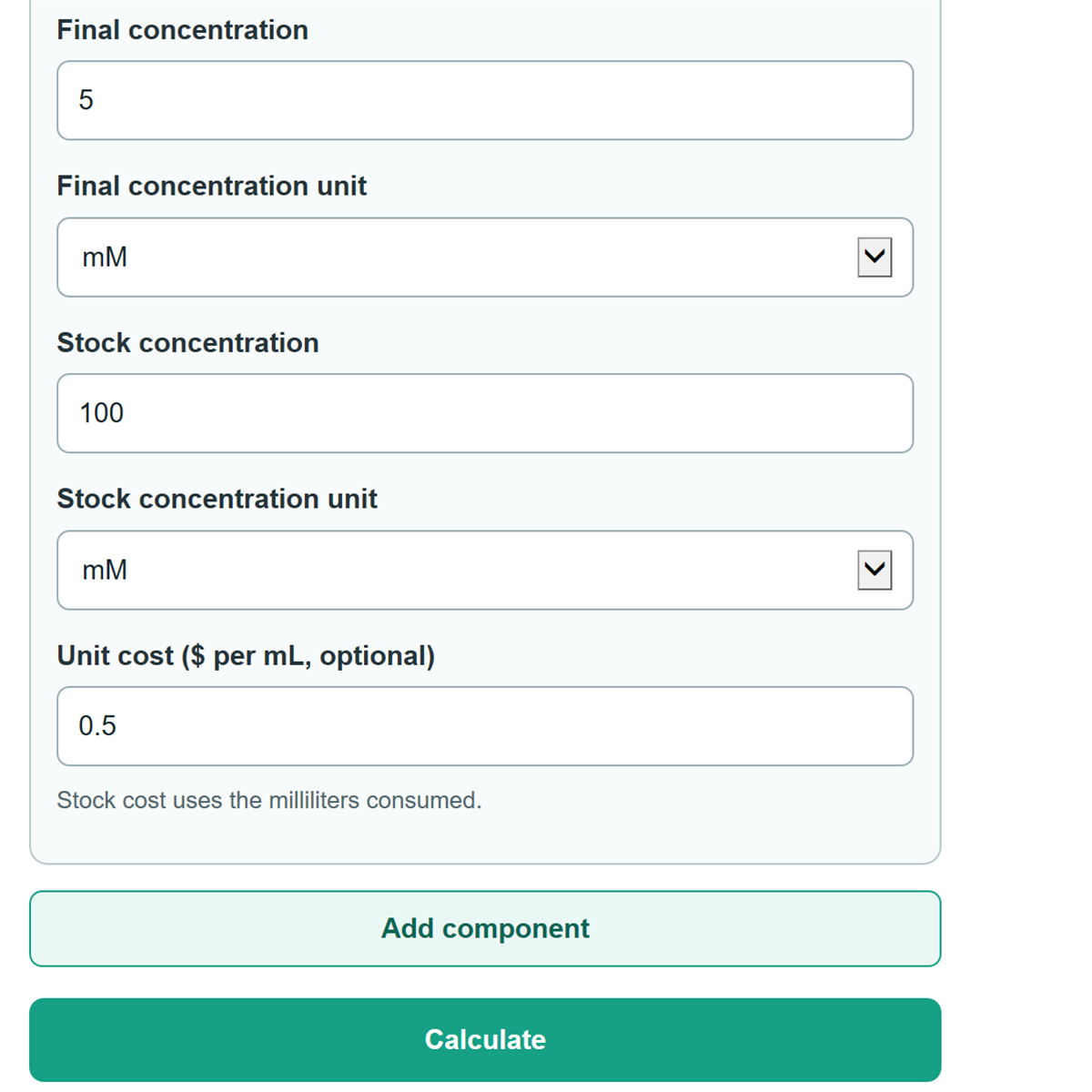
Final concentration: The concentration wanted in the finished recipe. M means mol per liter, mM means one-thousandth of a mol per liter, and uM means one-millionth.
Stock concentration: The concentration already present in a liquid stock solution before dilution into the final recipe.
Molecular weight (g/mol): The mass of one mole of the exact chemical form. The value must match the salt, hydrate, acid, or base form on the container.
Solvent needed to reach final volume: Final volume minus all calculated stock volumes. It is the planned top-up amount, not a substitute for bringing the mixture to the final mark.
Ingredient-use cost: The calculated amount consumed times the entered unit cost. Powder uses $ per g; stock uses $ per mL.
Common mistakes and quick fixes
Mistake: Entering a stock concentration as the desired final concentration in Recipe components.
Fix: Put the recipe target in Final concentration and the bottle strength in Stock concentration.
Mistake: Using a molecular weight for an anhydrous chemical when the container is a hydrate or salt.
Fix: Check Final volume and then recalculate. Check Exact reagent form first, then enter the matching Molecular weight (g/mol).
Mistake: Treating mM and M as the same unit in a powder or stock row.
Fix: Check Final volume and then recalculate. Choose the correct concentration unit for both Final concentration and Stock concentration before calculating.
Mistake: Adding the displayed Solvent needed to reach final volume without checking the actual liquid level.
Fix: Dissolve components and bring the mixture up to the Final volume mark; powder dissolution and pH adjustment can change volume.
Mistake: Reading Estimated recipe-use cost as the price of purchasing reagents.
Fix: Use it only for material consumed. It excludes package size, shipping, taxes, and waste.
Mistake: Assuming a calculated recipe guarantees final pH.
Fix: Check Final volume and then recalculate. Measure and adjust pH at the working temperature when the protocol requires it.
Limitations & Key Assumptions / Boundary Conditions
- The calculator plans quantities from the recipe you enter. It does not choose a buffer system, predict buffering capacity, or design a pH target.
- Powder mass is correct only if Molecular weight (g/mol) matches the Exact reagent form on the actual container.
- Stock calculations assume a simple dilution using the stated stock concentration. The final concentration cannot be higher than the stock concentration.
- Powder displacement, density, evaporation, temperature effects, activity corrections, and volume changes from pH adjustment are not estimated.
- A zero solvent result means stock additions fill the stated final volume. A recipe with stock additions above final volume is blocked as an error.
- Estimated recipe-use cost includes only rows with a supplied unit cost. It excludes full-package purchase cost, shipping, taxes, contract pricing, and waste.
- Measure final pH and adjust at the working temperature when required by the approved protocol.
Methodology
Quantity calculations
Final volume is converted internally to liters for powder mass calculations and kept in your selected volume unit for stock additions and solvent top-up.
powder mass (g) = final concentration (mol/L) * final volume (L) * molecular weight (g/mol)
For a stock row, the calculator uses the standard dilution relationship after converting both concentrations to the same molar unit.
stock volume = final concentration / stock concentration * final volume
solvent needed = final volume - combined stock volume
combined powder mass = sum of powder-row masses
Cost calculation
Each nonblank Unit cost is multiplied by that row's calculated use amount. Powder rows use grams, while stock rows are converted to mL for cost even if the displayed stock volume is uL or L.
row use cost = calculated amount * unit cost
estimated recipe-use cost = sum of costed row use costs
Blank Unit cost fields are excluded instead of treated as $0. If any row is blank, the displayed total is a partial estimate.
Worked example
For 100 mL, a 10 mM powder with molecular weight 100 g/mol needs 0.1 g. A 5 mM target made from a 100 mM stock needs 5 mL of stock, leaving 95 mL of calculated solvent space. At $2 per g for the powder and $0.50 per mL for the stock, ingredient-use cost is $0.20 + $2.50 = $2.70.
Calculation boundaries
The calculator blocks missing or nonpositive required values, a target concentration above a stock concentration, and combined stock volume above final volume. It does not estimate powder displacement or confirm final pH, so prepare the mixture according to the approved protocol and bring it to the final measured volume.