
Calculate blank-corrected volumetric Karl Fischer moisture, titrant titer, or planned sample mass and titrant use from laboratory readings.
Table of contents
How to use our Karl Fischer Moisture, Titer and Reagent Consumption Calculator
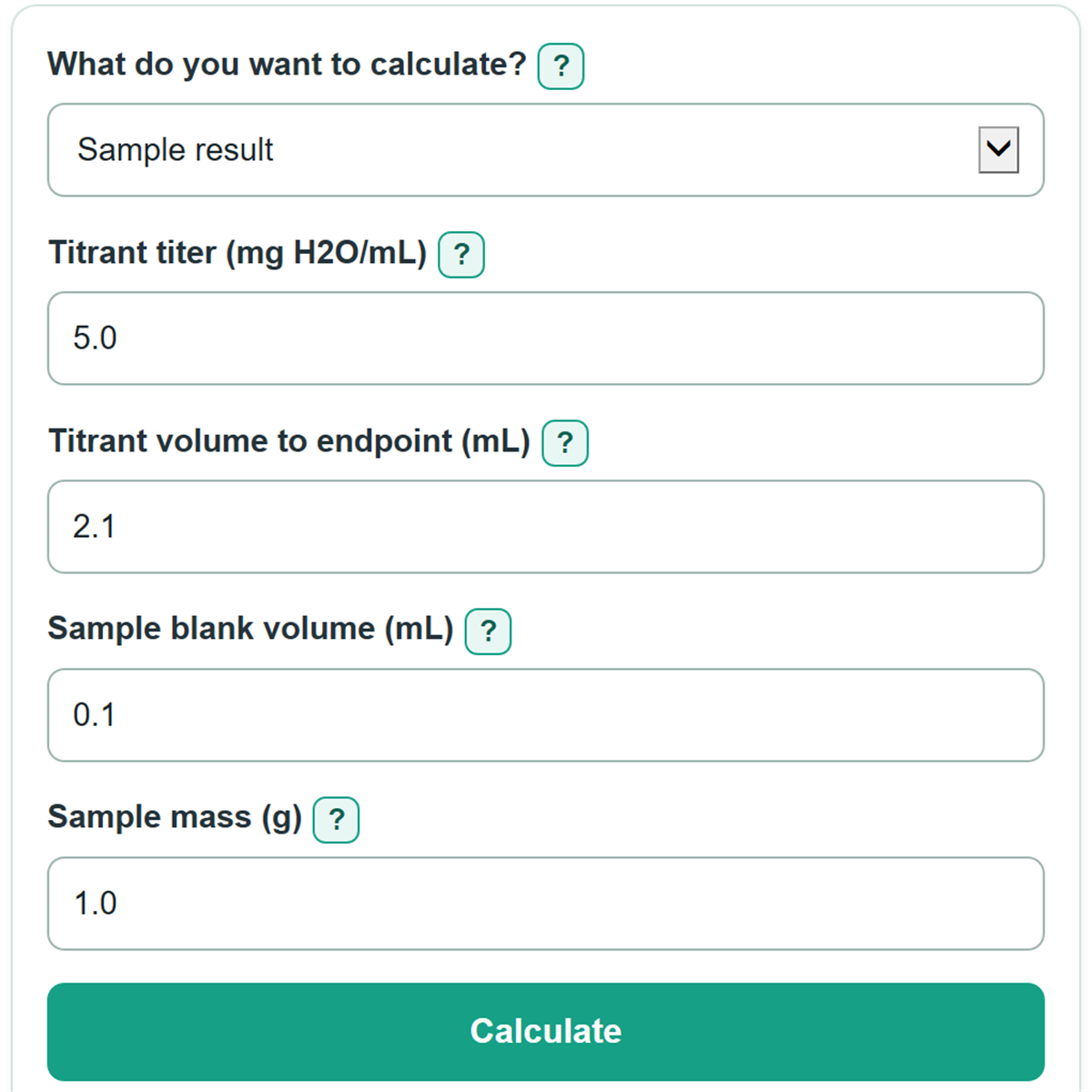
- Choose Sample result, Standardize titer, or Plan a run under "What do you want to calculate?"
- For a completed sample, enter the current Titrant titer (mg H2O/mL), endpoint reading, blank, and balance-measured Sample mass (g).
- For standardization, enter the certified Known water in standard (mg) and the standard run's titrant and blank volumes.
- For planning, enter expected water content with its printed unit, planned mass, current titer, and Desired titrant volume (mL).
- Click Calculate, then check that the blank-corrected volume is sensible and that planned titrant use fits your laboratory method and instrument capacity.
Definitions
Volumetric Karl Fischer titration: A water test that measures the volume of Karl Fischer titrant needed to reach an endpoint.
Titrant titer: The water mass measured by 1 mL of titrant, reported as mg H2O/mL. It is found by standardizing the titrant with a known water amount. [1]
Endpoint: The point where the titrator detects that the Karl Fischer reaction is complete; its titrant volume is the endpoint volume.
Blank volume: Titrant used by background water from the solvent or setup rather than the sample. The calculator subtracts it from the endpoint volume.
Percent w/w: Water mass as a percent of total sample mass. The two masses must use the same mass basis.
ppm by mass: Parts per million by mass. For this calculation, 1% w/w equals 10,000 ppm.
Common mistakes and quick fixes
Mistake: Entering the full endpoint reading as Water content (percent w/w) without subtracting background consumption.
Fix: Enter the separate blank run in Sample blank volume (mL) so the calculator can report Blank-corrected sample titrant volume.
Mistake: Entering a ppm specification while Expected water content unit is set to Percent w/w.
Fix: Match Expected water content unit to the specification before entering Expected water content ; 1% w/w equals 10,000 ppm.
Mistake: Using a reagent label value that is no longer current for Titrant titer (mg H2O/mL).
Fix: Use the current reagent record or calculate Calculated titrant titer from the latest standardization run.
Mistake: Setting Standard titrant volume (mL) equal to or below Standardization blank volume (mL).
Fix: Check both recorded readings. Standard titrant volume must be greater than the blank to calculate a titer.
Mistake: Treating Expected titrant use as the actual endpoint result.
Fix: Use it only to plan Planned sample mass (g) ; report a completed run from the measured endpoint and sample mass.
Limitations & Key Assumptions / Boundary Conditions
- This calculator is for volumetric Karl Fischer titration only. Coulometric Karl Fischer testing measures water differently and does not use a volumetric titrant titer.
- Blank correction uses the entered blank as a fixed volume. Follow the laboratory method for when and how a blank is measured.
- The moisture result assumes the sample mass, endpoint volume, blank volume, and current titrant titer are accurate.
- Planned titrant use and sample mass are estimates based on expected moisture. Side reactions, slow water release, atmospheric moisture, and sample handling can change the observed endpoint.
- Use mass-based inputs only. Do not enter sample volume as Sample mass (g) unless your approved method has already converted volume to mass.
- The calculator blocks a sample blank above its endpoint and a standard blank equal to or above its endpoint because those conditions do not produce a valid corrected volume.
Methodology
Calculation steps
For a completed sample, the calculator first removes the measured background titrant use. It then converts corrected titrant volume to water mass using the current titer and divides by sample mass.
Blank-corrected sample volume (mL) = Titrant volume to endpoint (mL) - Sample blank volume (mL)
Water found in sample (mg) = Blank-corrected sample titrant volume (mL) x Titrant titer (mg H2O/mL)
Water content (% w/w) = Water found in sample (mg) / [Sample mass (g) x 1000] x 100
Water content (ppm by mass) = Water found in sample (mg) / [Sample mass (g) x 1000] x 1,000,000
For titer standardization, known water is divided by the blank-corrected titrant volume from the standard run.
Calculated titrant titer (mg H2O/mL) = Known water in standard (mg) / [Standard titrant volume (mL) - Standardization blank volume (mL)]
For planning, the calculator reads expected water content as the selected percent w/w or ppm value. A ppm entry is divided by 10,000 to convert it to percent w/w before calculating water mass, expected titrant use, and the mass needed for the chosen target volume.
Expected water in planned sample (mg) = Planned sample mass (g) x 1000 x expected percent w/w / 100
Expected titrant use (mL) = Expected water in planned sample (mg) / Titrant titer (mg H2O/mL)
Sample mass for desired titrant use (g) = Desired titrant volume (mL) x Titrant titer (mg H2O/mL) x 100 / [1000 x expected percent w/w]
Worked example
With a 5.0 mg H2O/mL titer, a 2.1 mL endpoint, a 0.1 mL blank, and a 1.0 g sample, corrected volume is 2.0 mL. Water found is 10 mg, so water content is 1.0% w/w or 10,000 ppm. For planning, 10.0 g at 0.1% w/w contains an estimated 10 mg water and is expected to use 2.0 mL of the same titrant.