
Estimate daily herd drinking water, peak trough drawdown, and whether measured refill flow and usable storage can cover a busy drinking event.
The cow-calf pair amount and event settings are United States planning estimates. Replace them with local observations, records, or a water-system plan.
Advanced options
Peak drinking plan
Loss allowance
Table of contents
How to use our Livestock Water Demand and Trough Refill Calculator
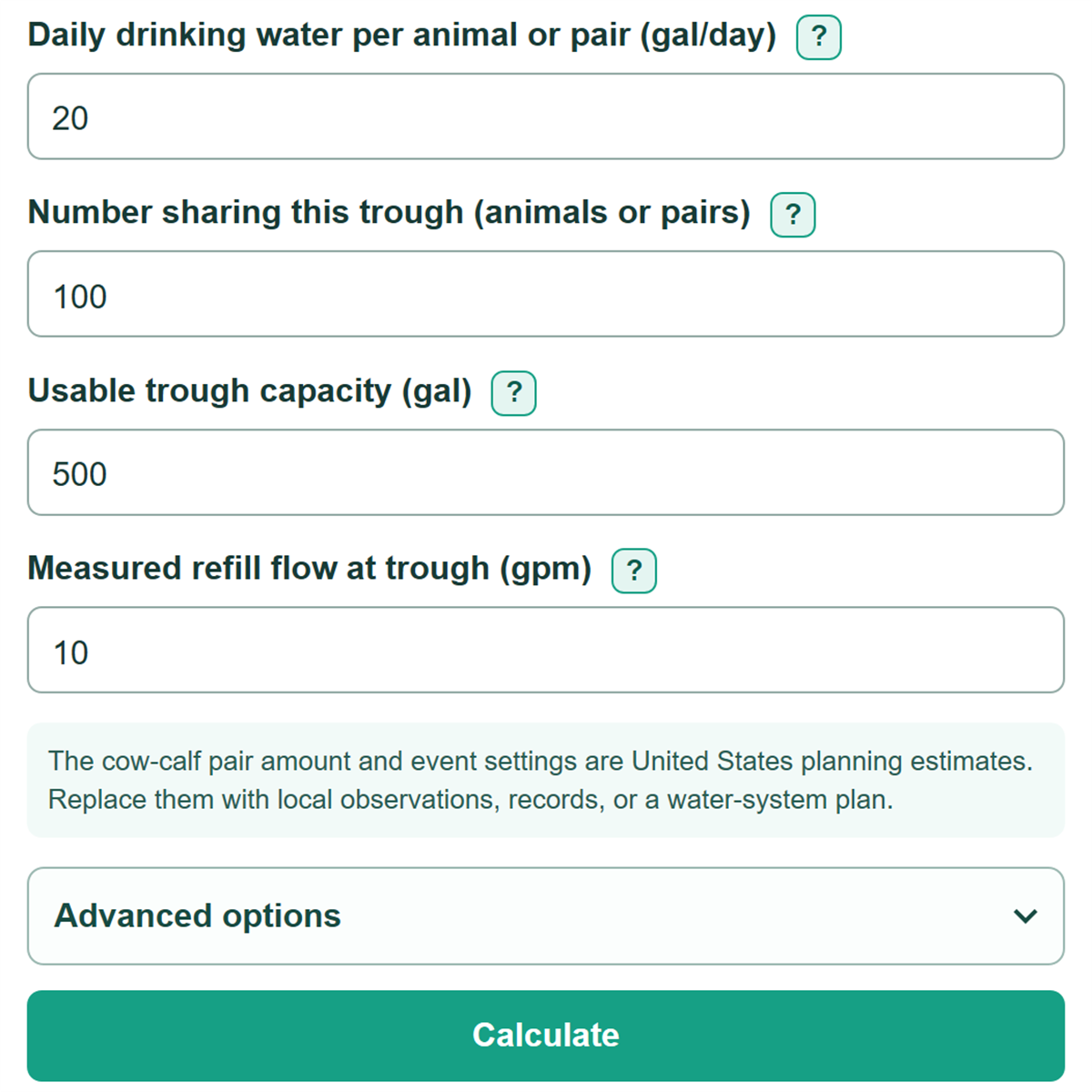
- Enter the daily drinking amount for one animal or matching pair, then enter the number that share this trough.
- Measure or estimate the usable water in the trough and test refill flow at the trough in gallons per minute.
- Open Advanced options to adjust the number of watering events, peak drinking event length, and extra loss allowance if local conditions differ.
- Click Calculate and check the Peak-event supply check first. A fail means usable trough storage is too small for the selected event.
- Sanity-check that Planned daily herd water demand matches your herd size and that Measured refill flow at trough (gpm) came from a test at the trough, not a pump nameplate.
Definitions
Daily drinking water per animal or pair: Expected gallons one animal or matching pair drinks in one day.
Usable trough capacity: Water already available in the trough for a busy drinking event, measured below the normal float level.
Peak drinking event: A concentrated period when many animals drink from the same trough.
Drawdown: Stored trough water used during the peak event after refill water is counted.
Refill flow: Water delivered to the trough each minute, in gallons per minute (gpm).
Storage margin: Usable trough capacity minus the event drawdown. A negative margin is a storage shortfall.
Refill flow margin: Measured trough flow minus the flow needed to supply the event without stored water. A negative margin means stored water is needed during the event.
Common mistakes and quick fixes
Mistake: Entering whole-herd gallons in Daily drinking water per animal or pair (gal/day).
Fix: Enter gallons for one animal or one matching pair only, then use Number sharing this trough (animals or pairs) for the group count.
Mistake: Using the tank's advertised size as Usable trough capacity (gal).
Fix: Use the water that can actually be drawn during a busy event below the normal float level.
Mistake: Copying pump or well capacity into Measured refill flow at trough (gpm).
Fix: Use a timed test at the trough under normal pipeline and float-valve conditions.
Mistake: Setting Peak drinking event length (minutes) to 0 or leaving it unrealistically short.
Fix: Enter a positive number of minutes based on an observed or planned concentrated drinking period.
Mistake: Treating Planned daily herd water demand as the needed pump flow.
Fix: Use Required refill flow without stored water for gallons per minute, and use Trough water used during peak event for storage needed during the event.
Limitations & Key Assumptions / Boundary Conditions
- This is a planning check for drinking water at one trough. It does not include washdown, cooling, irrigation, fire protection, or other water uses.
- Daily drinking demand can change with animal class, feed, weather, milk production, and local conditions. Replace the example drinking amount with a local estimate or observation.
- The calculation splits daily demand evenly across Watering events per day. If one event is much larger than the others, enter a smaller event count or plan that larger event separately.
- Measured refill flow should be tested at the trough with normal pipeline, pressure, and float-valve conditions. Pressure loss, clogged filters, leaks, ice, and valve limits can reduce delivered flow.
- A pass only means the entered storage and measured flow can cover the selected event. It does not size pipes, pumps, float valves, trough access space, reserve water, or backup supply.
- Mixed livestock groups should be calculated separately unless Daily drinking water per animal or pair (gal/day) is a defensible weighted average for the group.
Methodology
Calculation
The calculator keeps daily water volume separate from short-period refill flow, because a water point can meet daily volume yet still run low when animals drink together. Water-system planning also considers both daily demand and short-period delivery needs. [1]
planned daily herd water = daily water per animal or pair x number sharing trough x (1 + loss allowance / 100)
water needed in one peak event = planned daily herd water / watering events per day
required refill flow without stored water = peak event volume / peak drinking event length
trough water used during peak event = max(peak event volume - measured refill flow x event length, 0)
usable trough storage margin = usable trough capacity - trough water used during peak event
refill flow margin = measured refill flow - required refill flow without stored water
The Peak-event supply check is Pass when the usable trough storage margin is zero or greater. It is Fail when the margin is negative.
Worked example
For 100 cow-calf pairs at 20 gal/day each with a 10% allowance, planned daily herd water is 2,200 gal/day. With 3 watering events, one event needs 733.33 gal. Over 30 minutes, that needs 24.44 gpm without stored water. A 10 gpm refill supplies 300 gal during the event, so drawdown is 433.33 gal. A 500 gal usable trough has a 66.67 gal storage margin and passes this event check.