
Estimate hay pounds, whole bales, bales to buy from inventory, and cost for your horses over the days you will actually feed hay.
Hay plan
Bale purchase
Calculation details
Table of contents
How to use our Horse Hay Requirement, Bale Inventory and Annual Cost Calculator
- Enter the Number of horses and Average horse weight (lb) for the herd you are planning for.
- Enter the Hay feeding rate (% of body weight per day) from your current feeding plan, then add a Hay waste allowance (%) if needed.
- Set Hay-fed days in this plan (days) to the days hay will actually be fed, accounting for pasture and turnout.
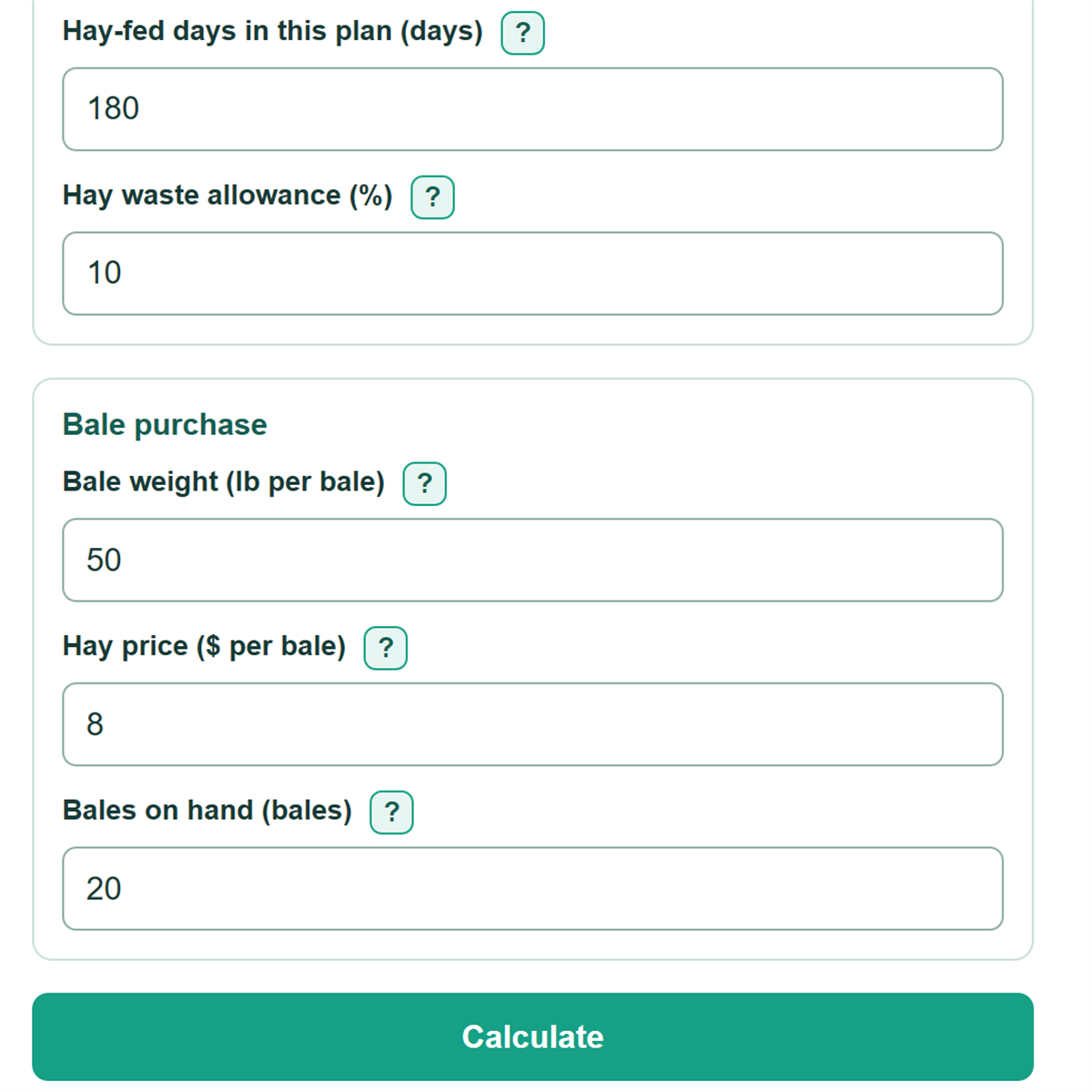
- Enter the actual Bale weight (lb per bale), Hay price ($ per bale), and usable Bales on hand (bales), then select Calculate.
- Check that Planned hay needed each day matches the herd feeding plan you intended, then use Bales to buy for this plan for a whole-bale purchase estimate.
Definitions
Hay feeding rate: The planned hay amount expressed as a percent of a horse's body weight each day.
Hay-fed days: Days in the entered plan when hay is actually fed. This may be fewer than 365 because of pasture or another feed plan.
Hay waste allowance: Extra hay included for expected loss during feeding, storage, or handling.
Bale weight: Actual pounds of hay in one bale. It converts the hay requirement in pounds into a bale count.
Whole-bale rounding: Rounding a bale need upward because hay is normally purchased by complete bales.
Bales on hand: Usable stored bales available for the entered horse plan.
Hay price per pound: The price per bale divided by the bale weight. It makes differently sized bales easier to compare.
Common mistakes and quick fixes
Mistake: Using a bale type name instead of the actual Bale weight (lb per bale).
Fix: Use the seller's stated bale weight or weigh a representative bale. Bale counts depend on pounds per bale.
Mistake: Entering 365 in Hay-fed days in this plan (days) even though the horses graze pasture for part of the year.
Fix: Count only the days hay is expected to be fed for this purchase plan. The 365-day cards already show a separate hay-only scenario.
Mistake: Treating Hay feeding rate (% of body weight per day) as a number picked only to make the bale total fit a budget.
Fix: Enter the rate from the current feeding plan and adjust the plan with a veterinarian, equine nutritionist, or barn manager when needed.
Mistake: Leaving Hay waste allowance (%) at 0 when hay is lost during feeding or storage.
Fix: Enter the loss percentage you expect so Total bales needed for this plan includes hay that must be available beyond the planned ration.
Mistake: Counting every stored bale as Bales on hand (bales).
Fix: Count only usable bales reserved for these horses. Do not include spoiled, sold, or already-promised hay.
Mistake: Comparing supplier quotes only by Hay price ($ per bale).
Fix: Compare Hay price per pound when bale weights differ.
Limitations & Key Assumptions / Boundary Conditions
- This is a weight-based purchasing estimate, not an individualized feeding or nutrition prescription.
- The calculation uses the entered Average horse weight (lb) and one shared Hay feeding rate (% of body weight per day). A herd with very different horses may need separate plans.
- The feeding-rate input is treated as an as-fed hay amount for planning. It does not convert dry-matter recommendations into an as-fed ration.
- Actual hay use can change with forage quality, pasture intake, weather, horse condition, activity, health, and other feeds.
- Bale totals are rounded up to whole bales. Actual purchase quantity can also depend on supplier minimums, delivery, spoilage, and storage space.
- The annual cards assume 365 hay-fed days at the same daily plan and do not subtract current inventory.
Methodology
Calculation steps
The calculator first finds planned daily hay for the whole herd. It applies the entered waste allowance after the planned ration.
daily hay (lb) = number of horses x average horse weight (lb) x feeding rate / 100 x (1 + waste allowance / 100)
It multiplies that daily amount by Hay-fed days in this plan (days) to find pounds needed for the purchase period.
plan hay (lb) = daily hay (lb) x hay-fed days
The plan pounds are divided by Bale weight (lb per bale) and rounded upward to a complete bale.
plan bales = ceil(plan hay (lb) / bale weight (lb per bale))
Stored inventory reduces only the purchase shortfall. A negative shortfall is set to zero because the calculator cannot recommend buying a negative number of bales.
bales to buy = max(0, plan bales - bales on hand)
Immediate cost uses only the bales still needed. Price per pound is the entered bale price divided by the entered bale weight.
buy-now cost ($) = bales to buy x hay price ($ per bale)
hay price per pound ($) = hay price ($ per bale) / bale weight (lb per bale)
Worked example
For 2 horses averaging 1,100 lb, a 2% feeding rate, and 10% waste, planned daily hay is 48.4 lb. Over 180 hay-fed days, that is 8,712 lb. With 50-lb bales, the plan needs 175 whole bales. If 20 bales are on hand, 155 bales remain to buy. At $8 per bale, the buy-now estimate is $1,240.
Annual view
The annual hay-only cards repeat the same daily plan for 365 days, round the bale count upward, and multiply by the entered price per bale. Current inventory is not subtracted from that separate annual purchase scenario.