
Estimate manure fertilizer credits, net value, and the one-way hauling distance that still makes sense for one field.
Calculation details
Table of contents
How to use our Manure Nutrient Value and Hauling Calculator
- Choose Manure form. For liquid manure, one manure unit means 1,000 gallons; for solid manure, it means 1 ton.
- Copy Total N, P2O5, and K2O from a recent manure report, then enter the first-year availability percentages allowed by your nutrient plan.
- Enter the planned rate, field crop needs, and replacement prices for actual N, P2O5, and K2O.
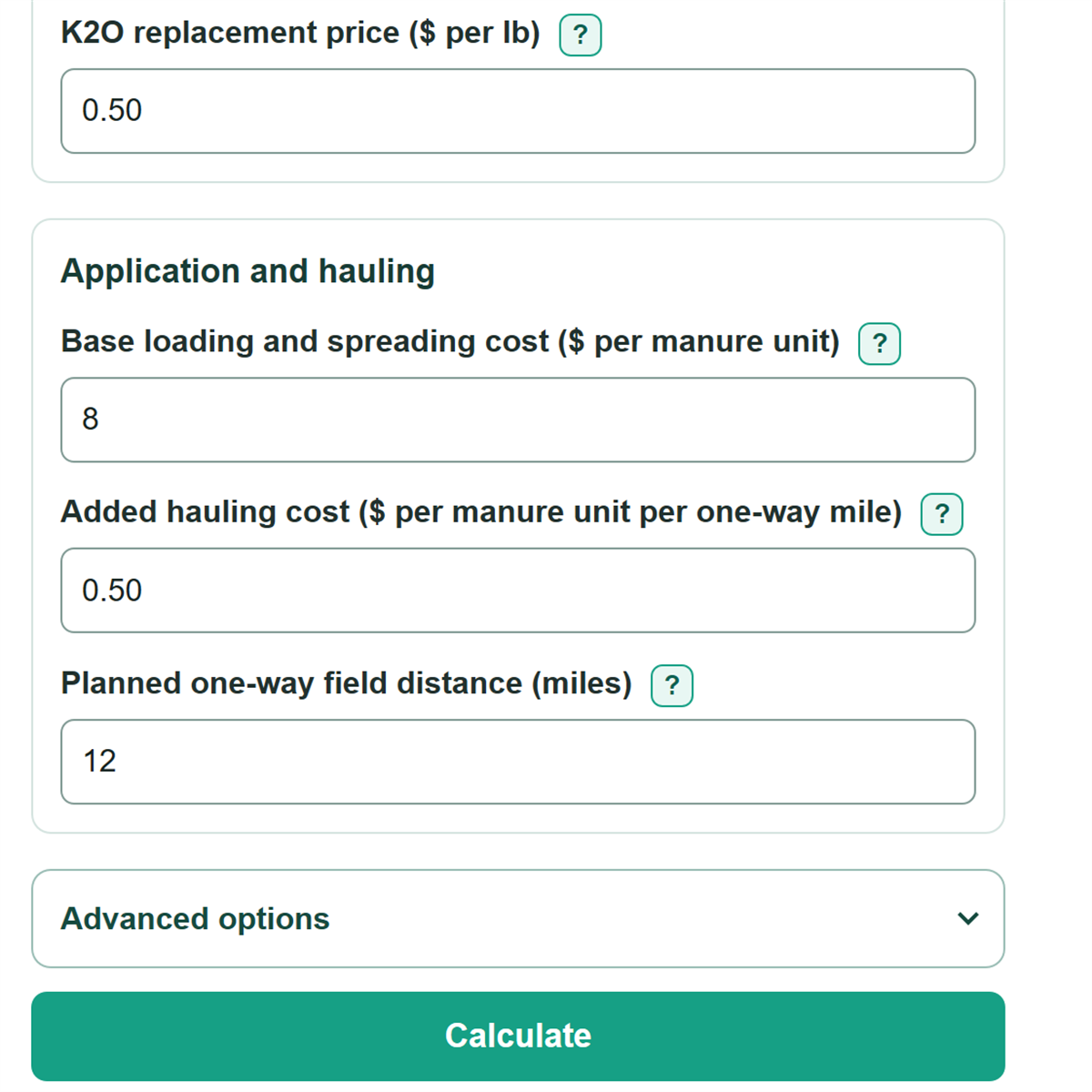
- Enter base loading and spreading cost, added hauling cost per one-way mile, and the planned one-way field distance. Open Advanced options only if a past N credit or avoided fertilizer spreading cost applies.
- Check Planned field distance margin: a positive value means the field is inside break-even, while a negative value means it is beyond it. Compare the credited nutrients with the additional nutrients still needed before making a fertilizer plan.
Definitions
Manure unit: 1,000 gallons for liquid manure or 1 ton for solid manure in this calculator.
Total N: Total nitrogen in the manure report before the first-year availability adjustment.
First-year available: The share of applied nutrient counted for the current crop year, entered as a percent.
P2O5 and K2O: Standard fertilizer-reporting forms for phosphate and potash. Enter these forms, not elemental P or K.
Fertilizer replacement value: The dollar value of credited current manure N, P2O5, and K2O up to the entered crop need.
Break-even one-way hauling distance: The farthest one-way distance where credited value and any avoided fertilizer application cost still cover base and added hauling costs.
Planned field distance margin: Break-even one-way distance minus planned one-way field distance. Positive means inside break-even; negative means beyond it.
Common mistakes and quick fixes
Mistake: Entering total N as if all of it is available to this year's crop.
Fix: Use First-year N available (percent) from your nutrient-management plan, then review Current manure N credited.
Mistake: Copying elemental phosphorus or potassium into P2O5 (lb per manure unit) or K2O (lb per manure unit).
Fix: Enter values reported as P2O5 and K2O so they match Crop P2O5 need (lb per acre) and Crop K2O need (lb per acre).
Mistake: Entering gallons per acre as the liquid Planned rate (manure units per acre).
Fix: For liquid manure, enter thousands of gallons per acre. A rate of 5 means 5,000 gallons per acre.
Mistake: Using a fertilizer product price per ton for N replacement price ($ per lb).
Fix: Enter the price of one pound of actual nutrient, not the price of a ton of fertilizer product.
Mistake: Entering round-trip miles in Planned one-way field distance (miles).
Fix: Enter road miles in one direction only, from the manure source to the field.
Mistake: Counting the same spreading charge in both Base loading and spreading cost ($ per manure unit) and Avoided fertilizer application cost ($ per acre).
Fix: Add the avoided cost only when manure truly avoids a separate commercial fertilizer application charge.
Limitations & Key Assumptions / Boundary Conditions
- This is a field-level planning estimate. It does not replace a nutrient-management plan, manure application rules, soil-test interpretation, or permit requirements.
- Credited N, P2O5, and K2O are capped at the entered crop needs. Nutrients applied above those needs are not given current fertilizer replacement value.
- First-year availability depends on manure source, timing, application method, incorporation, weather, and local guidance. Replace the example percentages with approved local values.
- Liquid entries use lb per 1,000 gallons and planned rate in thousands of gallons per acre. Solid entries use lb per ton and planned rate in tons per acre.
- The break-even result requires a positive Added hauling cost ($ per manure unit per one-way mile). It uses one-way road distance and assumes the entered per-mile rate already reflects the hauling pattern, including any return travel.
- Base loading and spreading cost is charged at every distance. Do not include the same cost again in avoided fertilizer application cost or nutrient prices.
- The calculation does not include yield effects, soil phosphorus buildup, micronutrients, odor, runoff risk, storage losses, application limits, or future-year nutrient value.
Methodology
How nutrient credits are calculated
The calculator first changes each manure-report value from a manure-unit basis to pounds per acre. It then applies the entered first-year availability percentage. Each current manure credit is limited to the crop need, so excess applied nutrient does not increase current fertilizer replacement value.
raw nutrient per acre = nutrient per manure unit * planned rate
available nutrient per acre = raw nutrient per acre * first-year availability / 100
credited nutrient = min(available nutrient per acre, remaining crop need)
For N, remaining crop need is reduced by Past manure N credit (lb per acre) first, with a minimum of zero. The calculator then shows the unmet amount as Additional N still needed, Additional P2O5 still needed, or Additional K2O still needed.
How dollar value and distance are calculated
Fertilizer replacement value adds each credited nutrient multiplied by its entered actual-nutrient price. Base loading and spreading cost is charged per manure unit at every field. Added hauling cost rises with planned one-way distance.
fertilizer replacement value = credited N * N price + credited P2O5 * P2O5 price + credited K2O * K2O price
net value before distance = fertilizer replacement value + avoided fertilizer application cost - base cost per unit * planned rate
break-even one-way distance = max(net value before distance, 0) / (added hauling cost per unit per mile * planned rate)
net value at planned distance = net value before distance - added hauling cost per acre per mile * planned one-way distance
planned field distance margin = break-even one-way distance - planned one-way field distance
Worked example
With 30 lb of Total N per manure unit, a planned rate of 5 manure units per acre, and 60% first-year N available, available N is 90 lb per acre. If the crop N need is 120 lb per acre and no past manure N credit applies, the calculator credits 90 lb per acre and shows 30 lb per acre still needed. With the example nutrient prices, credited N, P2O5, and K2O produce a $146 per acre fertilizer replacement value. If base cost is $8 per manure unit, added hauling is $0.50 per manure unit per one-way mile, planned distance is 12 miles, and optional avoided fertilizer application cost is zero, net value is $76 per acre and break-even distance is 42.4 one-way miles.