
Enter pump curve points and system details to find the in-range flow and total head where the two curves meet.
Advanced options
Table of contents
How to use our Pump System Curve and Operating Point Calculator
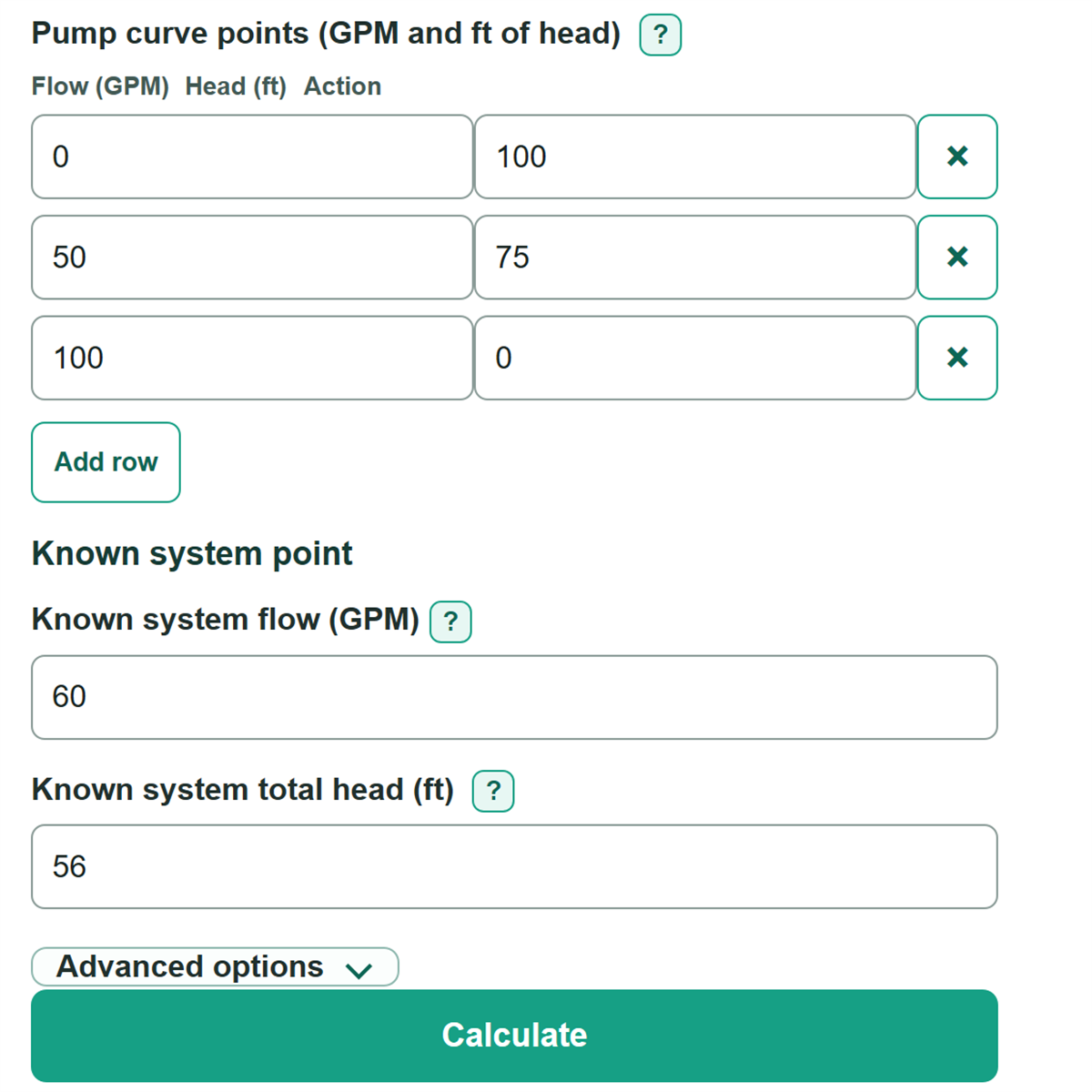
- Enter at least three paired values under Pump curve points (GPM and ft of head), all copied from one pump speed and impeller curve.
- Choose how you will describe the system: use Known design point for a known flow and total head, or Detailed pipe system for pipe data.
- Enter Elevation head and Required outlet pressure, then complete the fields shown for your selected method.
- Click Calculate and read Operating flow and Operating total head first. In Detailed pipe system mode, also check Pipe velocity at the operating point.
- Check Operating-point range check and Pump curve fit score. Use the result only if the intersection is within the entered pump-flow range and the entered points fit closely.
Definitions
Pump curve points: Paired flow and total-head values showing what head one pump can produce at different flows.
System curve: The head the piping system requires at each flow. It combines static head with losses that rise approximately with flow squared.
Operating flow: The flow where the fitted pump curve and calculated system curve are equal.
Operating total head: The total head at the operating flow. It is a head measurement in ft, not a pressure reading in psi.
Elevation head: The vertical elevation or liquid-level difference the pump must overcome. It can be negative when the destination is lower.
Darcy friction factor: A dimensionless factor used with pipe length and inside diameter to calculate straight-pipe loss. It is different from the Fanning friction factor.
Fittings and valve loss coefficient: The combined dimensionless K value for losses from fittings, valves, entrances, and exits.
Pump curve fit score: R-squared, from 0 to 1, measures how closely the fitted quadratic follows the entered pump points.
Common mistakes and quick fixes
Mistake: Mixing Pump curve points (GPM and ft of head) from different impeller diameters or pump speeds.
Fix: Enter points from one selected manufacturer curve only.
Mistake: Entering pump discharge gauge pressure as Required outlet pressure.
Fix: Enter the pressure required at the system outlet, or enter 0 for an open outlet with no residual-pressure requirement.
Mistake: Using nominal pipe size for Pipe inside diameter.
Fix: Look up and enter the actual inside diameter for the pipe material and schedule.
Mistake: Entering a Fanning factor in Darcy friction factor.
Fix: Use a Darcy friction factor from the same hydraulic calculation or reference.
Mistake: Setting Known system total head equal to or below Elevation head plus Required outlet pressure.
Fix: Recheck the known design point. At positive Known system flow, total head must include additional flow-related losses.
Mistake: Treating an out-of-range Operating-point range check as a usable duty point.
Fix: Add pump points that cover the expected flow range or choose a pump curve that covers the system demand.
Limitations & Key Assumptions / Boundary Conditions
- The result applies only within the smallest to largest flow entered in Pump curve points. The calculator does not extrapolate beyond that range.
- All pump points must come from one pump speed and impeller diameter. A quadratic fit is only an approximation of the entered curve shape.
- The system curve uses a square-law loss model. Actual resistance can change with valve position, fluid properties, pipe condition, parallel paths, or changing equipment.
- Detailed pipe system mode uses one constant inside diameter, a user-supplied Darcy friction factor, and a combined fittings and valve loss coefficient.
- Required outlet pressure is converted using 2.307692 ft of water head per psi and adjusted by Liquid specific gravity. Temperature-dependent fluid properties are not modeled.
- This calculator does not check pump power, efficiency, motor limits, suction conditions, NPSH, cavitation, transient pressure, or minimum-flow requirements.
- If more than one in-range curve intersection exists, the system needs engineering review rather than an automatic choice of one duty point.
Methodology
Curve calculation
The calculator fits a quadratic to the entered pump flow-head pairs, then compares it with a system curve. A pump and system operate where their head values are equal. [2]
H_p(Q) = fitted quadratic pump head, where Q is flow in GPM and H_p is head in ft
H_s(Q) = H_static + R x Q^2
In the system equation, H_static is Elevation head plus the outlet-pressure head, and R is System resistance from flow-related losses.
H_static = elevation head + (required outlet pressure x 2.307692) / liquid specific gravity
The pressure conversion uses ft of water head per psi and adjusts for the entered liquid specific gravity. Unit conversions and standard gravity follow conventional published unit guidance. [1]
Two ways to find resistance
Known design point mode removes static head from Known system total head, then divides the remaining friction head by Known system flow squared.
R = (known total head - H_static) / known flow^2
Detailed pipe system mode calculates velocity from actual Pipe inside diameter, then applies the Darcy-Weisbach form using Darcy friction factor, Pipe length, and Fittings and valve loss coefficient.
R = (f x L / D + K) x velocity per GPM^2 / (2 x g)
Worked example
With pump points of 0 GPM at 100 ft, 50 GPM at 75 ft, and 100 GPM at 0 ft, the fitted pump curve is H_p(Q) = 100 - 0.01Q^2. If Elevation head is 20 ft and the known system point is 60 GPM at 56 ft, resistance is (56 - 20) / 60^2 = 0.01 ft per GPM squared. Solving 100 - 0.01Q^2 = 20 + 0.01Q^2 gives about 63.25 GPM and 60 ft.
Assumptions and limits
The solver accepts only a real intersection inside the entered pump-flow range. It rejects invalid pump rows, fewer than three distinct flow values, nonpositive pipe diameter or friction factor, and a known system point that would create zero or negative resistance. R-squared describes fit to the entered points; it does not verify manufacturer data, pump condition, or suitability for the application.