
Estimate ideal vacuum pump-down time from your system volume, starting and target pressures, and effective pump speed.
Pressure
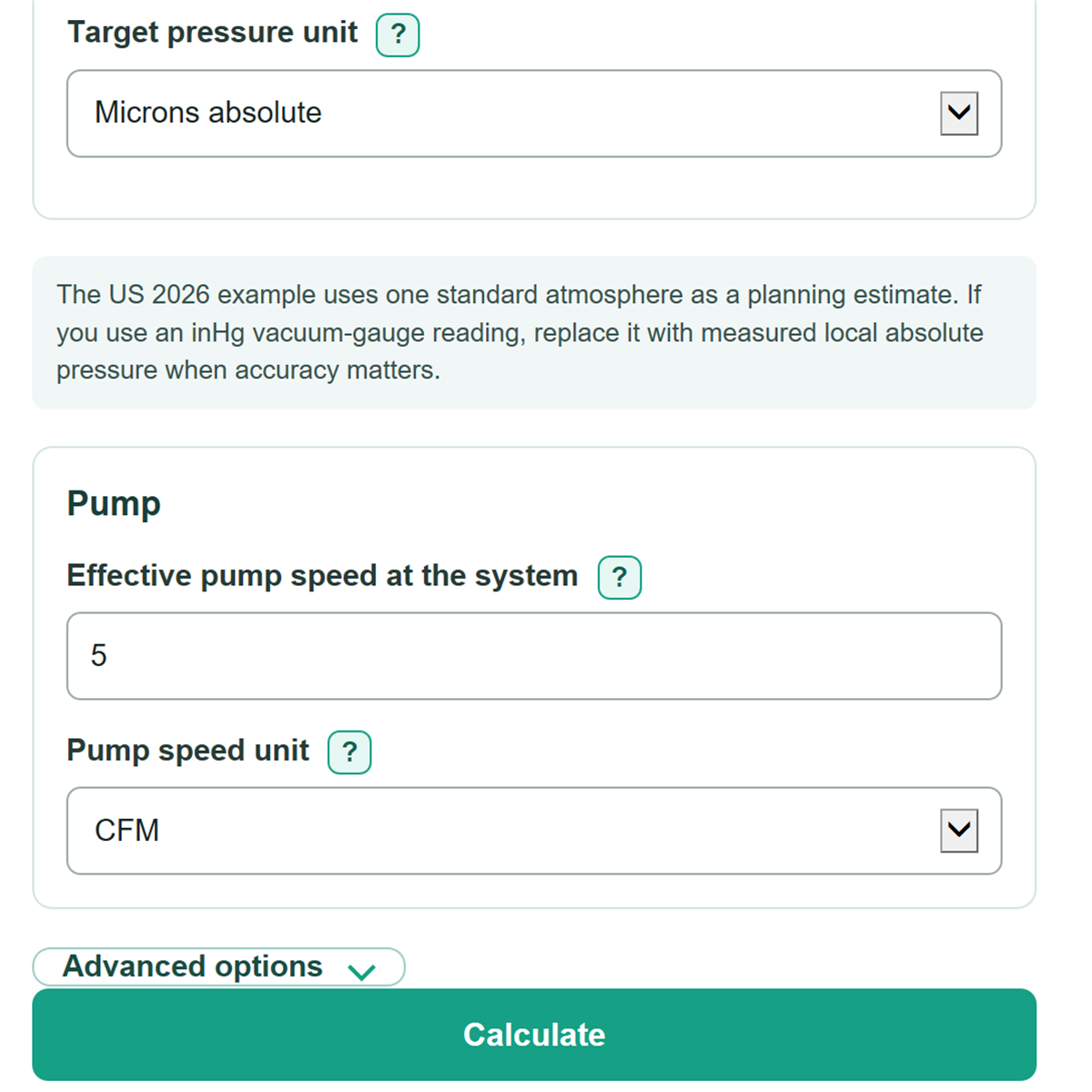
The US 2026 example uses one standard atmosphere as a planning estimate. If you use an inHg vacuum-gauge reading, replace it with measured local absolute pressure when accuracy matters.
Pump
Advanced options
Table of contents
How to use our Vacuum Pump Evacuation and Pump-Down Time Calculator
- Enter Total system volume, including the chamber, hoses, manifolds, receivers, and fixtures connected during evacuation.
- Choose the matching Volume unit, then enter Starting pressure and its unit. Select an absolute unit unless you are copying an inHg vacuum-gauge reading.
- Enter Target pressure and its unit, then enter Effective pump speed at the system with the matching Pump speed unit.
- If either pressure uses inHg vacuum gauge, enter local barometric pressure in Ambient pressure for inHg gauge readings.
- Click Calculate, then sanity-check that the converted starting pressure is higher than the converted target pressure and that the effective speed is the speed at the system rather than only a free-air rating.
Definitions
Absolute pressure: Pressure measured from a perfect vacuum. The pump-down equation uses absolute pressure, such as Torr absolute, psia, mbar absolute, or microns absolute.
inHg vacuum gauge: A pressure drop measured below local ambient pressure in inches of mercury. It must be converted using Ambient pressure for inHg gauge readings before calculation.
Micron: In this calculator, a micron is a micron of mercury, equal to 0.001 Torr absolute.
Effective pump speed: The gas-removal speed available at the system or chamber. It can be lower than a pump nameplate rating because of hoses, valves, and other restrictions.
Pressure ratio: Starting absolute pressure divided by target absolute pressure. A larger ratio means the pump must remove gas over a larger pressure change.
CFM: Cubic feet per minute. The calculator converts CFM and the other supported speed units to liters per second before finding time. NIST lists the underlying pressure, volume, and flow conversions. [1]
Common mistakes and quick fixes
Mistake: Entering only the vessel nameplate size in Total system volume and leaving out hoses, manifolds, or receivers.
Fix: Add all connected internal volumes that the pump evacuates.
Mistake: Selecting an absolute Starting pressure unit for an inHg vacuum-gauge reading.
Fix: Choose inHg vacuum gauge and enter the local value in Ambient pressure for inHg gauge readings.
Mistake: Using a Target pressure that is equal to or higher than Starting pressure after conversion.
Fix: Check both pressure units and enter a lower target absolute pressure.
Mistake: Copying a pump's free-air rating into Effective pump speed at the system.
Fix: Use a pump curve or measured speed at the chamber or system inlet when available.
Mistake: Treating SCFM as interchangeable with the selected Pump speed unit of CFM.
Fix: Use a speed value that is applicable to the evacuation condition, or confirm the source gives usable pumping speed for the system.
Limitations & Key Assumptions / Boundary Conditions
- The time is an ideal lower-bound estimate based on constant effective pump speed, fixed system volume, and no added gas load.
- Leaks, water vapor, material outgassing, process gas, and permeation can make actual evacuation take longer or prevent the system from reaching the target pressure.
- Hose length, pipe diameter, valves, filters, and fittings can reduce speed at the system. Enter effective speed at the system when possible.
- The calculation does not check pump ultimate pressure, pump curves, contamination, or whether the target is physically reachable.
- An inHg vacuum-gauge reading depends on local ambient absolute pressure. Replace the standard-atmosphere example with a local barometer reading when accuracy matters.
- Do not treat CFM and SCFM as automatically interchangeable for this estimate.
Methodology
Calculation method
The calculator converts volume to liters, pump speed to liters per second, and both pressures to Torr absolute. For an explicitly selected inHg vacuum-gauge reading, it subtracts the gauge pressure from Ambient pressure for inHg gauge readings before converting to Torr absolute. NIST provides the pressure, volume, and gas-flow conversion relationships used for these steps. [1]
pressure ratio = starting absolute pressure / target absolute pressure
ideal time (seconds) = (system volume in L / effective pump speed in L/s) x ln(pressure ratio)
ln is the natural logarithm. The equation requires starting absolute pressure to be greater than target absolute pressure. Time in minutes is seconds divided by 60, and time in hours is seconds divided by 3,600. This constant-speed logarithmic model is commonly used for preliminary pump-down estimates. [2]
Worked example
With 10 US gal of system volume, 5 CFM effective speed, a 760 Torr absolute start, and a 500-micron target, the calculator uses 37.854 L, 2.3597 L/s, and 0.5 Torr. The pressure ratio is 1,520, producing an ideal time of about 117.53 seconds, or 1.959 minutes.
Assumptions and limits
This method assumes speed stays constant at the system inlet and that no gas enters the system during evacuation. Real pump-down behavior can change substantially as pressure falls because conductance, leakage, outgassing, vapor, and pump performance change with pressure. Use measured pump-down data or a pump curve when planning a real cycle time.