
Calculate dryer water removal, finished product, simplified heat load, and average heating power for continuous feed or one batch.
Advanced options
Calculation details
Table of contents
How to use our Industrial Dryer Evaporation Load Calculator
- Choose Operating mode: Continuous for a measured feed rate or Batch for one wet charge.
- Enter the wet feed amount, then choose whether Moisture percentages use wet basis or dry basis.
- Enter Inlet moisture (percent) and Target outlet moisture (percent) using the same basis. Enter 60 for 60 percent.
- Open Advanced options to replace the 100 percent Thermal efficiency (percent) boundary with a vendor or site value, or fill all three detailed-energy fields to include dry-solid heating.
- Check that water evaporated is positive, finished product is lower than wet feed, and the shown operating basis and units match your production record.
Definitions
Wet basis: Water mass divided by total wet material mass. A 60 percent wet-basis feed contains 60 lb of water and 40 lb of dry solids per 100 lb of wet feed.
Dry basis: Water mass divided by dry-solid mass. A 150 percent dry-basis feed has 150 lb of water per 100 lb of dry solids.
Water evaporated: Incoming water minus water remaining in the finished product at the target moisture.
Thermal efficiency: The share of supplied heat that reaches the modeled process heat requirement. Lower efficiency raises simplified supplied heat.
Dry-solid specific heat: Heat needed to raise 1 lb of dry material by 1 deg F. It is used only for the optional dry-solid heating add-on.
Average supplied heating power: Average thermal input rate in kW. For a batch, the calculator divides heat per batch by Batch cycle time (hours).
BTU per kWh: The conversion used to express thermal heat as kWh or kW is 3,412.141633 BTU per kWh. [1]
Common mistakes and quick fixes
Mistake: Entering 0.60 in Inlet moisture (percent) when the test says 60 percent.
Fix: Enter 60, not 0.60. The moisture fields expect percent values.
Mistake: Choosing Wet basis when the QA report gives dry-basis moisture.
Fix: Match Moisture percentages use to the test method or product specification before entering either moisture value.
Mistake: Setting Target outlet moisture (percent) equal to or above Inlet moisture (percent).
Fix: Set the target outlet moisture below the inlet moisture on the selected basis.
Mistake: Treating a Wet charge per batch (lb) as an hourly rate.
Fix: Choose Batch and enter Batch cycle time (hours) to calculate average evaporation rate and heating power.
Mistake: Using dryer-air temperature for Target material temperature (deg F).
Fix: Use the material temperature for the optional dry-solid heating add-on, not exhaust-air temperature.
Mistake: Filling only one or two detailed-energy fields.
Fix: Fill Feed material temperature (deg F), Target material temperature (deg F), and Dry-solid specific heat (BTU/lb-deg F), or clear all three.
Limitations & Key Assumptions / Boundary Conditions
- This is a simplified mass and heat balance for planning. It is not a dryer vendor performance guarantee or equipment-sizing result.
- The model assumes dry solids are conserved. Product loss, fines carryover, leakage, and added ingredients are not included.
- The latent heat assumption is 970.3 BTU per lb of water near water's normal boiling point at about 1 atmosphere. It does not adjust for vacuum operation, elevated pressure, boiling temperature, bound moisture, or material-water interactions.
- The baseline heat result includes water evaporation and Thermal efficiency (percent). Dry-solid heating is included only if all three detailed-energy fields are completed.
- The model does not include heating of exhaust air, makeup air, wet product water before evaporation, dryer metal, insulation losses, radiation, infiltration, heat recovery, startup, or shutdown.
- Average supplied heating power is thermal input, not automatically electric demand, burner capacity, steam flow, fuel use, or utility billing demand.
- For Batch mode, Batch cycle time (hours) should cover the full start-to-start production cycle if the average hourly results are meant to represent capacity.
Methodology
Mass balance
The calculator first converts both moisture entries to wet-basis fractions. It then holds dry solids constant from feed to finished product.
inlet wet fraction = inlet moisture / 100 for wet basis, or inlet moisture / (100 + inlet moisture) for dry basis
dry solids = wet feed at operating basis x (1 - inlet wet fraction)
finished product = dry solids / (1 - outlet wet fraction)
water evaporated = wet feed at operating basis - finished product
Heat calculation
Water evaporation heat uses 970.3 BTU per lb of removed water, a simplified value near water's normal atmospheric boiling point. The detailed-energy add-on is active only when all three temperature and specific-heat fields are filled.
water evaporation heat = water evaporated x 970.3 BTU/lb
dry-solid heating add-on = dry solids x dry-solid specific heat x (target material temperature - feed material temperature)
simplified supplied heat = (water evaporation heat + dry-solid heating add-on) / (thermal efficiency / 100)
average supplied heating power = supplied heat / 3,412.141633 BTU per kWh
In Batch mode, the calculator also divides supplied heat and water evaporated by Batch cycle time (hours) to calculate average kW and average lb/hr. The BTU-to-kWh conversion follows NIST unit-conversion guidance. [1]
Worked example
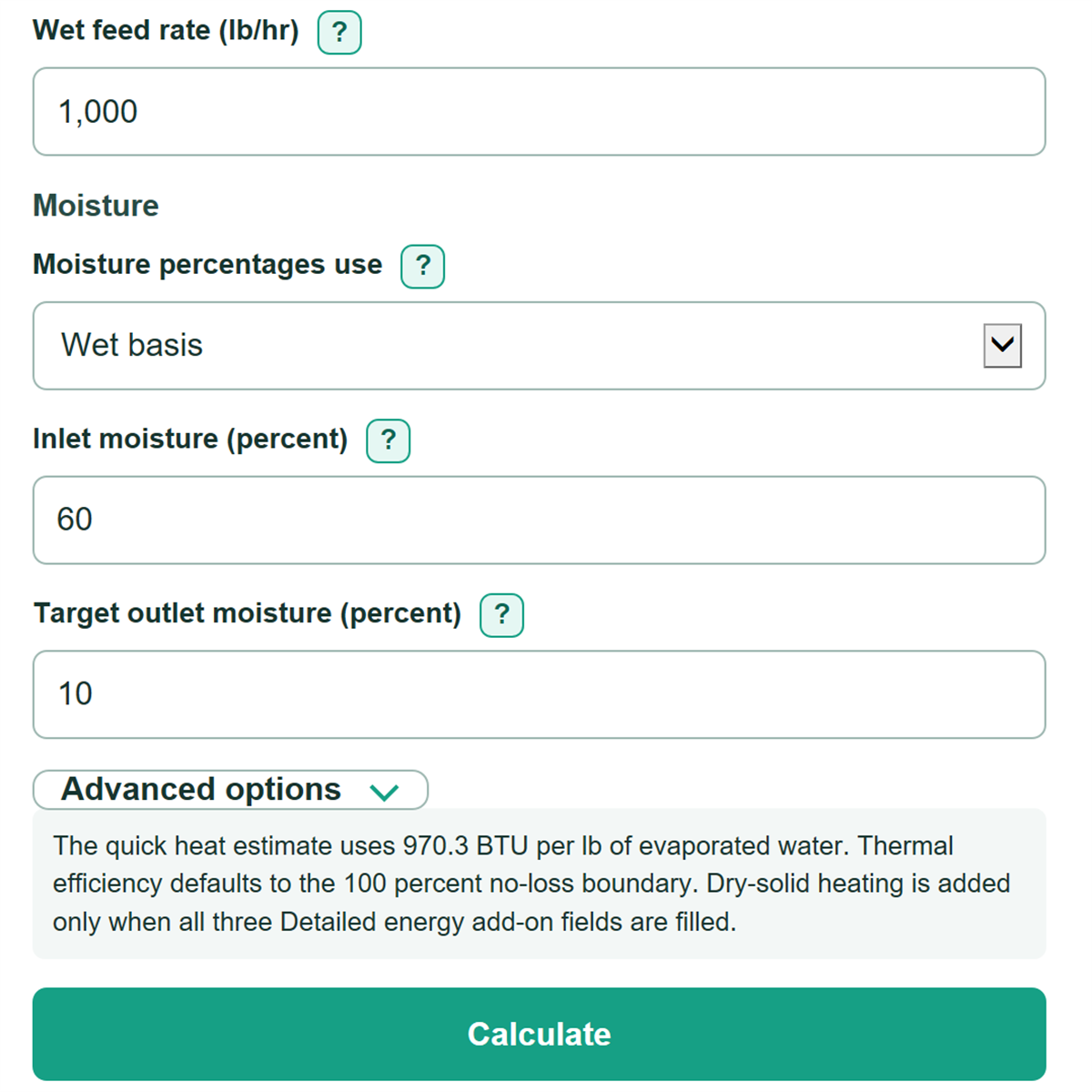
For 1,000 lb/hr feed at 60 percent inlet moisture and 10 percent target outlet moisture on a wet basis, dry solids are 400 lb/hr. Finished product is 444.44 lb/hr, so water evaporated is 555.56 lb/hr. With no dry-solid heating add-on and 100 percent thermal efficiency, water evaporation heat and simplified supplied heat are about 539,056 BTU/hr, or 157.98 kW.
Calculation scope
The formula reports a planning heat requirement from the entered material balance. It does not model air-side humidity, exhaust conditions, pressure, equipment warmup, heat recovery, or other dryer-specific heat flows.