
Compare drying times before and after vent cleaning to estimate annual utility savings and how long they may take to repay the cleaning cost.
Advanced options
Table of contents
How to use our Dryer Vent Cleaning Energy Savings Calculator
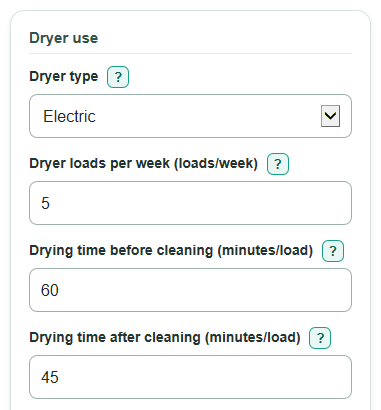
- Choose Dryer type, then enter your usual Dryer loads per week and typical drying times before and after cleaning.
- Enter the full one-time Dryer vent cleaning cost from a quote or invoice.
- Enter the usage-only Electricity price from your bill. For a gas dryer, also enter the usage-only Natural gas price.
- Open Advanced options and replace the example power or gas input values with ratings from your dryer label or manual when available.
- Click Calculate, then sanity-check that a shorter after-cleaning time produces positive Estimated annual utility savings. If the after time is longer, a negative savings result is expected.
Definitions
kWh: Kilowatt-hour, the electricity unit used on most electric bills. Dryer electricity use is estimated from running power and time.
Therm: A natural-gas billing unit equal to 100,000 Btu. [2]
Btu/hour: British thermal units per hour, a gas dryer's heat-input rate while it is running.
Usage-only utility rate: The part of a utility price that changes with energy use. Fixed customer and meter charges are not included.
Simple energy payback: The months of estimated utility savings needed to equal the one-time dryer vent cleaning cost.
Common mistakes and quick fixes
Mistake: Entering a full monthly electric bill in Electricity price.
Fix: Enter only the variable cents per kWh charge, not fixed customer charges or other household electricity use.
Mistake: Counting washer loads instead of Dryer loads per week when one washer load needs two dryer cycles.
Fix: Count each completed dryer cycle as one load.
Mistake: Using a planned time reduction as if it were measured Drying time after cleaning.
Fix: Time several similar finished loads after cleaning and update Drying time after cleaning with a typical value.
Mistake: Entering a gas bill total in Natural gas price.
Fix: Enter the variable charge in $ per therm and leave out fixed monthly fees.
Mistake: Entering only a base service price in Dryer vent cleaning cost while leaving out required access or obstruction work.
Fix: Enter the full one-time amount you expect to pay for the cleaning work.
Mistake: Treating the example Electric dryer power while running or Gas heat input while running as a rating for every dryer.
Fix: Replace the example assumption with the input rating on your own dryer label or manual if available.
Limitations & Key Assumptions / Boundary Conditions
- This is a simplified planning estimate based on entered running time and equipment input ratings. A dryer may cycle its heater on and off, so actual energy use can differ.
- Use comparable loads when measuring drying time. Fabric type, load size, starting moisture, room temperature, and dryer settings can change the time.
- The estimate includes only variable electricity and natural-gas charges. It excludes fixed utility fees and all other household energy use.
- For a gas dryer, the calculation estimates both gas heat and a separate electric component for the drum, controls, and blower.
- A positive energy payback does not measure safety, maintenance, lint removal, convenience, vent damage, or any repair needs. Cleaning may still be appropriate even when energy payback is long.
- If Drying time after cleaning is equal to or greater than Drying time before cleaning, energy savings alone do not repay the cleaning cost.
Methodology
Calculation
The calculator turns weekly dryer cycles into annual running hours using 52 weeks per planning year. It then calculates modeled energy cost before and after cleaning from the selected dryer type and the applicable utility rates.
annual_loads = loads_per_week * 52
annual_hours = annual_loads * minutes_per_load / 60
electric_annual_cost = annual_hours * electric_power * electricity_price / 100
gas_annual_cost = annual_hours * gas_heat_input / 100000 * gas_price + annual_hours * gas_electric_power * electricity_price / 100
annual_utility_savings = annual_cost_before - annual_cost_after
payback_months = cleaning_cost / annual_utility_savings * 12
For electric dryers, electricity price is entered in cents per kWh, so the formula divides by 100 to convert cents to dollars. For gas dryers, gas heat input is divided by 100,000 Btu per therm before applying the $ per therm rate. The supplied 18.44 cents per kWh default is a May 2026 US residential planning average; replace it with the usage-dependent rate on your bill. [1]
Worked example
Suppose an electric dryer runs 5 loads per week, takes 60 minutes per load before cleaning and 45 minutes after cleaning, uses 5.0 kW while running, and electricity costs 18.44 cents per kWh. Annual running time falls from 260 hours to 195 hours, saving 65 hours. Estimated electricity use avoided is 325 kWh per year. The modeled annual cost falls from $239.72 to $179.79, for estimated annual utility savings of $59.93. With a $150 cleaning cost, simple energy payback is about 30.0 months.