
Estimate annual recovered heat, avoided fuel, net savings, and simple payback from your plant runtime, boiler efficiency, fuel bill rate, and project cost.
Fuel and boiler
Project cost
Advanced options
Recurring project costs
Result formatting
Calculation details
Table of contents
How to use our Waste Heat Recovery Energy, Fuel Savings and Payback Calculator
- Enter Recoverable heat and Operating time for the hours when the heat source and heat demand overlap.
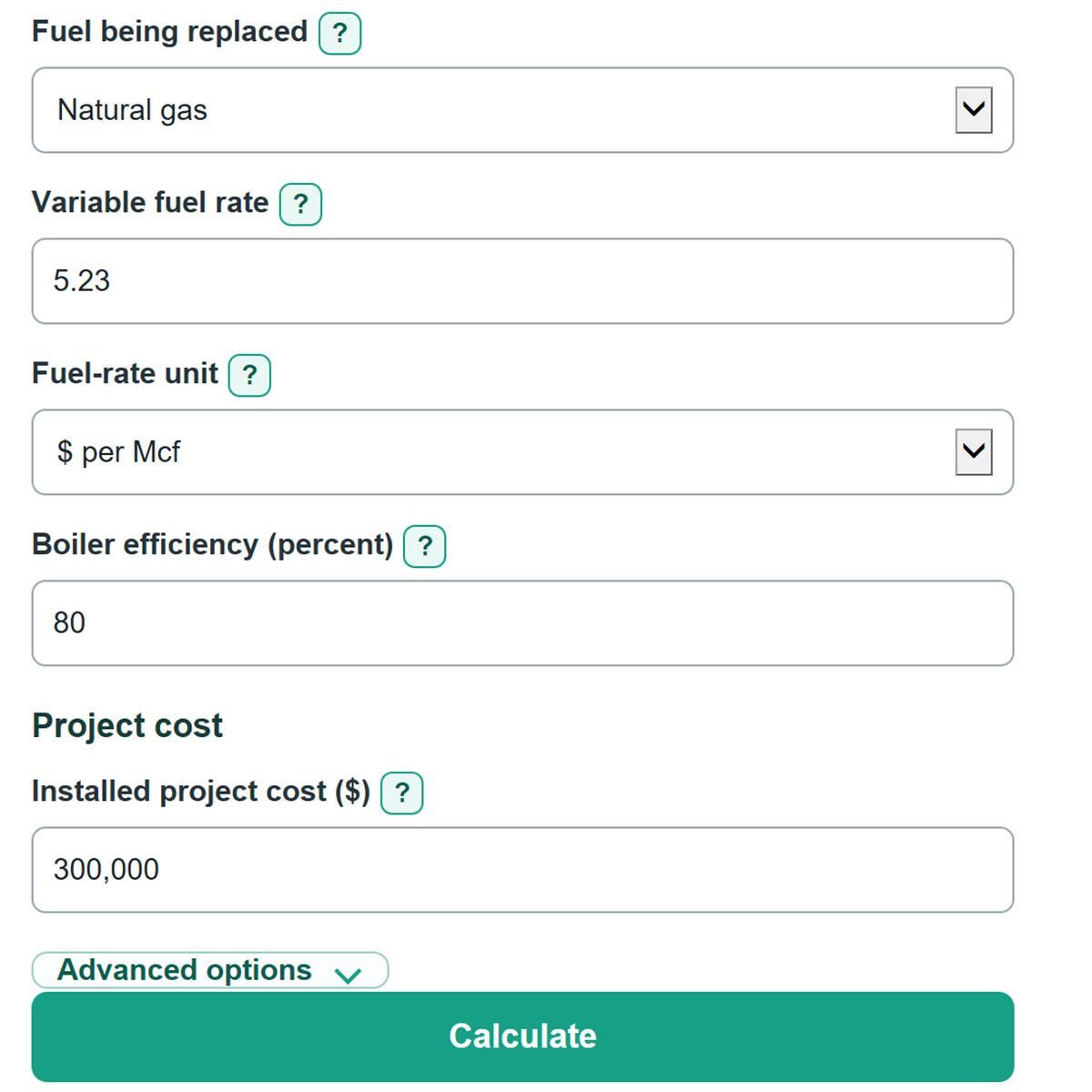
- Choose Fuel being replaced, then copy the variable charge into Variable fuel rate and match its bill unit in Fuel-rate unit.
- Enter Boiler efficiency for the existing boiler and the all-in Installed project cost.
- Open Advanced options if the project adds service work or electricity use, then enter Annual maintenance and service ($ per year), Added electricity use (kWh per year), and Electricity rate ($ per kWh).
- Check that the converted fuel rate looks like your expected bill energy price, then compare gross fuel savings with estimated net savings before using simple payback for a project screen.
Definitions
Waste heat recovery: Using heat that would otherwise be discharged from a process for a useful purpose, such as heating water, air, or another process stream. [1]
MMBtu: One million British thermal units (Btu), a common US unit for fuel and heat energy.
Recoverable heat: Useful heat delivered by the recovery project while it operates, measured here in MMBtu/hr.
Boiler efficiency: The percentage of fuel energy that the existing boiler turns into useful heat.
Variable fuel rate: The part of the fuel bill that changes when fuel use changes, entered in the bill's own unit.
Ccf and Mcf: Ccf is 100 cubic feet of natural gas; Mcf is 1,000 cubic feet.
Simple payback: Installed project cost divided by positive estimated net savings per year.
Common mistakes and quick fixes
Mistake: Entering raw exhaust heat instead of Recoverable heat.
Fix: Use the useful heat expected after the recovery equipment, from a survey, vendor estimate, or engineering calculation.
Mistake: Using full calendar hours for Operating time.
Fix: Count only hours when both the waste-heat source and the place using the heat are available.
Mistake: Copying a $ per Mcf gas charge while selecting $ per therm in Fuel-rate unit.
Fix: Match Fuel-rate unit exactly to the unit printed beside the Variable fuel rate on the bill.
Mistake: Including fixed customer or meter charges in Variable fuel rate.
Fix: Include only charges that fall when fuel use falls, unless the project will reduce or end the service itself.
Mistake: Treating recovery equipment performance as Boiler efficiency.
Fix: Enter the existing boiler's fuel-to-useful-heat efficiency; the recoverable-heat input already reflects recovery equipment performance.
Mistake: Using equipment-only cost for Installed project cost.
Fix: Include installation, piping, controls, engineering, commissioning, downtime, and contingency when known.
Limitations & Key Assumptions / Boundary Conditions
- This is a first-pass screening estimate. It assumes the entered recoverable heat is available whenever the entered operating time occurs and has a matching heat demand.
- The calculation uses the existing boiler efficiency to convert useful recovered heat into avoided fuel input. Actual operating efficiency can differ from a nameplate or manual value.
- Natural-gas energy content varies. The calculator uses fixed screening conversions for therms, Ccf, and Mcf, so actual billed fuel units may differ slightly.
- Fuel savings exclude fixed customer, meter, demand, and account charges unless lower consumption actually changes those charges.
- Simple payback includes installed cost and entered annual recurring costs only. It excludes financing, taxes, incentives, depreciation, escalation, replacement, outage risk, and the time value of money.
- A zero or negative estimated net savings has no simple payback. Review added electricity, maintenance, fuel rate, runtime, and recoverable heat before proceeding.
Methodology
Calculation path
The calculator first annualizes the useful heat that the recovery project can deliver. It then estimates the fuel energy that the existing boiler would have needed to provide the same useful heat.
annual recovered heat = recoverable heat x operating time
avoided fuel energy = annual recovered heat / (boiler efficiency / 100)
The selected fuel and bill unit identify the energy in one billed unit. The entered Variable fuel rate is divided by that energy amount to show one comparable rate in $/MMBtu.
fuel rate per MMBtu = variable fuel rate / fuel energy per bill unit
gross fuel savings = avoided fuel energy x fuel rate per MMBtu
Added electricity cost and annual maintenance are subtracted from gross fuel savings. Negative net savings remain negative rather than being changed to zero.
added electricity cost = added electricity use x electricity rate
net annual savings = gross fuel savings - annual maintenance - added electricity cost
Simple payback is calculated only when net annual savings are positive. A zero installed project cost with positive savings produces a payback of 0 years.
simple payback = installed project cost / net annual savings
Worked example
For 2 MMBtu/hr of recoverable heat running 4,000 hours/year, annual recovered heat is 8,000 MMBtu/year. With 80% boiler efficiency, avoided fuel energy is 10,000 MMBtu/year. A gas price of $0.80 per therm converts to $8.00/MMBtu, producing $80,000 in gross fuel savings. If maintenance is $5,000/year and added electricity is 50,000 kWh/year at $0.12/kWh, recurring cost is $11,000/year, net savings are $69,000/year, and a $300,000 project has simple payback of about 4.35 years.
Assumptions and limits
The method treats the entered heat rate, runtime, fuel rate, and boiler efficiency as steady annual averages. It does not model seasonal load changes, part-load boiler efficiency, heat-storage losses, heat-exchanger fouling, fuel-price changes, demand charges, incentives, or financing.